

Sealife guideThe french gruntHaemulon flavolineatum
Last updated on 09/05/2024 at 09:40 PM
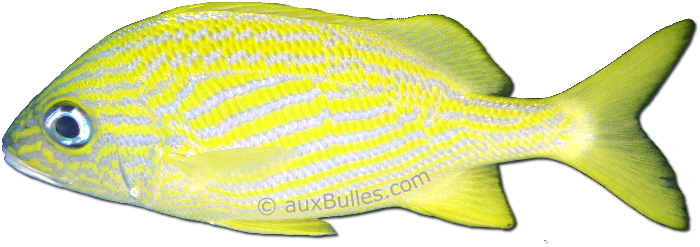
The french grunt (Haemulon flavolineatum)
Taxonomy
- Common name: French grunt, banana grunt, gold laced grunt, open-mouthed grunt, redmouth grunt, yellow grunt
- French name: Gorette jaune
- Spanish name: Ronco condenado
- Scientific name: Haemulon flavolineatum (Desmarest, 1823)
- Family name: Haemulidae
- Order name: Perciformes
- Class name: Actinopterygii
Description
The french grunt is a medium-sized fish, about 6 inches long, with a maximum length of around 12 inches. The french grunt has an oblong body, predominantly yellow with broad yellow stripes that are horizontal on the upper part of the body and oblique below the lateral line. Its pelvic, dorsal, anal and caudal fins are also entirely yellow.
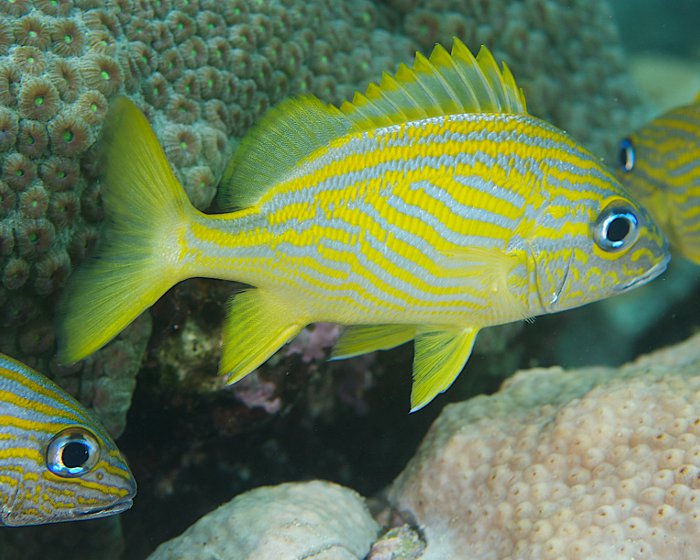
The french grunt is predominantly yellow due to its broad yellow stripes, which run horizontally on the upper part of the body and obliquely below the lateral line, as well as the yellow color of its fins
Juvenile french grunts have a slightly different appearance with a black spot at the base of their tail and additional broad black horizontal stripes across their body !
Geographic range
The french grunt is commonly found in the Caribbean sea, the Gulf of Mexico and along the coasts of Florida. It inhabits the tropical waters of the western Atlantic, from Florida in the north to the coasts of Brazil in the south, including Central America and the Caribbean with its many islands like the Keys, the Bahamas and Guadeloupe.
Habitat
The french grunt typically lives in shallow waters from the surface down to about 100 feet. It forms large schools, sometimes numbering in the thousands, around coral reefs. These schools often stay sheltered along rocks, under rock overhangs or beneath large branches of elkhorn coral.
Diet
The french grunt is a carnivorous fish that hunts at night. Its diet consists mainly of small crustaceans, mollusks and marine worms.
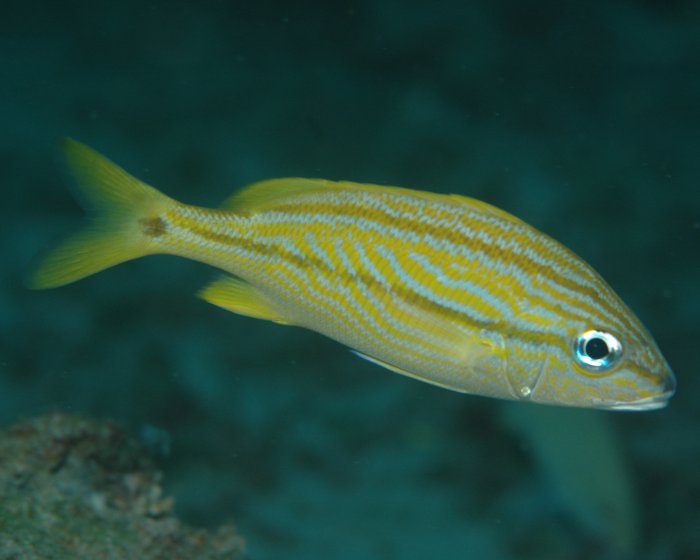
Juvenile french grunts are distinguishable from adults by a black spot at the base of their tail and additional broad black longitudinal stripes, which fade as they age !
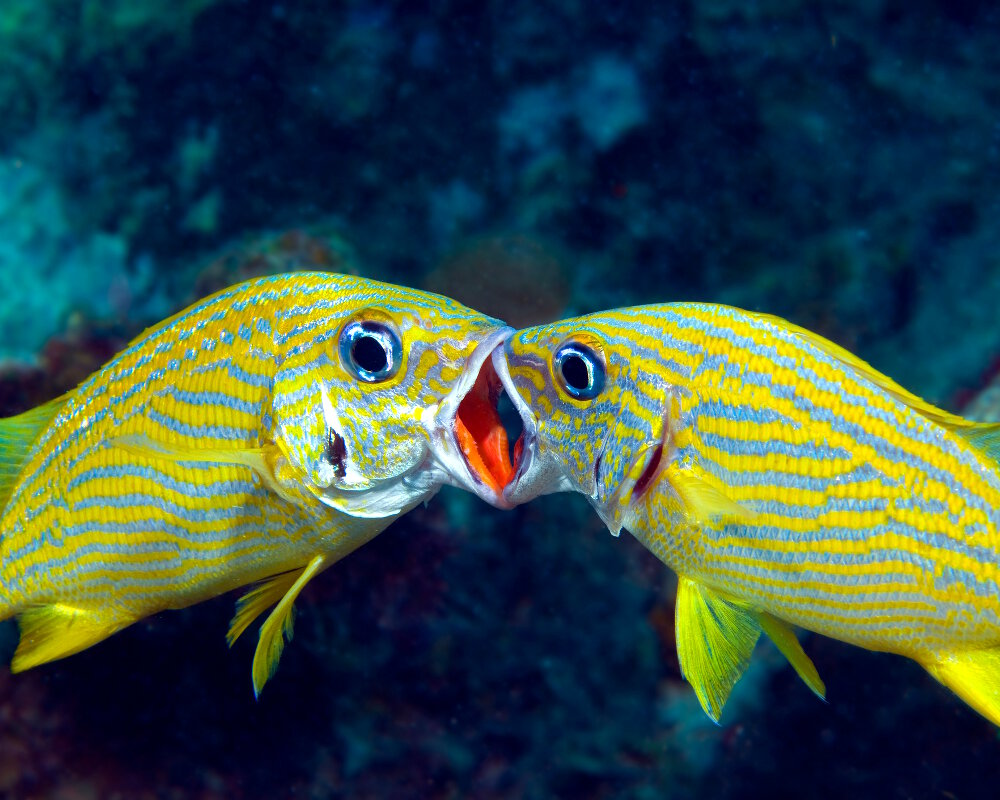
Observe the red color inside the mouth of the french grunt, which gives it its english name « redmouth grunt » ! © Luizrocha | Dreamstime.com
In the marine food chain, the french grunt is preyed upon by larger reef fish such as groupers.
Reproduction
The french grunt reproduces sexually. Juvenile french grunts are characterized by a black spot at the base of the tail and broad longitudinal black stripes that fade with age.
Did you know ?
The common english name « grunt » refers to the sounds the fish makes, which resemble the grunts of a pig. The sound is produced by the fish's well-developed teeth located in its throat.
Grunts are related to snappers but are generally smaller and have more deeply forked tails.
The french grunt is listed as many other marine species within The IUCN Red List of threatened species. The french grunt appears in the IUCN Red List since 2016 within the category Least Concern !
Tips for observing
Schools of grunts are rarely composed of individuals of a single species. It is common to see a predominant species along with one or more individuals of other species, so you might often observe a school of french grunts with one or more blue striped grunts, white grunts or smallmouth grunts.
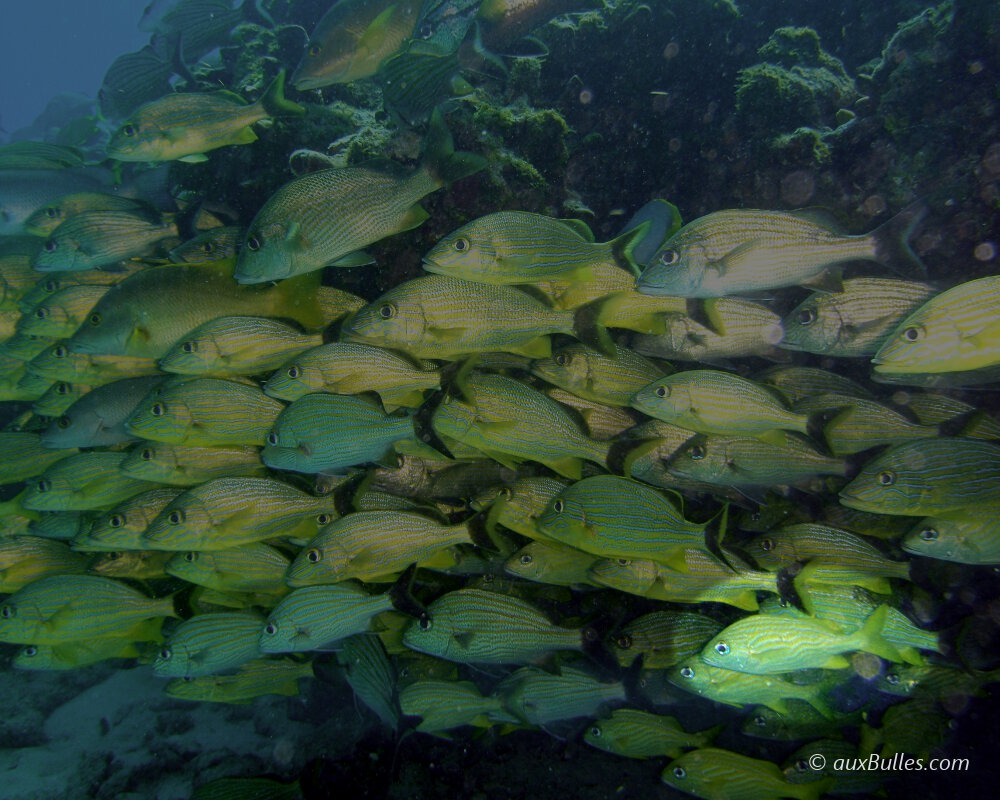
When the french grunt does not form an entire school on its own, it stays inconspicuous and blends into schools of other grunt species !
Within the same genus
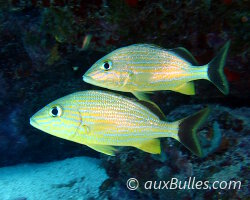
Blue striped grunt
(Haemulon sciurus)
(Haemulon sciurus)
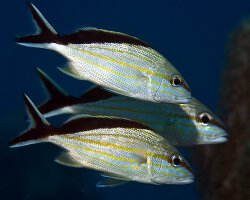
Cottonwick grunt
(Haemulon melanurum)
(Haemulon melanurum)
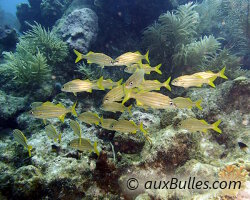
Smallmouth grunt
(Haemulon chrysargyreum)
(Haemulon chrysargyreum)
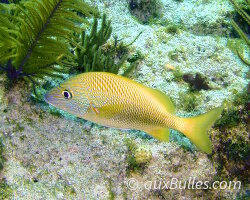
White grunt
(Haemulon plumierii)
(Haemulon plumierii)
Within the same family
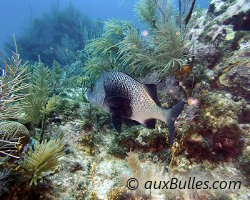
Black margate
(Anisotremus surinamensis)
(Anisotremus surinamensis)
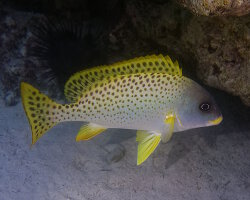
Blackspotted rubberlips
(Plectorhinchus gaterinus)
(Plectorhinchus gaterinus)
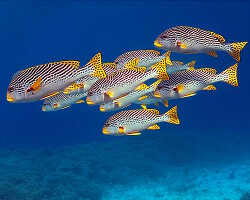
Diagonal-banded Sweetlip
(Plectorhinchus lineatus)
(Plectorhinchus lineatus)
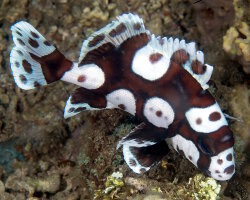
Harlequin sweetlips
(Plectorhinchus chaetodonoides)
(Plectorhinchus chaetodonoides)
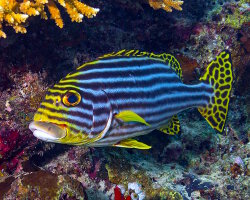
Oriental sweetlips
(Plectorhinchus vittatus)
(Plectorhinchus vittatus)
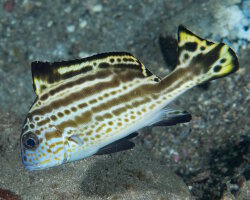
Painted sweetlips
(Diagramma pictum)
(Diagramma pictum)
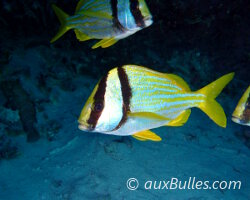
Porkfish
(Anisotremus virginicus)
(Anisotremus virginicus)
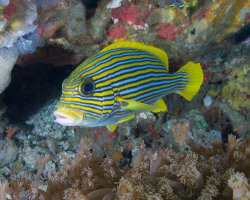
Ribboned sweetlips
(Plectorhinchus polytaenia)
(Plectorhinchus polytaenia)
Discover also
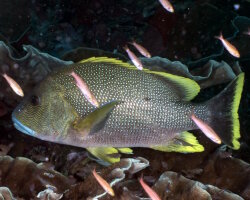
Blubberlip snapper
(Lutjanus rivulatus)
(Lutjanus rivulatus)
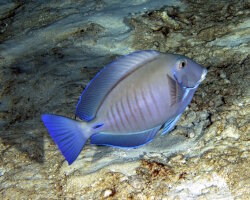
Doctorfish
(Acanthurus chirurgus)
(Acanthurus chirurgus)
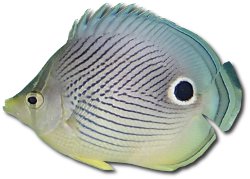
Foureye butterflyfish
(Chaetodon capistratus)
(Chaetodon capistratus)
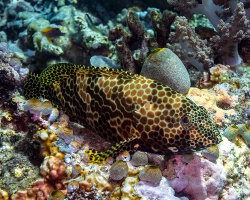
Honeycomb grouper
(Epinephelus merra)
(Epinephelus merra)
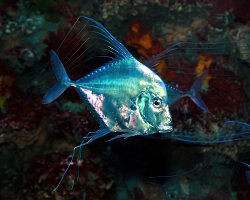
Indian threadfish
(Alectis indica)
(Alectis indica)
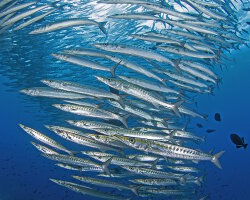
Mexican barracuda
(Sphyraena ensis)
(Sphyraena ensis)
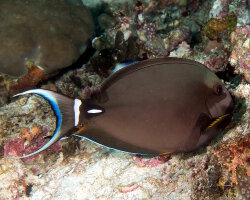
Palelipped surgeonfish
(Acanthurus leucocheilus)
(Acanthurus leucocheilus)
Suckerfish
(8 espèces)
(8 espèces)
Our latestUpdates

Monday, September 14th 2026
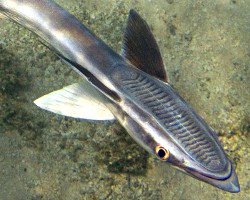
The striped remora
Discover the striped remora (Echeneis naucrates), a marine fish easily recognized by the suction disc on its head, which allows it to attach to large marine animals and travel with them.
Saturday, September 12th 2026
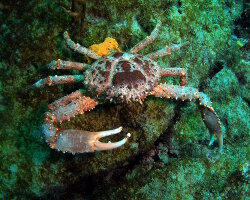
The Caribbean king crab
Discover the Caribbean king crab (Maguimithrax spinosissimus), an impressive reef crab found throughout the Caribbean and western Atlantic.
Thursday, September 10th 2026
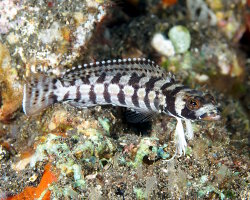
The reticulated sandperch
Discover the reticulated sandperch (Parapercis tetracantha), a small Indo-Pacific fish known for its elongated body and distinctive brown and white pattern.
Photo of the Day
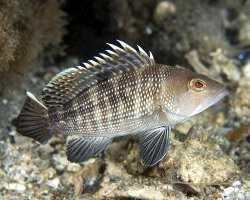
Loup de mer noir
(Centropristis striata)
(Centropristis striata)
 Copyright © 2007-2026 auxBulles.com - All rights reserved. Legal notices.
Photo credits - Our partners