Offshore SailingA smooth start, an uncertain AtlanticThe Route du Rhum 2026
Last updated on 11/01/2026 at 12:26 PM
The 115 competitors in the Route du Rhum – Destination Guadeloupe will set sail on Sunday in favorable conditions, with northeasterly winds and sunny skies. After a fast start to the race, the fleet will have to contend with an unusual weather pattern: the trade winds will be difficult to reach, and a route north of the Azores is expected to become the preferred option. Route choices and weather management could therefore play a major role in this transatlantic race.
The start is scheduled for Sunday at 1:02 p.m., with northeasterly winds of 8 to 11 knots and sunny weather. After several editions marked by difficult conditions from the very first hours, skippers will be able to start sailing downwind in much calmer conditions. The last time the Route du Rhum had a start under similar conditions was in 2010.
A technical passage toward Cap Fréhel
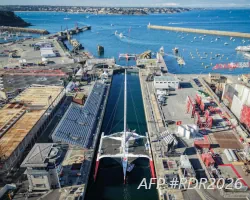
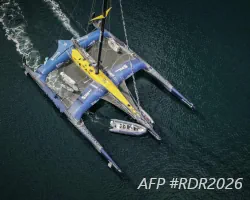
The starting line will be oriented north to south, but not all boats will be able to head directly toward the Cap Fréhel gate, located 16 nautical miles away. The Ultim boats, in particular, are expected to make two gybes, with their large sails hoisted and potentially reaching high speeds. Crossings between competitors in a confined area will require particular attention, especially between multihulls and IMOCA boats.
Safety at the heart of preparations
The Race Management has assigned each of the six sailing classes a dedicated section of the starting line, with positions adapted to their characteristics. Sailing under spinnaker, monohulls, Class40 boats and some IMOCA boats with daggerboards will be less maneuverable, making the first few hours particularly challenging as the fleet remains tightly packed between Saint-Malo and Cap Fréhel.
Diagram showing the arrangement of the six sailing classes along the starting line of the 2026 Route du Rhum – Destination Guadeloupe
A fast start heading west
A strong easterly flow
After the start, the different classes are expected to follow converging courses toward the west-northwest. The Ultim boats will make their first gybe south of the Fastnet Rock during the first night, while the last competitors will still be in the English Channel. Winds are then expected to strengthen, reaching around 20 knots with gusts of 25 to 30 knots on Monday.
An intense crossing
The leading Ultim boats could pass the Azores by Tuesday evening. This rapid progress could allow several classes to set speed records. However, skippers will also have to contend with the cold, long hours on watch and potentially building seas if their course takes them into the windiest areas.
Weather forces a northern route
An unusual Atlantic weather pattern
The weather pattern is shaped by several high-pressure systems and a low-pressure system off Greenland, whose cold front is disrupting the trade winds as far south as the Tropic of Cancer. Starting Wednesday, a new low-pressure system is expected to develop near the Azores, complicating the progress of part of the fleet.
The fastest competitors could cross the trough separating the two high-pressure systems before conditions deteriorate. For the others, heading significantly farther south does not appear favorable. The planned routes are expected to remain north of the direct course, with variations in positioning but no clearly winning option at this stage. With the trade winds pushed back toward Cape Verde, skippers will have to follow a long route north of the Azores, far from the usual favorable winds.
An uncertain finish
Without established trade winds, skippers will not be able to count on a direct run down toward the Caribbean. The final leg will remain highly uncertain and require important strategic decisions to reach the Lesser Antilles. Weather models currently show few scenarios in which the leaders could reach Pointe-à-Pitre within seven days, and the first arrivals are not expected before next Sunday.