Sealife guideThe yellowline yellowline arrow crabStenorhynchus seticornis
Last updated on 05/07/2026 at 10:12 PM
Taxonomy
- Common name: Yellowline yellowline arrow crab
- French name: Crabe tour Eiffel, crabe flèche
- Scientific name: Stenorhynchus seticornis (Herbst, 1788)
- Family name: Inachidae
- Order name: Decapoda
- Class name: Crustaceans [Malacostraca]
Description
The yellowline arrow crab, also known as the yellowline arrow crab, gets its name from the characteristic shape of its body, which is broad at the base and tapers to a point. The yellowline arrow crab belongs to the phylum Arthropoda and more specifically to the crustaceans. It generally measures around 2 inches , but with its long, thin legs extended, its total span can reach up to 4 inches.
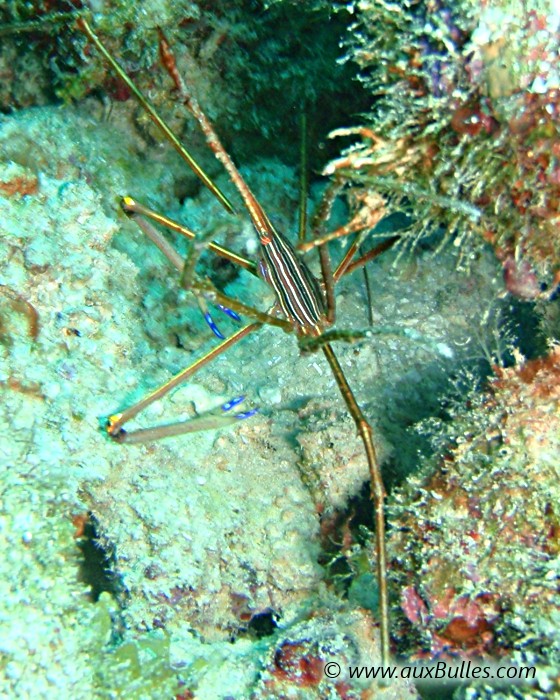
The yellowline arrow crab gets its name from the characteristic shape of its body, which is broad at the base and tapers to a point
The yellowline arrow crab has 4 pairs of long, thin legs as well as one pair of long claws, the tips of which are blue in color. Because of its long and slender legs, the yellowline arrow crab actually looks more like a spider !
Geographic range
The yellowline arrow crab is found in the western Atlantic ocean, including
Florida, the
Bahamas, and the Caribbean such as
Guadeloupe. It is also present in the tropical waters of the
Indian ocean.
Habitat
The yellowline arrow crab is found from the surface down to depths of around 66 ft. The yellowline arrow crab inhabits crevices in coral reefs and rocky bottoms.
Diet
The yellowline arrow crab is mainly a detritivorous and opportunistic animal, playing an important role in cleaning coral reefs. It feeds on organic debris, dead animals, and decomposing matter found on the seafloor.
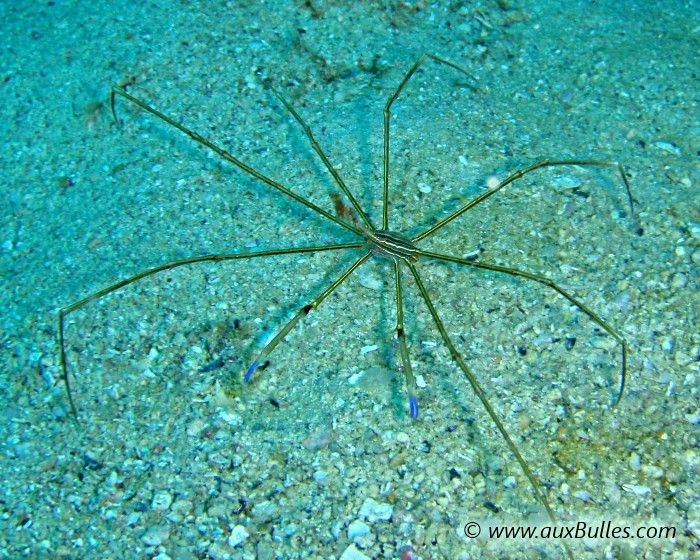
The yellowline arrow crab has four pairs of long, thin legs as well as one pair of long claws, the tips of which are blue in color
However, its diet is not limited to this: it also captures small invertebrates living on coral reefs, such as tube worms, small
crustaceans, and other benthic organisms. Thanks to its long pointed rostrum and fine claws, it explores coral and rock crevices in search of food, mainly at night when it is most active.
Reproduction
During the breeding period, once the female yellowline arrow crab has been fertilized by the male, she carries the eggs until they hatch.
Tips for observing
To observe the yellowline arrow crab, one must carefully examine the crevices of coral reefs in search of this animal, which at first glance strongly resembles a spider. You may then spot its long, thin legs protruding from its shelter.
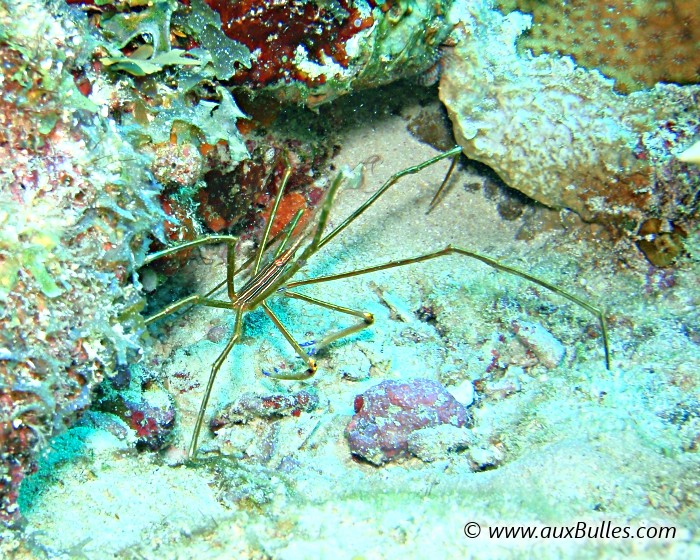
The yellowline arrow crab lies in wait in the crevices of the coral reef
Within the same family
Giant spider crab
(Macrocheira kaempferi)
Discover also
Atlantic ghost crab
(Ocypode quadrata)
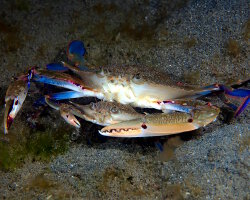
Blue swimmer crab
(Portunus pelagicus)
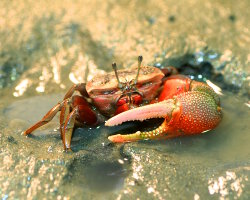
Bowed fiddler crab
(Uca arcuata)
Haig's Porcelain Crab
(Porcellanella haigae)
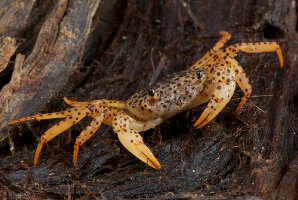
Panther crab
(Parathelphusa pantherina)
Soft coral porcelain crab
(Lissoporcellana nakasonei)
Spanish lobster
(Scyllarides nodifer)
Spotted spiny lobster
(Panulirus guttatus)
The marine species in the Northwestern Atlantic
Honeycomb cowfish
(Acanthostracion polygonium)
Lane snapper
(Lutjanus synagris)
Long-spined sea urchin
(Diadema antillarum)
Mutton snapper
(Lutjanus analis)
Queen angelfish
(Holacanthus ciliaris)
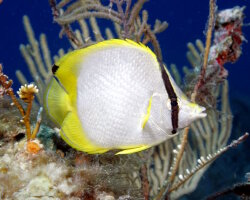
Spotfin butterflyfish
(Chaetodon ocellatus)
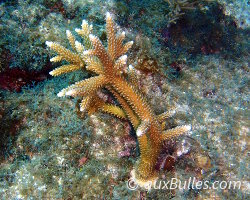
Staghorn coral
(Acropora cervicornis)
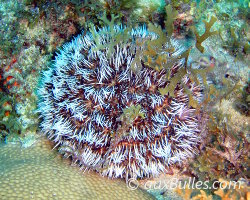
West Indian sea egg
(Tripneustes ventricosus)