

Sealife guideThe marine tunicates
The phylum of marine tunicates, also known as urochordates, is a group of marine invertebrate animals characterized by the presence of a gelatinous covering called a tunic, which surrounds and protects their body. It includes more than 1,300 species grouped into a single class called Ascidiacea. Marine tunicates play a vital role in marine ecosystems, both as filter feeders and as an integral part of marine food chains.
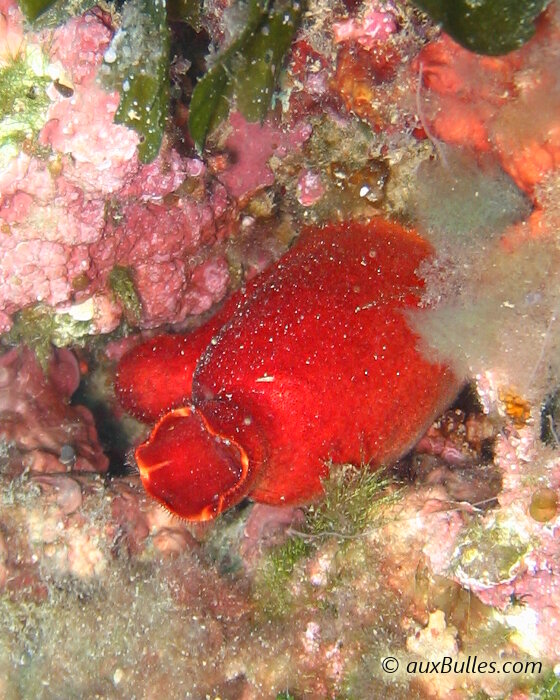
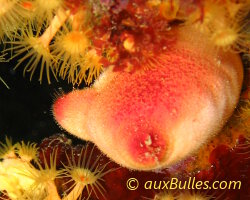
Tunicates with a characteristic representative, the red sea-squirt, inflated like a balloon
Tunicates inhabit a wide variety of marine environments, from shallow coastal waters to the abyssal depths. They are found in two forms: ascidians, which are fixed to substrates, and salps, which are free-swimming and part of the plankton.
Description
Tunicates have a unique morphology with a body protected by a gelatinous tunic that gives the phylum its name. This tunic is composed of cellulose, a substance rare in the animal kingdom. The body structure of tunicates generally includes two openings called siphons: an inhalant siphon through which water enters the body and an exhalant siphon through which filtered water is expelled.
Diet
This ability to actively filter seawater allows them to feed by extracting organic particles and microorganisms.
Reproduction
Tunicates can reproduce sexually and asexually. Sexual reproduction typically occurs through internal fertilization, although some species may release their gametes into the water for external fertilization.
Additionally, many species of tunicates can reproduce by budding, where a fragment of the animal detaches and forms a new individual, ensuring rapid multiplication.
Habitat
The tunicate phylum includes a diversity of species, each with unique morphological and behavioral adaptations to survive in different types of marine habitats.
Ascidians are often seen attached to rocks, shells, or even other marine animals. In contrast, salps, more mobile, move through the water column and form interconnected chains that can travel long distances. These variations allow tunicates to inhabit various marine environments, contributing to their wide geographic distribution.
Did you know ?
Tunicates play a fundamental role in marine ecosystems as filter feeders. Their ability to filter water helps maintain the balance of planktonic communities and reduce excess particles and nutrients in the water. Fixed ascidians, for example, are key elements in benthic habitats, providing shelters for many marine species. Additionally, tunicates are a food source for various predators, including certain fish, starfish, and sea turtles.
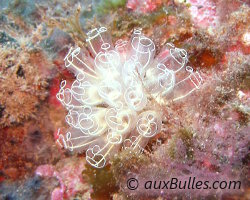
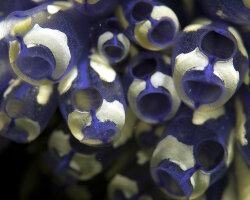
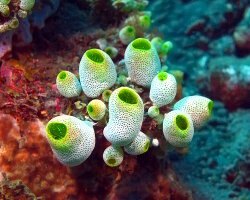
Some marine tunicates to discover

Our latestUpdates

The Guide des poissons de Nouvelle-CalédonieDiscover Guide to the Fishes of New Caledonia by Pierre Laboute and René Grandperrin, an illustrated reference featuring nearly 1,200 species, from rivers and coral reefs to the depths of the ocean.Read more
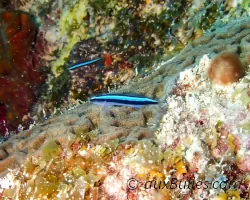
The neon gobyDiscover the neon goby (Elacatinus oceanops), a small western Atlantic reef fish known for its brilliant blue stripe and its role as a cleaner fish that removes parasites from other fish.Read more
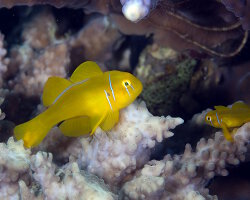
The poison gobyDiscover the poison goby (Gobiodon citrinus), a tiny reef fish with a bright yellow body and distinctive blue markings. It lives among branching Acropora corals in the tropical waters of the Indo-Pacific.Read more
Photo of the Day

Requin nourrice
(Ginglymostoma cirratum)
(Ginglymostoma cirratum)
 Copyright © 2007-2026 auxBulles.com - All rights reserved. Legal notices.
Photo credits - Our partners