

Sealife guideThe black margateAnisotremus surinamensis
Last updated on 09/25/2026 at 07:10 PM
The black margate (Anisotremus surinamensis) is a large fish found on reefs in the tropical Atlantic. Its silvery gray body is darker toward the front, and its fins range from grayish to black, with the anal and pelvic fins particularly dark.
The black margate is mainly active at night, when it leaves its shelter to search for food along the bottom. During the day, it usually remains hidden in a cave, under an overhang, or near another refuge.
Taxonomy
English names
Black margate
French namesLippu croupiaGueule camille (Guadeloupe/Martinique)
Scientific nameAnisotremus surinamensis (Bloch, 1791)
FamilyHaemulidae
OrderPerciformes
ClassActinopterygii
Description
The black margate has a deep, laterally compressed body, with a short, massive head. Its body is silvery gray, with the front darker than the rear. A broad dark area is usually found behind the pectoral fin, but its intensity can vary.
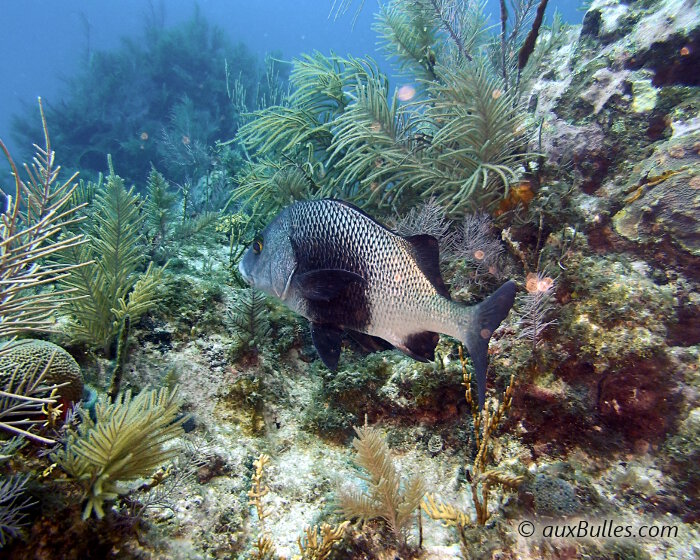
The black margate (Anisotremus surinamensis) has a distinctive broad dark area behind the pectoral fin
Its fins range from grayish to black, with the anal and pelvic fins particularly dark. Juveniles have a different coloration from adults, with two black bands and a black spot at the base of the caudal fin. The black margate averages around 16 inches in length, but the largest individuals can reach up to 30 inches.
Geographic range
The black margate inhabits tropical waters of the western Atlantic Ocean, from Florida and the Bahamas to Brazil, including the Gulf of Mexico and the Caribbean Sea. It is found around islands such as Jamaica, Guadeloupe, and Martinique.
Habitat
The black margate inhabits coral reefs, rocky bottoms, and shipwrecks. It seeks out areas with caves, crevices, or overhangs where it can hide.
It generally stays close to its shelter during the day and becomes more active at dusk. It mainly lives in shallow coastal waters, but can be found at depths of up to 230 feet.
Diet
The black margate feeds mainly at night. It searches the bottom for crustaceans, mollusks, small fish, and other marine animals.
It also eats long-spined diadem urchins, which it can find on reefs and rocky bottoms.
Reproduction
Reproduction in the black margate is still poorly known, but adults appear to form pairs during the breeding season.
Did you know ?
The black margate can produce grunting sounds. These sounds are thought to be produced by rubbing teeth located at the back of the throat together and amplified by its swim bladder.
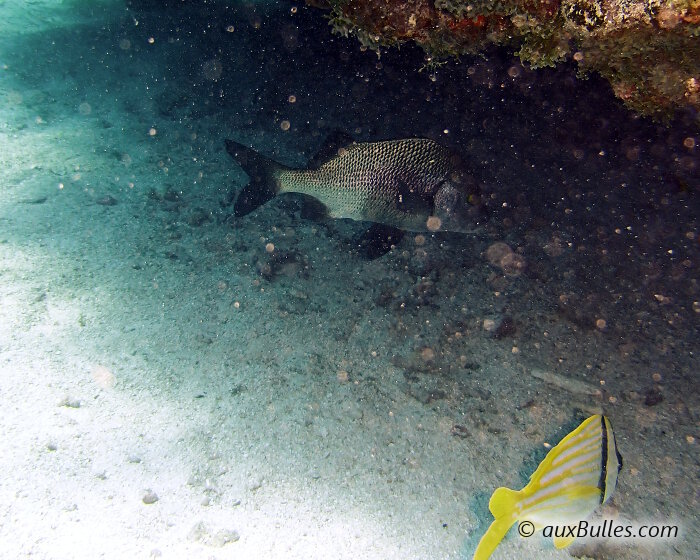
The black margate (Anisotremus surinamensis)
The black margate is listed as many other marine species within The IUCN Red List of threatened species. The black margate appears in the IUCN Red List since 2016 within the category Data Deficient !
Within the same genus
Within the same family
Discover also


Our latestUpdates
The neon gobyDiscover the neon goby (Elacatinus oceanops), a small western Atlantic reef fish known for its brilliant blue stripe and its role as a cleaner fish that removes parasites from other fish.Read more
The poison gobyDiscover the poison goby (Gobiodon citrinus), a tiny reef fish with a bright yellow body and distinctive blue markings. It lives among branching Acropora corals in the tropical waters of the Indo-Pacific.Read more
The wahooDiscover the wahoo (Acanthocybium solandri), a powerful pelagic predator found in tropical and subtropical oceans. Recognizable by its streamlined body and distinctive blue vertical stripes, it is a fast swimmer that feeds mainly on fish and squid.Read more
Photo of the Day

Fou à pieds rouges
(Sula sula)
(Sula sula)
 Copyright © 2007-2026 auxBulles.com - All rights reserved. Legal notices.
Photo credits - Our partners