

Islands destinationIschia IslandCampanian Archipelago | Mediterranean Sea
Last updated on 10/06/2026 at 11:55 PM
Located at the entrance to the Gulf of Naples, Ischia is the largest of the Phlegraean Islands. This volcanic island stands out for the diversity of its landscapes, where beaches, cliffs, lush hills, vineyards, and terrain dominated by Mount Epomeo alternate. Nicknamed the Green Island, it offers a very different character depending on the area, from lively seaside resorts and fishing villages to trails winding through abundant Mediterranean vegetation.
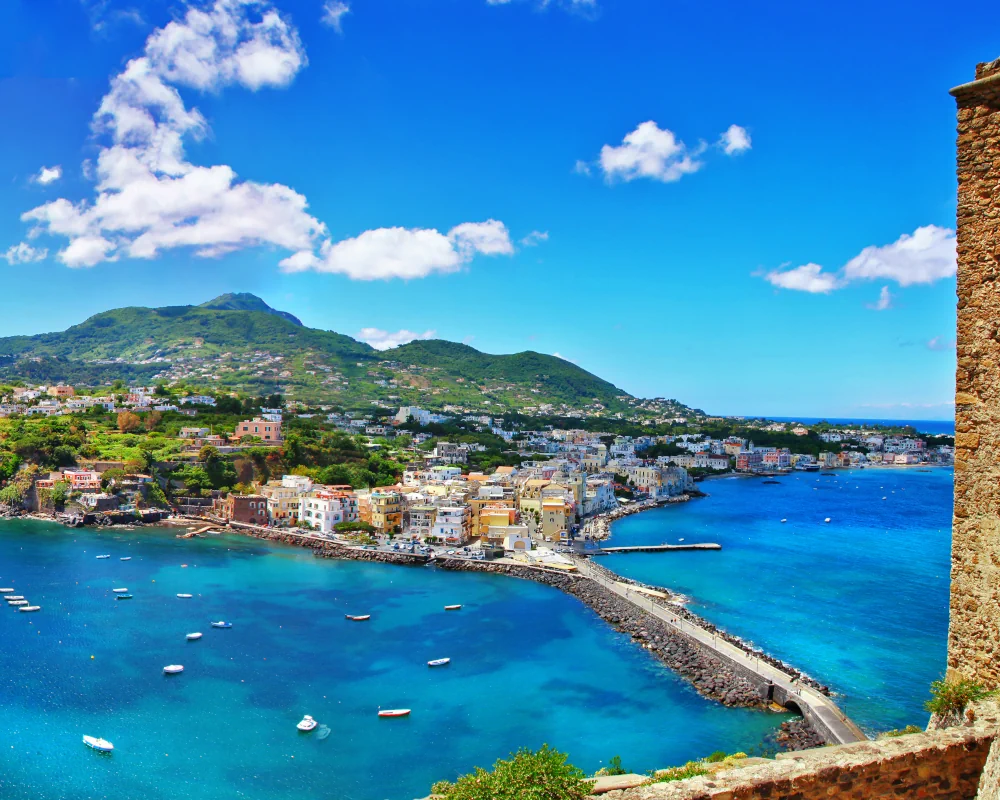
Panoramic view of Ischia Island from the Aragonese Castle © Freesurf69 | Dreamstime.com
Ischia is also renowned for its thermal springs, which have been used since ancient times and remain an important part of the island's landscape. Added to this natural wealth are a rich historical heritage, remarkable gardens, and numerous hiking opportunities, allowing you to discover the island well beyond its beaches.
Sant'Angelo Beach
Sant'Angelo Beach offers a picturesque setting with fine sand and clear waters, surrounded by lush hills and cliffs. The village of Sant'Angelo, with its colorful houses, narrow lanes, and stone stairways, overlooks the bay and gives it a typically Mediterranean atmosphere.

Sant'Angelo Beach with its giant rock connected to Ischia Island © Stevanzz | Dreamstime.com
Connected to the village by a narrow strip of land, the Sant'Angelo promontory offers beautiful views of the coast and the Le Fungo islets. Nearby, Maronti Beach and Sorgeto Bay also provide opportunities to discover the distinctive features of Ischia's coastline, including its hot springs and volcanic phenomena.
The medieval Aragonese Castle
The Aragonese Castle is an impressive medieval fortress built on a rocky islet connected to the main island of Ischia by a bridge. Built on a promontory overlooking the sea, it occupies a strategic position and offers spectacular panoramic views of Ischia Island and the Tyrrhenian Sea.


At various times a military fortress, prison, and monastery, the Aragonese Castle is now a tourist site where you can explore its imposing fortifications, towers, chapel, gardens, and museum. Several historic buildings can also be visited on the islet, reflecting the importance of the site over the centuries.
The castle takes its name from Alfonso V of Aragon, King of Naples, who had the bridge connecting the islet to Ischia built in 1441 and significantly strengthened the existing fortifications. This transformation gave the castle the Aragonese fortress appearance with which it is still associated today.
Thermal springs, an ancient tradition
Thermal waters are one of Ischia's main distinctive features. The island has numerous springs, fumaroles, and areas where volcanic activity can still be felt, particularly around Sant'Angelo, Forio, Casamicciola Terme, and Barano. These waters, whose temperature and composition vary from one area to another, have been used since ancient times in thermal establishments and wellness parks.
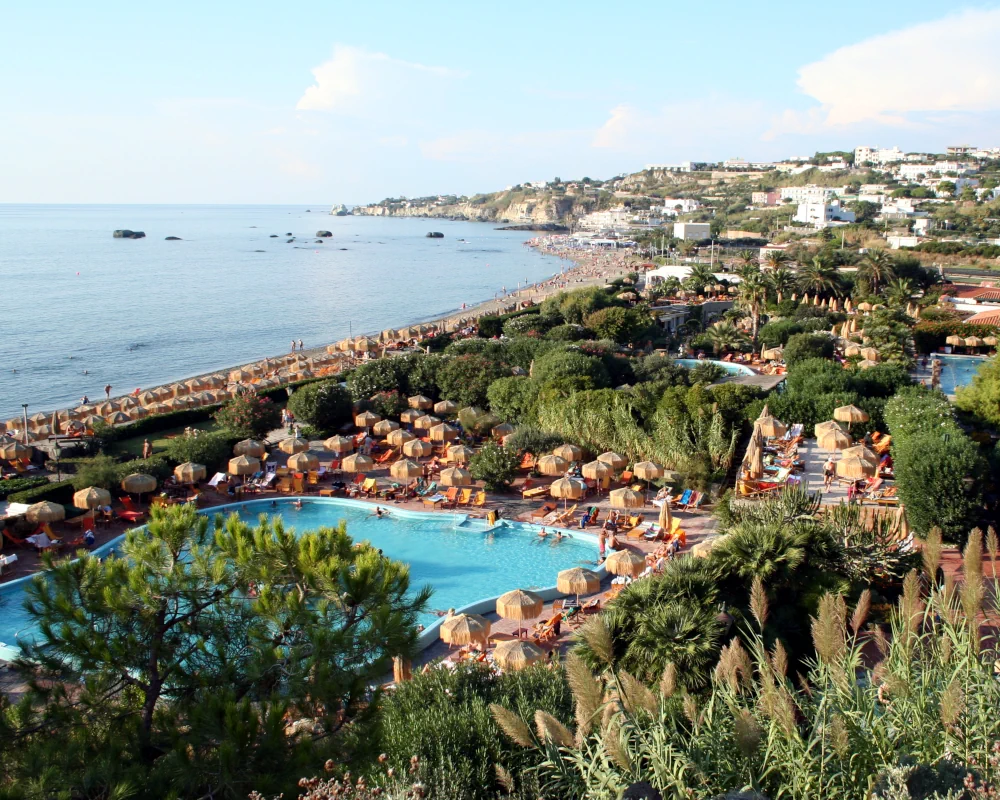
Poseidon Thermal Gardens near Forio on Ischia Island © Oxanam | Dreamstime.com
Several sites allow you to experience this distinctive feature in very different ways. The Poseidon Thermal Gardens, in Citara Bay, feature numerous thermal pools, while Negombo Park, in San Montano Bay, combines thermal waters with lush vegetation. At Sorgeto, hot springs mix directly with seawater to form natural thermal pools at the foot of the cliffs.
Mount Epomeo and the volcanic landscapes
Rising to 2,589 feet, Mount Epomeo dominates the island and is one of its main viewpoints. The climb from the Fontana area takes about an hour and provides elevated views over Ischia's terrain and coastline. On clear days, the panorama also extends toward Capri, the Sorrento Peninsula, Mount Vesuvius, Naples, and the Phlegraean Fields.
Ischia's trails also allow you to explore traces of its volcanic activity. Some routes cross the areas of Buceto, Cretaio, and Fondo Ferraro, where you can see the Fondo Ferraro crater and the Arso lava flow, resulting from the island's last eruption in 1302. Vegetation has since reclaimed these landscapes, particularly in the form of pine and chestnut forests.
Forio and the La Mortella gardens
Located on the western coast, Forio is the largest of Ischia's six municipalities. Its historic center is home to palaces, artisan workshops, art galleries, and several monuments, while its coastline alternates between beaches and bays. Citara Bay is particularly known for its thermal springs and the Poseidon Thermal Gardens, while the Church of Soccorso is one of the town's most iconic landmarks.
Near Forio, the La Mortella Gardens offer another way to discover the island's natural richness. Created from 1956 onward by Susana Walton, the wife of composer William Walton, this garden was established on former volcanic terrain and features Mediterranean and subtropical plants from different parts of the world. Its terraces, pools, pathways, and oriental garden dominated by a small Thai temple make it one of Ischia's remarkable attractions.
Beaches, bays, and hot springs
About 1.2 miles long, Maronti Beach is the longest beach on Ischia. It stretches along the southeastern coast of the island in a setting bordered by hills and cliffs. The presence of several thermal springs nearby, including those of Olmitello and Cava Scura, highlights the close connection between Ischia's coastline and its volcanic activity.
Other areas also reveal this combination of sea and thermal waters. At Sant'Angelo, fumaroles can be observed near the shore, while Sorgeto Bay is home to natural pools where hot spring water mixes with seawater. These phenomena give some sections of Ischia's coastline a particularly distinctive atmosphere, different from that of more typical Mediterranean beaches.
How to get there ?
From Naples
The easiest way to reach Ischia is via Naples, which is easily accessible by air, train, or car. From central Naples, several ferry and hydrofoil services connect the city with the island. Ferries depart mainly from the Port of Naples and Pozzuoli, while hydrofoils provide faster crossings from the ports around Naples.
The crossing time depends on the type of vessel and departure port. Ferries are particularly convenient if you want to bring a car, while hydrofoils are for passengers only. Most arrivals are at Ischia Porto, although some services also call at Casamicciola Terme and Forio.
By ferry from the neighboring islands
Ischia is also connected to the other islands of the Gulf of Naples, particularly Procida and Capri. These connections make it easy to include Ischia in an itinerary through the islands of the Campanian Archipelago, although schedules and available services vary depending on the season.
If you arrive with a car, it is important to check any traffic restrictions that may apply to non-resident vehicles on the island, particularly during the summer. Since these regulations can change from one year to the next, it is best to check the official information before departure.
Italian islands
The islands from mediterranean Sea
Embiez island
Frioul islands

Grand Gaou island
If island
Lipari island
Medes islands
Menorca island
Vulcano island
Explore new islands



Our latestUpdates
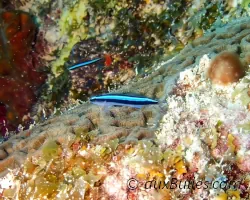
The neon gobyDiscover the neon goby (Elacatinus oceanops), a small western Atlantic reef fish known for its brilliant blue stripe and its role as a cleaner fish that removes parasites from other fish.Read more
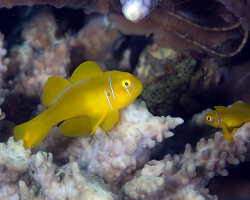
The poison gobyDiscover the poison goby (Gobiodon citrinus), a tiny reef fish with a bright yellow body and distinctive blue markings. It lives among branching Acropora corals in the tropical waters of the Indo-Pacific.Read more
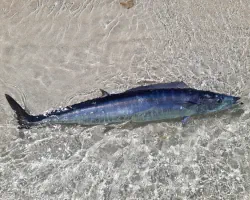
The wahooDiscover the wahoo (Acanthocybium solandri), a powerful pelagic predator found in tropical and subtropical oceans. Recognizable by its streamlined body and distinctive blue vertical stripes, it is a fast swimmer that feeds mainly on fish and squid.Read more
Photo of the Day

Anémone encroûtante
(Parazoanthus axinellae)
(Parazoanthus axinellae)
 Copyright © 2007-2026 auxBulles.com - All rights reserved. Legal notices.
Photo credits - Our partners