Sealife guideThe giant barrel spongeXestospongia testudinaria

Last updated on 04/15/2026 at 10:18 PM
Taxonomy
  • Common name: Giant barrel sponge
  • French name: Eponge tonneau géante, éponge barrique géante
  • Scientific name: Xestospongia testudinaria (Lamarck, 1815)
  • Family name: Petrosiidae
  • Order name: Haplosclerida
  • Class name: The demosponges [Demospongiae]
Description
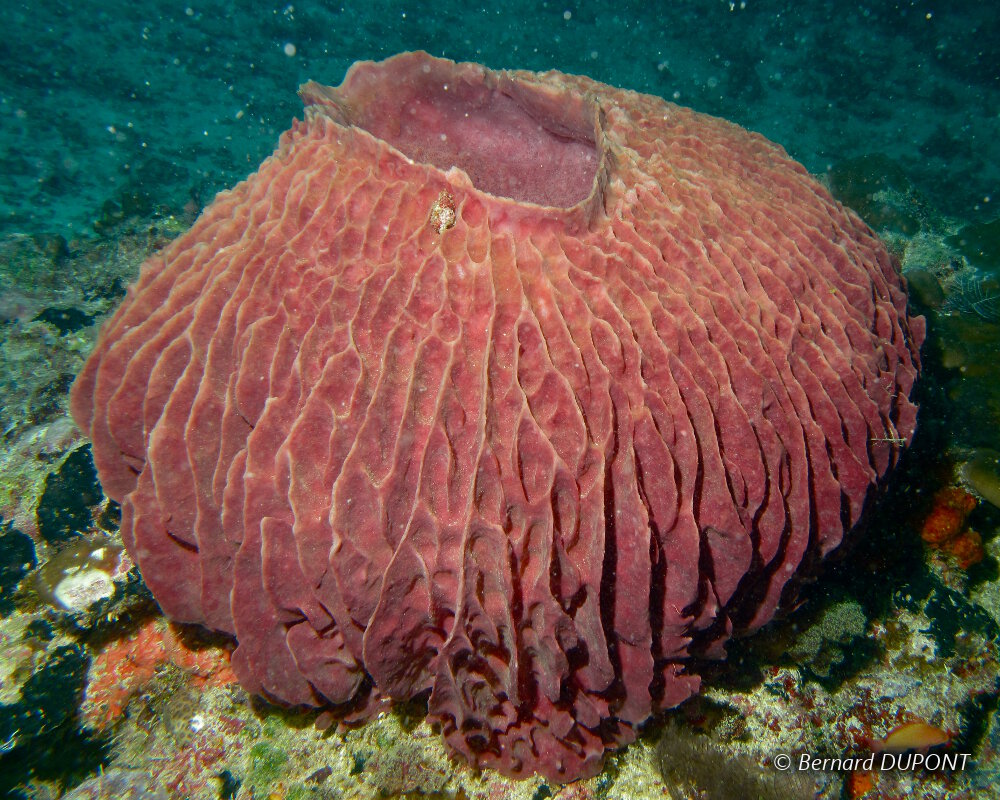
The giant barrel sponge is easily recognized by its barrel or vase shape, with a large opening at the top called an osculum, through which seawater is expelled. It can reach up to 6.6 feet in height, making it one of the largest sponges on tropical reefs along with its Caribbean cousin, the giant Caribbean barrel sponge (Xestospongia muta).
The giant barrel sponge (Xestospongia testudinaria)
The giant barrel sponge (Xestospongia testudinaria) © Bernard DUPONT sous licence Creative Commons
The coloration of the giant barrel sponge generally ranges from reddish-brown to pink, with an opening that is often lighter. Its texture is firm and sometimes slightly stony.
Geographic range
The giant barrel sponge is found in the waters of the Indo-Pacific region, particularly in the Philippines, Indonesia, Malaysia, Australia, New Caledonia, and several areas of the Indian ocean.
Habitat
The giant barrel sponge grows in clear, well-oxygenated tropical waters, mainly on hard substrates of coral reefs, down to several dozen feet in depth.
The giant barrel sponge often serves as a refuge for many marine organisms, such as crustaceans, fish, and microorganisms, making it a true micro-habitat within reef ecosystems.
Diet
Like most sponges, the giant barrel sponge feeds on microscopic plankton and organic particles by filtering the seawater that flows through its walls.
A single sponge can filter large amounts of water, helping to clarify seawater and support the functioning of reef ecosystems.
Reproduction
The giant barrel sponge can reproduce sexually: typically hermaphroditic, it produces both male and female gametes and, after fertilization, gives rise to a larva capable of moving before settling on a substrate and developing into a new sponge.
The giant barrel sponge can also reproduce asexually, by budding or fragmentation, when a piece of the sponge detaches and develops into a new individual.
Within the same genus
Caribbean giant barrel sponge (Xestospongia muta)
Caribbean giant barrel sponge
(Xestospongia muta)
Within the same family
Stony sponge (Petrosia ficiformis)
Stony sponge
(Petrosia ficiformis)
Discover also
Azure vase sponge (Callyspongia plicifera)
Azure vase sponge
(Callyspongia plicifera)
Compressed purse sponge (Grantia compressa)
Compressed purse sponge
(Grantia compressa)
Orange-red encrusting sponge (Crambe crambe)
Orange-red encrusting sponge
(Crambe crambe)
Rred boring sponge (Cliona delitrix)
Rred boring sponge
(Cliona delitrix)
Venus flower basket (Euplectella aspergillum)
Venus flower basket
(Euplectella aspergillum)
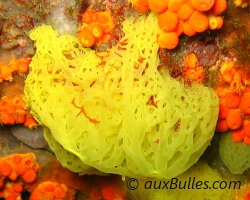
Yellow sponge Clathrina (Clathrina clathrus)
Yellow sponge Clathrina
(Clathrina clathrus)
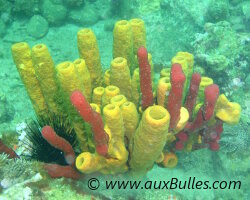
Yellow tube sponge (Aplysina fistularis)
Yellow tube sponge
(Aplysina fistularis)
The marine species from Indo-Pacific
Bicolor angelfish (Centropyge bicolor)
Bicolor angelfish
(Centropyge bicolor)
Bigeye trevally (Caranx sexfasciatus)
Bigeye trevally
(Caranx sexfasciatus)
Bobbitt worm (Eunice aphroditois)
Bobbitt worm
(Eunice aphroditois)
Copperbanded butterfly (Chelmon rostratus)
Copperbanded butterfly
(Chelmon rostratus)
Pearl-scaled angelfish (Centropyge vrolikii)
Pearl-scaled angelfish
(Centropyge vrolikii)
Persian carpet flatworm (Pseudobiceros bedfordi)
Persian carpet flatworm
(Pseudobiceros bedfordi)
Thornback cowfish (Lactoria fornasini)
Thornback cowfish
(Lactoria fornasini)

Our latestUpdates

Faroe islands
Thursday, May 7th 2026
Faroe islands
Discover the Faroe islands, a remote archipelago between Iceland and Norway known for its dramatic cliffs, colorful villages, and untouched Nordic landscapes. Find travel tips, itineraries, hiking guides, local culture, and inspiration to explore this unique destination in the North Atlantic.
The short-finned pilot whale
Wednesday, May 6th 2026
The short-finned pilot whale
Discover the tropical pilot whale (Globicephala macrorhynchus), a highly social large cetacean from tropical and subtropical waters, specialized in deep dives in search of squid.
Where to see groupers in the Mediterranean ?
Thursday, April 23rd 2026
Where to see groupers in the Mediterranean ?
Discover where to see groupers in the Mediterranean: the best diving spots and protected marine areas to observe this iconic fish in its natural habitat.
Photo of the Day
Méduse bleue (Aurelia aurita)
Méduse bleue
(Aurelia aurita)