Sealife guideThe crown-of-thorns starfishAcanthaster planci
Last updated on 08/12/2026 at 10:34 PM
Taxonomy
English names
Crown-of-thorns starfish
French namesEtoile de mer couronne d'épinesCoussin de belle-mèreAcanthaster pourpre
Scientific nameAcanthaster planci (Linnaeus, 1758)
Description
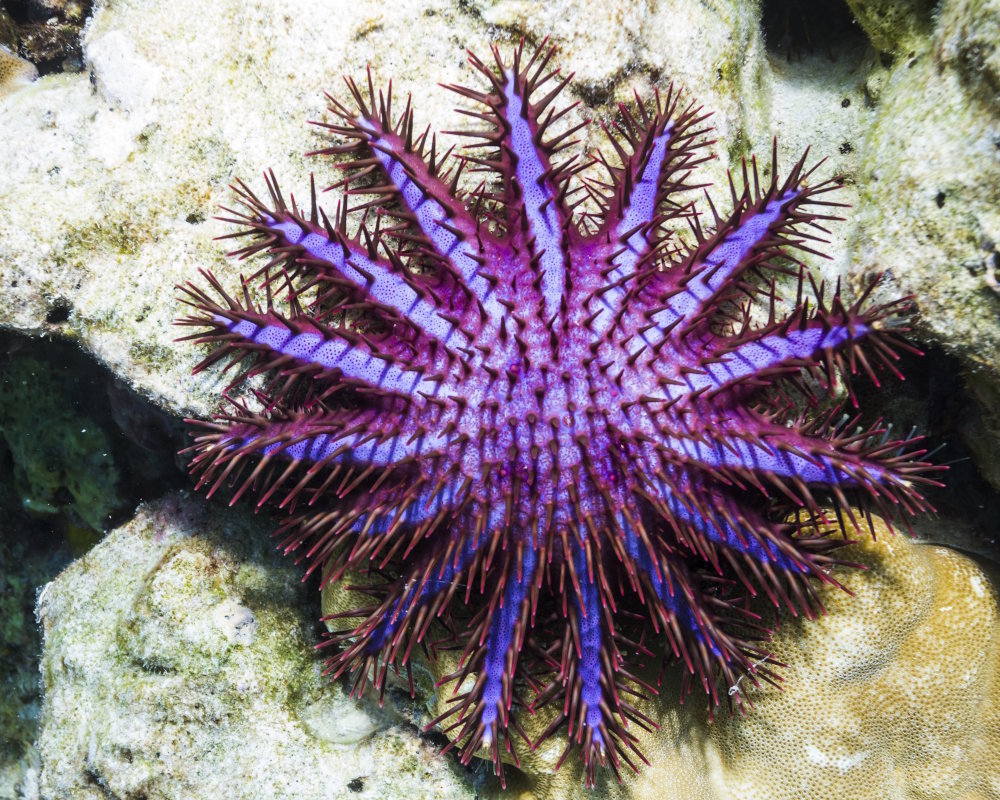
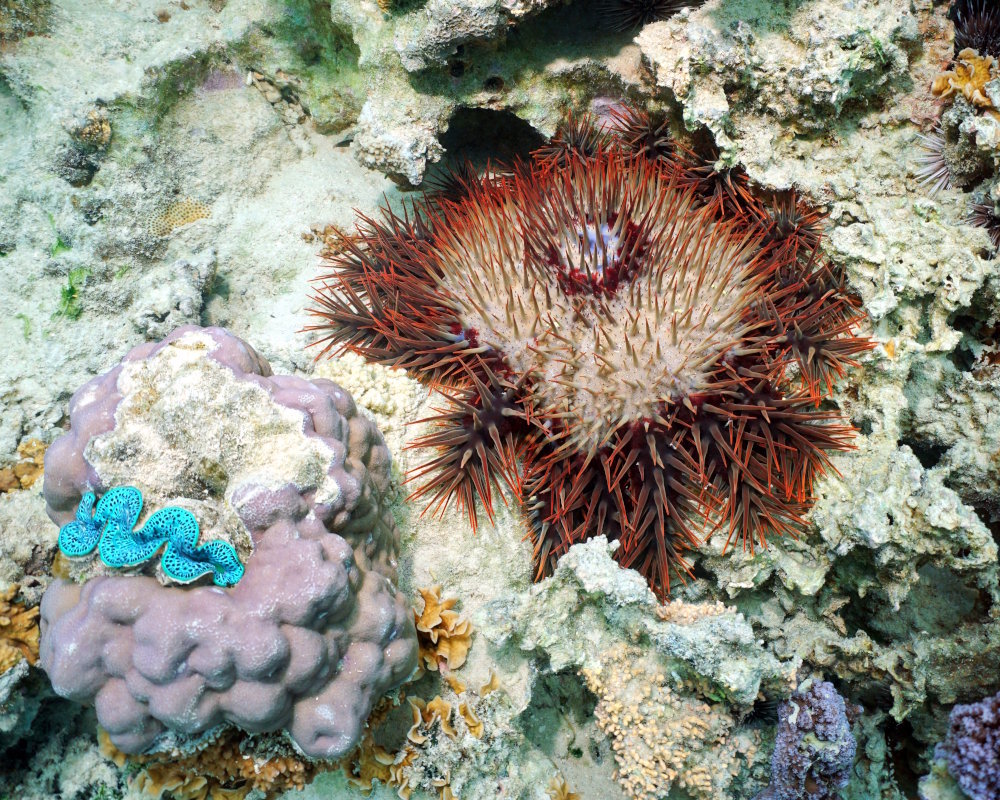
The crown-of-thorns starfish is a large tropical sea star with a particularly spectacular appearance. It typically measures around 12 inches in diameter but can reach up to 31 inches. It has a highly variable number of arms, averaging around 15 but sometimes reaching as many as 21, arranged around a relatively large central disk.
Its upper surface is covered with long, rigid, pointed spines arranged in groups and reminiscent of the spines of a crown, giving the species its common name. Its coloration is highly variable, ranging from brown, gray, green, red, or purple depending on the individual. These spines are also venomous and can cause significant pain if touched.
Geographic range
The crown-of-thorns starfish is found in tropical waters throughout the Indo-Pacific.
However, Acanthaster planci in the strict sense has a more restricted distribution and is found primarily in the tropical waters of the northern Indian Ocean, particularly in the Arabian Sea and along the coast of India.
Habitat
The crown-of-thorns starfish lives primarily on tropical coral reefs, where it finds its main source of food. It moves directly across coral colonies or over the substrate between colonies in search of food.
Juveniles can be more elusive and live in sheltered areas of the reef before gradually adopting a lifestyle closely associated with corals.
Diet
The crown-of-thorns starfish is a specialized coral predator, a true coral eater. It feeds primarily on the living tissues of reef-building corals. It moves across a colony, presses its underside against the coral, and then everts its stomach to digest the tissues directly on the surface of the colony.
It can therefore consume a substantial amount of coral as it grows. However, it shows a preference for certain species, particularly several corals of the genus Acropora. When populations become exceptionally abundant, this predation can cause a significant decline in coral cover and locally affect the balance of reef ecosystems.
Reproduction
The crown-of-thorns starfish reproduces sexually, with spawning taking place in seawater. Males and females release their sperm and eggs into the water, where fertilization occurs. During spawning, individuals generally raise themselves above the reef and release their
gametes through openings located on their upper surface.
Reproduction is seasonal and takes place during the warmer months, with the timing varying depending on the region: it occurs mainly between May and August in the Northern Hemisphere and between November and February in the Southern Hemisphere. After hatching, the young pass through several larval stages before settling on the seafloor and developing into small
sea stars.
Did you know ?
For a long time, several crown-of-thorns starfish with very similar appearances were considered to be a single species under the name Acanthaster planci. Research has since shown that they actually belong to several distinct species. Today, Acanthaster planci in the strict sense corresponds primarily to populations in the northern Indian Ocean, while Acanthaster mauritiensis occurs in the southern Indian Ocean, particularly around Mauritius, Acanthaster benziei occurs in the Red Sea, and other species of the genus Acanthaster are found in different regions of the Pacific.
Discover also

Australian sea apple
(Pseudocolochirus axiologus)
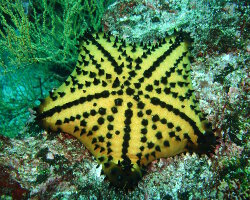
Chocolate chip sea star
(Nidorellia armata)
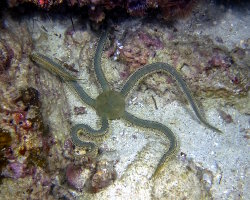
Green Brittle Star
(Ophiarachna incrassata)
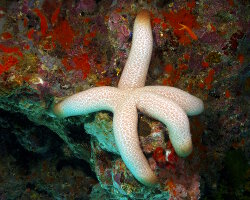
Heavy starfish
(Thromidia catalai)
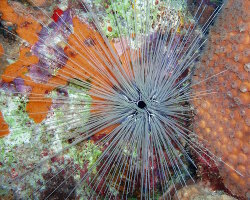
Long-spined sea urchin
(Diadema antillarum)
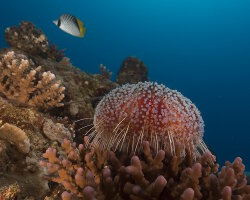
Red Sea fire sea urchin
(Asthenosoma marisrubri)

Royal sea star
(Astropecten articulatus)
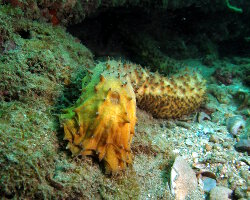
Tiger tail sea cucumber
(Holothuria thomasi)
The marine species in the Indo-Pacific
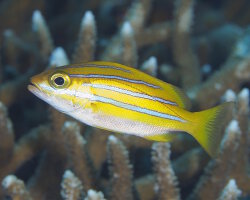
Bengal snapper
(Lutjanus bengalensis)
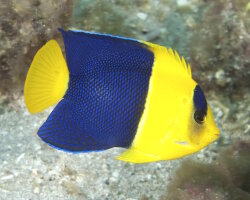
Bicolor angelfish
(Centropyge bicolor)

Blue tunicate
(Rhopalaea fusca)
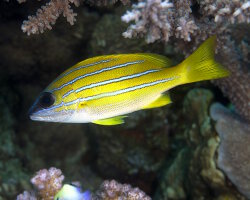
Common bluestripe snapper
(Lutjanus kasmira)
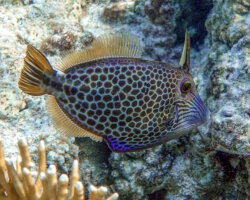
Honeycomb filefish
(Cantherhines pardalis)
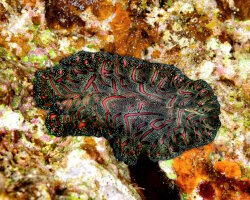
Persian carpet flatworm
(Pseudobiceros bedfordi)

Reef manta ray
(Mobula alfredi)
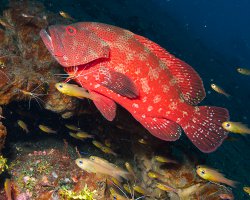
Tomato grouper
(Cephalopholis sonnerati)