Sealife guideThe skunk cleaner shrimpLysmata amboinensis
Last updated on 08/24/2026 at 10:41 PM
The skunk cleaner shrimp (Lysmata amboinensis) is a small crustacean easily recognized by its red-and-white body and long white antennae. It is best known for its remarkable cleaning behavior. It establishes itself on the reef at genuine cleaning stations, where fish come to have parasites and dead tissue removed.
This relationship benefits both partners: the shrimp obtains part of its food by cleaning the fish, while the fish are rid of numerous unwanted organisms living on their skin. The skunk cleaner shrimp generally lives alone or in pairs and can even approach fish much larger than itself, including potential predators.
Taxonomy
English names
Skunk cleaner shrimpPacific cleaner shrimpScarlet skunk cleaner shrimp
French namesCrevette nettoyeuse d'Amboine
Scientific nameLysmata amboinensis (De Man, 1888)
Description
The skunk cleaner shrimp has an elongated and relatively slender body, with bright red coloration crossed by a broad longitudinal white stripe along its back. Its abdomen also has white and red markings, while its long white antennae are easily visible as it moves or signals its presence to a fish. Its eyes are borne on short stalks, and its numerous legs allow it to move across the reef and cling to its clients during cleaning. It generally measures around 2.4 inches in total length.
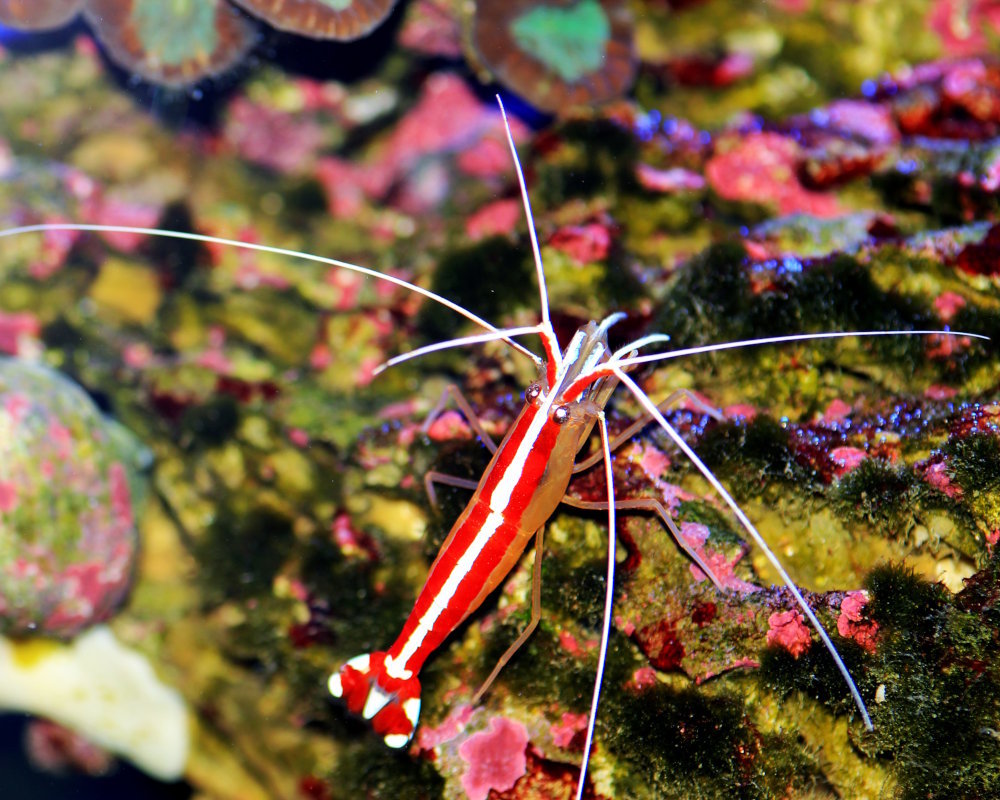
A skunk cleaner shrimp is recognizable by its bright red coloration crossed by a broad white stripe along its back
© Voislav Kolevski | Dreamstime.comIts highly contrasting coloration also plays a role in its cleaning behavior, as it allows fish to easily recognize the small shrimp when approaching a cleaning station. It waves its long antennae and legs to attract the attention of fish and signal that it is ready to clean them.
Geographic range
The skunk cleaner shrimp is found in the tropical waters of the Indo-Pacific and Red Sea, including around the
Seychelles,
Maldives, Indonesia, the Philippines, New Caledonia, French Polynesia, and
Hawaii.
Habitat
The skunk cleaner shrimp mainly lives on coral reefs, where it seeks out caves, crevices, and rocky recesses that provide shelter. It occurs from shallow waters down to depths of about 131 feet. These shelters often serve as genuine cleaning stations visited by numerous species of fish.
The skunk cleaner shrimp generally lives alone or in pairs and often remains close to its shelter. When a fish approaches, it emerges from its cavity and makes characteristic movements with its antennae and legs to attract its attention. It can then move over the fish's body, mouth, or sometimes gills to search for parasites and debris.
Diet
The skunk cleaner shrimp mainly feeds on material it removes from the bodies of its clients during cleaning sessions. It removes external parasites, pieces of dead skin, and various small debris from their bodies. It can therefore feed while helping fish get rid of organisms that may bother them.
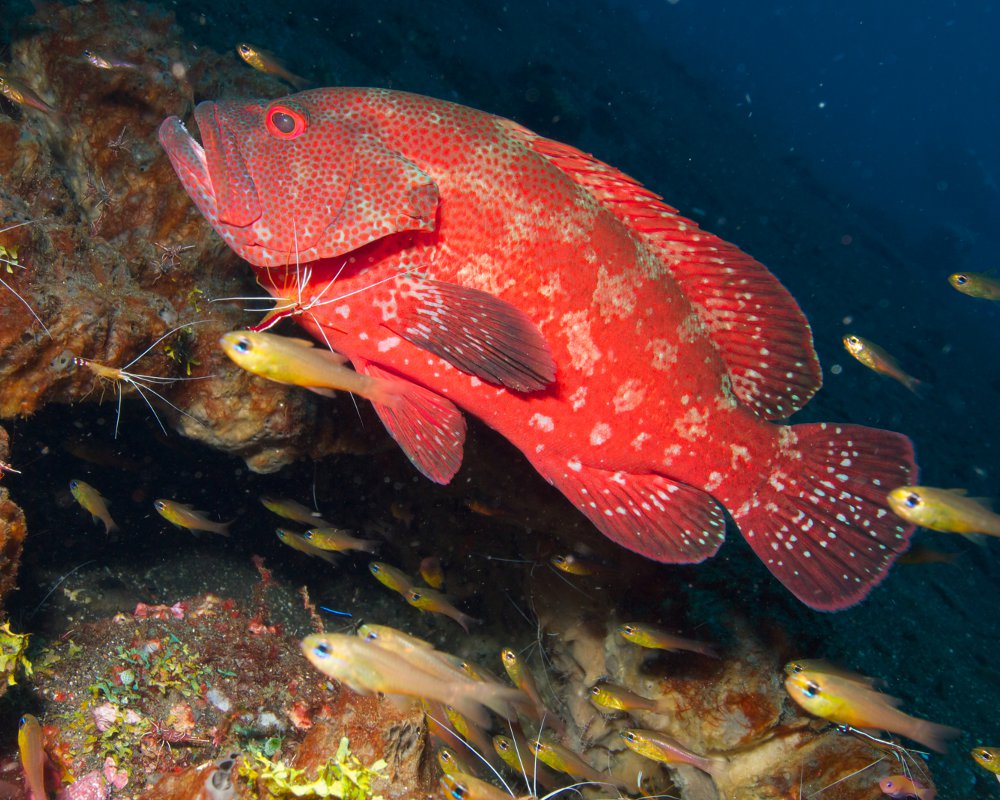
A tomato grouper being cleaned by a skunk cleaner shrimp, surrounded by cardinalfish at a cleaning station in Tulamben, Bali
© Stephankerkhofs | Dreamstime.comThis behavior is an example of a relationship known as
mutualism, because both animals can benefit from it. The shrimp obtains part of its food while the fish are rid of parasites and dead tissue. However, it can adapt its behavior when dealing with predatory fish and is more cautious with them than with species that pose less risk.
Reproduction
The skunk cleaner shrimp has a particularly unusual reproductive strategy: it is a
protandrous hermaphrodite. Young individuals begin their lives as males and later become capable of producing both sperm and eggs. They can then alternate between the male and female roles during mating.
Mating generally takes place shortly after the individual acting as the female molts, when its new shell is still soft. Fertilization is external, and the female then carries the eggs beneath her abdomen until they hatch. The eggs hatch into larvae that initially live in the plankton before gradually metamorphosing into young shrimp living on the seafloor.
Although it can produce both sperm and eggs, the shrimp cannot fertilize itself.
Did you know ?
The characteristic coloration of this cleaner shrimp, with its broad white stripe along the back bordered by red stripes, resembles the black-and-white coat of a skunk. This resemblance gives rise to its common name, skunk cleaner shrimp.
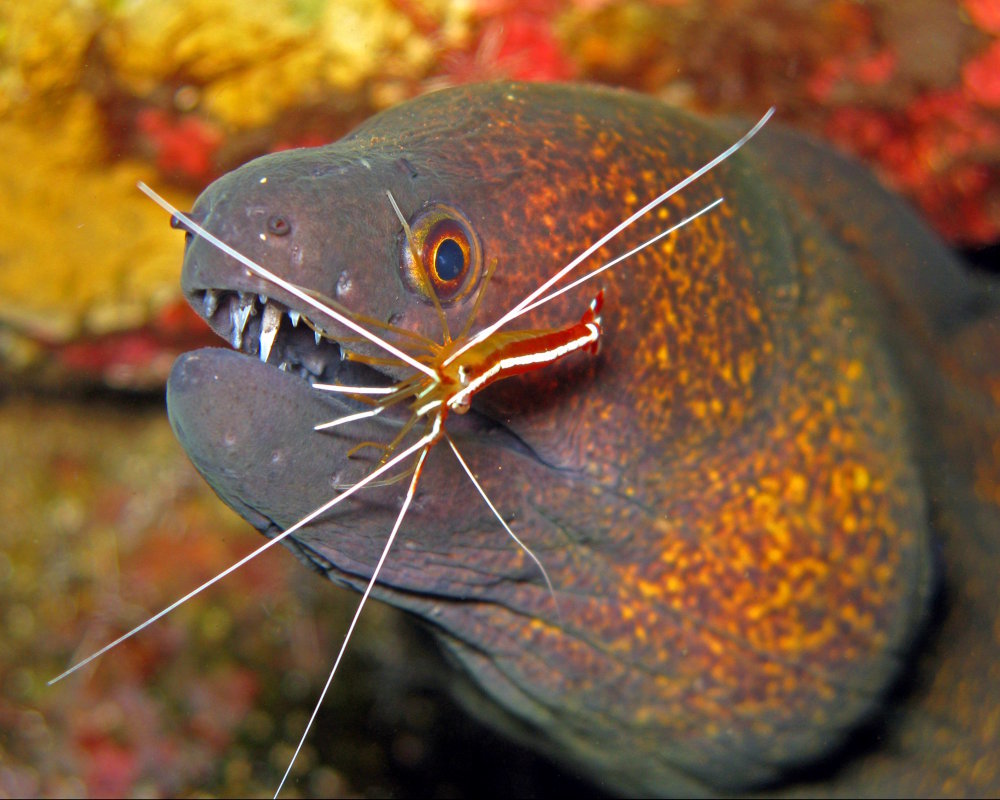
A yellow-edged moray eel (Gymnothorax flavimarginatus) allows a skunk cleaner shrimp (Lysmata amboinensis) to clean it
© Jamesdawson | Dreamstime.comDiscover also
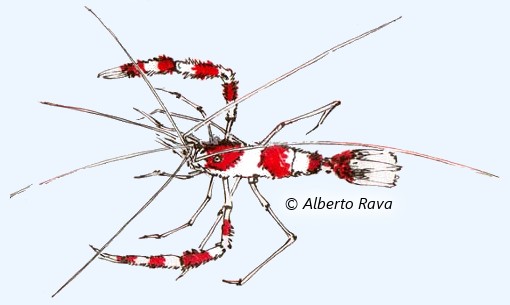
Banded cleaner shrimp
(Stenopus hispidus)
Batwing coral crab
(Carpilius corallinus)
Corallimorph decorator crab
(Cyclocoeloma tuberculata)
Gulf of Mexico golden crab
(Chaceon fenneri)
Long arm prawn
(Heteropenaeus longimanus)
Mediterranean slipper lobster
(Scyllarides latus)
Pink ghost crab
(Ocypode ryderi)
Urchin carrier crab
(Dorippe frascone)
The marine species in the Indo-Pacific

Blue tunicate
(Rhopalaea fusca)
Bluegirdled angelfish
(Pomacanthus navarchus)

Bluelashed butterflyfish
(Chaetodon bennetti)
Common bluestripe snapper
(Lutjanus kasmira)

Crown of thorns starfish
(Acanthaster planci)
Eightband butterflyfish
(Chaetodon octofasciatus)
Necklace sea star
(Fromia monilis)
Persian carpet flatworm
(Pseudobiceros bedfordi)