

Sealife guideThe stony spongePetrosia ficiformis
Last updated on 04/15/2026 at 10:18 PM
Taxonomy
English names
Stony sponge
French namesEponge pierre
Scientific namePetrosia ficiformis (Poiret, 1789)
FamilyPetrosiidae
OrderHaplosclerida
ClassDemospongiae
Description
The stony sponge is a massive sponge with varied shapes. It may be globular, irregular, or cushion-shaped. Its surface is generally rough and perforated with numerous small pores allowing seawater to enter its body.
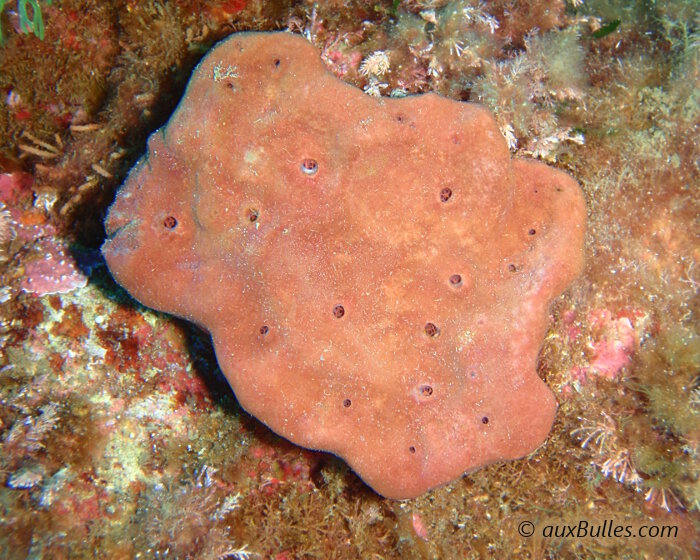
The stony sponge (Petrosia ficiformis)
Its color varies depending on the environment and the presence of symbiotic organisms. It may be brownish-purple, reddish, or sometimes grayish. Its internal structure is composed of a skeleton of siliceous spicules, which gives it a firm and sometimes slightly stony texture.
Geographic range
The stony sponge is found mainly in the Mediterranean sea and in certain areas of the eastern Atlantic ocean, particularly along the European and North African coasts.
Habitat
The stony sponge usually lives attached to hard substrates, such as rocks or underwater walls. It is most often found in coastal rocky areas, caves, and underwater overhangs, from a few feet to several dozen feet in depth.
It prefers shaded or dimly lit areas, where it can grow sheltered from strong light.
Diet
Like most sponges, the stony sponge is a filter-feeding organism. Seawater enters the sponge through numerous small pores and circulates through a network of internal canals.
The stony sponge mainly feeds on microscopic plankton, bacteria, and organic particles suspended in seawater.
This filtration process helps clarify the water and recycle organic matter within the marine ecosystem.
Reproduction
The stony sponge can reproduce in two ways.
The stony sponge is typically hermaphroditic, producing male and female gametes. The sperm cell, released by the sponge, drifts through the water with the currents. If it is drawn into another sponge, it can fertilize an egg. The egg then develops into a free-swimming larva capable of moving through the water using its cilia. It is then expelled from the sponge, before settling on a substrate where it develops into a new sponge.
The stony sponge can also reproduce asexually by fragmentation or budding. A fragment of the sponge detaches, then settles on a substrate and develops into a new individual.
Did you know ?
The stony sponge is a favorite food of the dotted sea slug, whose presence is easily recognized by the whitish craters left on the sponge where they have grazed while feeding.
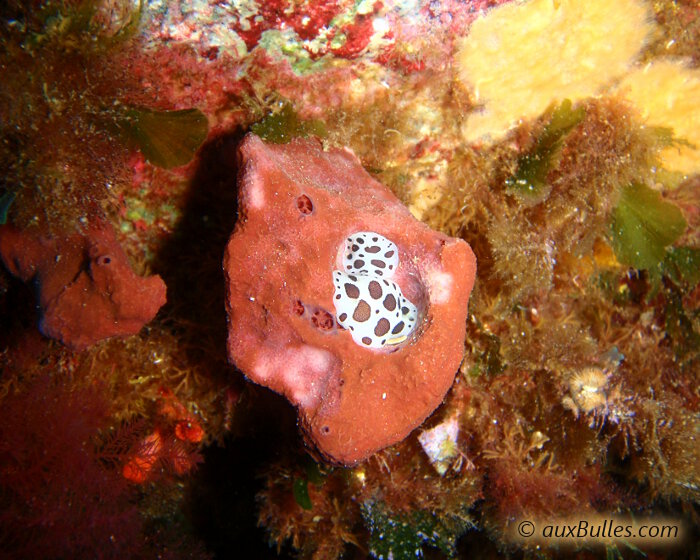
The stony sponge is a preferred food of the dotted sea slug
Within the same family
Discover also
The marine species in the Mediterranean Sea
Our latestUpdates
The neon gobyDiscover the neon goby (Elacatinus oceanops), a small western Atlantic reef fish known for its brilliant blue stripe and its role as a cleaner fish that removes parasites from other fish.Read more
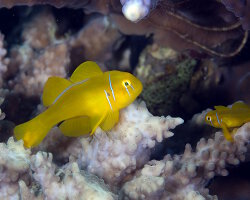
The poison gobyDiscover the poison goby (Gobiodon citrinus), a tiny reef fish with a bright yellow body and distinctive blue markings. It lives among branching Acropora corals in the tropical waters of the Indo-Pacific.Read more
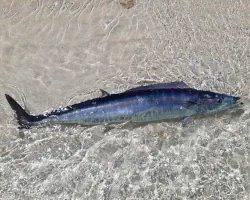
The wahooDiscover the wahoo (Acanthocybium solandri), a powerful pelagic predator found in tropical and subtropical oceans. Recognizable by its streamlined body and distinctive blue vertical stripes, it is a fast swimmer that feeds mainly on fish and squid.Read more
Photo of the Day

Fou à pieds rouges
(Sula sula)
(Sula sula)
 Copyright © 2007-2026 auxBulles.com - All rights reserved. Legal notices.
Photo credits - Our partners