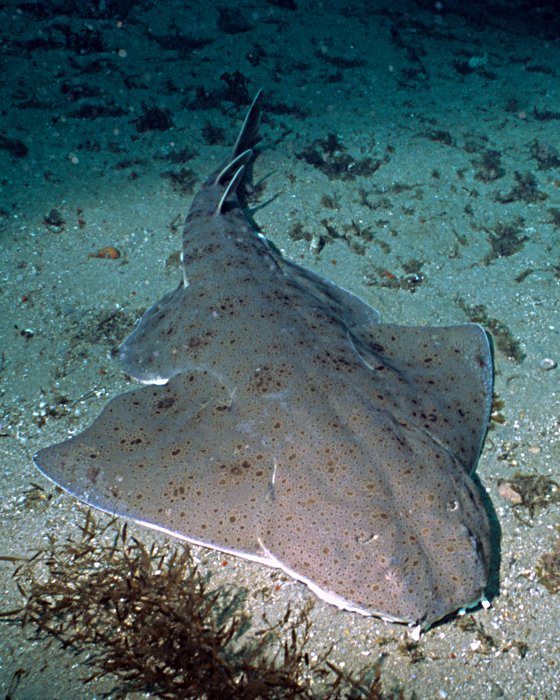
Sealife guideThe Pacific angelsharkSquatina californica
Last updated on 09/15/2026 at 11:55 PM
The Pacific angel shark (Squatina californica) is a shark that remarkably resembles a ray, with its very flattened body and large pectoral fins. It spends much of its time resting on the seafloor, where its body shape and coloration allow it to blend into the sand or mud.
Rather elusive, it remains motionless while waiting for its prey before capturing it with a very rapid movement. It lives in the coastal waters of the eastern Pacific, mainly along the coasts of California and Mexico. Its relatively slow growth and reproduction make it particularly vulnerable to fishing.
Taxonomy
English names
Pacific angelsharkPacific angel shark
French namesAnge de mer du Pacifique
Spanish namesAngelote del Pacífico
Scientific nameSquatina californica (Ayres, 1859)
Description
The Pacific angel shark is a small shark, reaching a maximum length of 4.9 feet. At first glance, the Pacific angel shark resembles a ray because of its flattened body, but it can be distinguished by its broad, flat pectoral fins.
The Pacific angel shark has a grayish coloration mottled with brown, allowing it to blend easily into the seafloor and remain unnoticed by both its prey and predators.
Geographic range
The Pacific angel shark lives in the waters of the eastern Pacific Ocean, along the West Coast of the United States, from southeastern Alaska and the coast of British Columbia to the Gulf of California and the Baja California Peninsula in Mexico. It is particularly common off central and southern California, especially around the Santa Barbara area.
Habitat
The Pacific angel shark is mainly found near the seafloor, on the continental shelf and in coastal areas. It prefers sandy or muddy bottoms where it can bury itself almost completely to camouflage itself. It also frequents rocky areas, the vicinity of underwater canyons and, occasionally, kelp forests.
It is generally found in shallow waters, but it can also be encountered at depths of up to 328 feet and occasionally as deep as 656 feet. Buried or resting on sandy bottoms during the day, the Pacific angel shark is more active at night.
Diet
The Pacific angel shark is an ambush predator. Thanks to its camouflage, it can blend into the sand or mud and remain almost invisible. It waits for a fish to come close enough to its wide mouth before suddenly lunging forward to capture it. It feeds mainly on bottom-dwelling fish, but also on squid.
Reproduction
The Pacific angel shark is
ovoviviparous, meaning that the embryos develop inside the female's uterus without receiving nourishment through a placenta. They are nourished solely by the yolk reserves contained within their own eggs.
The female gives birth each year after a gestation period of 10 months, producing about a dozen pups. The Pacific angel shark reaches sexual maturity relatively late, at around 13 years of age, when it is only about 3.3 feet long.
Did you know ?
The Pacific angel shark can remain perfectly motionless and almost invisible on the seafloor before capturing prey in a fraction of a second. This technique allows it to hunt without having to actively pursue its prey.
Pacific angel shark populations are heavily concentrated in limited geographic areas and are therefore highly sensitive to overfishing. Today, the Pacific angel shark is listed on the
IUCN Red List as a Vulnerable shark species !
Tips for observing
As with nurse sharks or wobbegong sharks, when you encounter a Pacific angel shark, approach slowly and, above all, remember to leave it an escape route so it can slip away if it feels exposed !
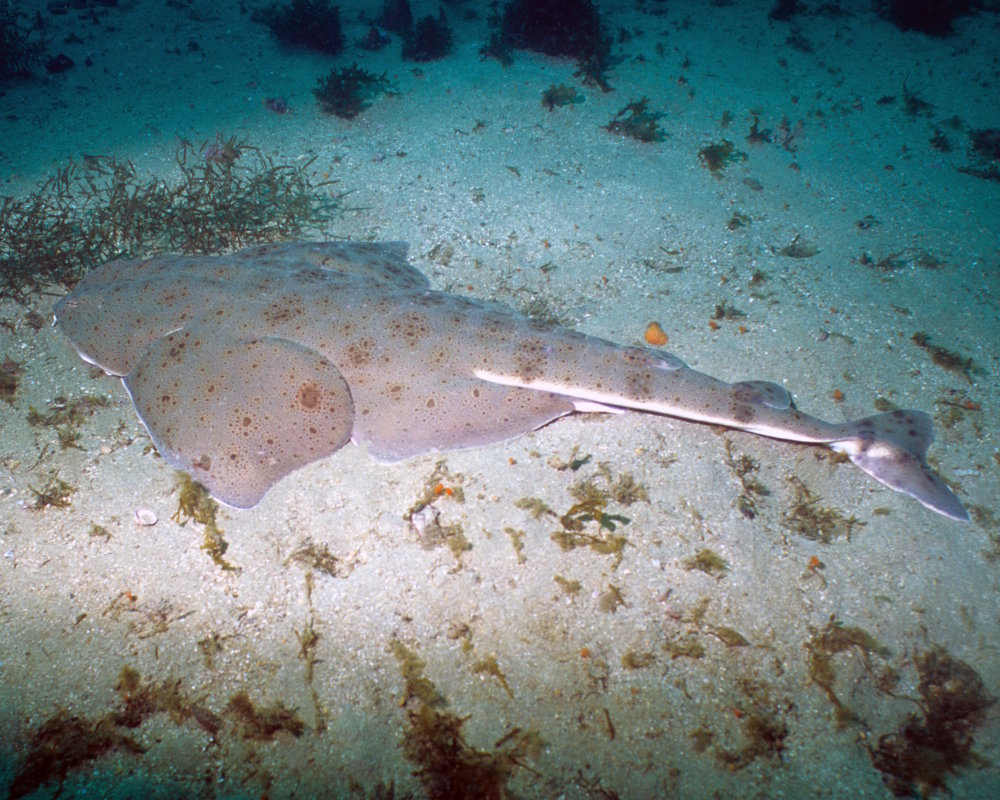
A Pacific angel shark (Squatina californica) lying motionless on a sandy bottom dotted with seagrass, off Catalina Island, California
© Michael Wood | Dreamstime.comWithin the same genus
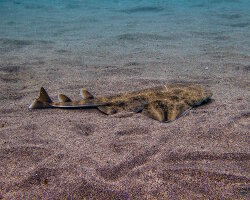
Common angelshark
(Squatina squatina)
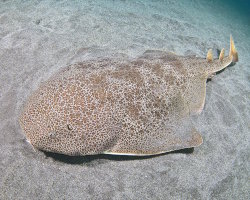
Japanese angelshark
(Squatina japonica)
Discover also
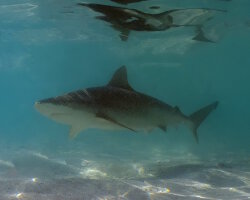
Blacknose shark
(Carcharhinus acronotus)
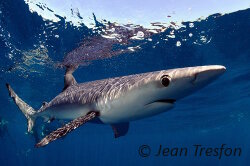
Blue shark
(Prionace glauca)

Copper shark
(Carcharhinus brachyurus)
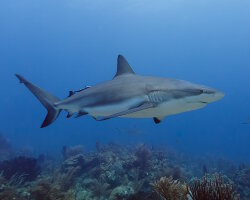
Gray reef shark
(Carcharhinus amblyrhynchos)
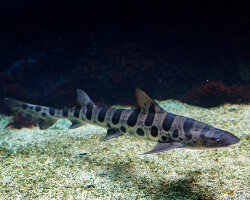
Leopard shark
(Triakis semifasciata)
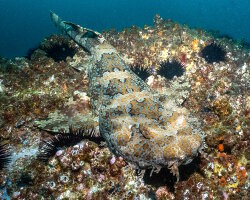
Ornate wobbegong
(Orectolobus ornatus)

Scalloped hammerhead
(Sphyrna lewini)
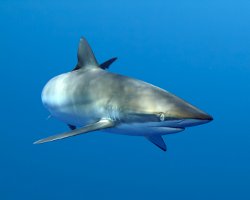
Silky Shark
(Carcharhinus falciformis)
The marine species in the Eastern Pacific
California sheephead
(Bodianus pulcher)
Frilled shark
(Chlamydoselachus anguineus)

Giant kelp
(Macrocystis pyrifera)
Giant tube worm
(Riftia pachyptila)
Gorgona guitarfish
(Pseudobatos prahli)
Leopard shark
(Triakis semifasciata)
Mosshead warbonnet
(Chirolophis nugator)

Sheep crab
(Loxorhynchus grandis)