

Sealife guideThe sand tiger sharkCarcharias taurus
Last updated on 09/14/2026 at 11:03 PM
Taxonomy
English names
Sand tiger sharkGrey nurse sharkSpotted raggedtooth sharkBull shark
French namesRequin taureau
Spanish namesTiburón toro
Scientific nameCarcharias taurus (Rafinesque, 1810)
FamilyOdontaspididae
OrderLamniformes
ClassElasmobranchii
Description
The sand tiger shark has a conical-shaped snout and very sharp, dagger-like teeth. It averages around 6.5 feet in length but can reach a maximum length of up to 10.5 feet and weigh as much as 353 pounds.
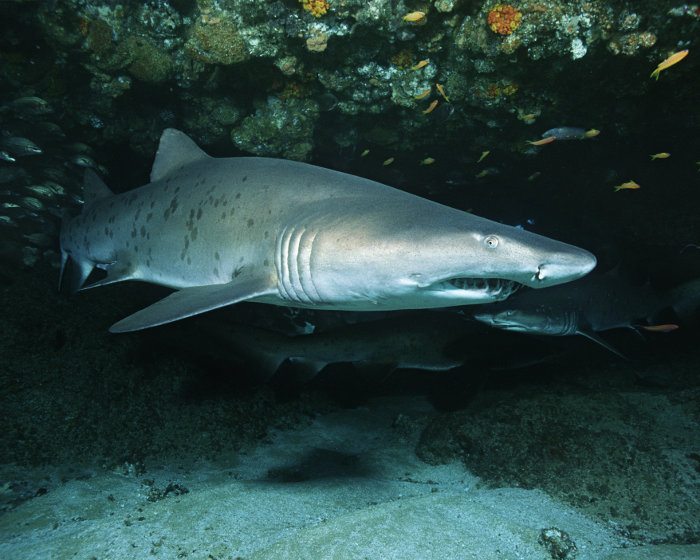
The sand tiger shark has a grayish-brown body with brown spots scattered along its sides © Photographerlondon | Dreamstime.com
The sand tiger shark has a grayish-brown body with brown spots scattered along its sides.
Geographic range
The sand tiger shark is found in the coastal waters of western and southern Africa, as well as along the eastern, western, and southern coasts of Australia. It is also found to a lesser extent in southern South America, the southeastern United States, and the Atlantic Ocean.
Habitat
The sand tiger shark is most commonly found at depths of around 80 feet, but it can occasionally descend to depths of nearly 660 feet. It usually stays close to sandy bottoms along the coast, near coral reefs, or in rocky areas with caves or deep crevices.
The sand tiger shark can live either alone or in groups of around 20 to 80 individuals.
Diet
The sand tiger shark feeds mainly, like most shark species, on various types of fish, as well as mollusks and crustaceans.

A sand tiger shark (Carcharias taurus) resting in a cave, surrounded by a school of small fish © Nicolás Sánchez Biezma | Dreamstime.com
Reproduction
The sand tiger shark is ovoviviparous. After a gestation period of 9 to 12 months, the female gives birth to only two sand tiger shark pups at a time. This is because in each of the female's uteri, the most developed embryo devours the other embryos and eggs present. This phenomenon is known as embryophagy or intrauterine cannibalism. At birth, the shark pups are already around 3.3 feet long.
Did you know ?
The sand tiger shark is listed as many other marine species within The IUCN Red List of threatened species. The sand tiger shark appears in the IUCN Red List since 2021 within the category Critically Endangered !

The sand tiger shark has very sharp, dagger-like teeth © Stefan Pircher | Dreamstime.com
Discover also

Banded houndshark
(Triakis scyllium)
(Triakis scyllium)
Blacknose shark
(Carcharhinus acronotus)
(Carcharhinus acronotus)
Great hammerhead shark
(Sphyrna mokarran)
(Sphyrna mokarran)
Great white shark
(Carcharodon carcharias)
(Carcharodon carcharias)
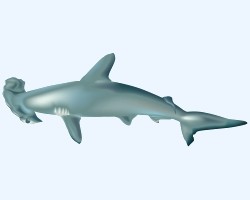
Hammerhead sharks
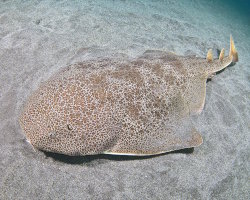
Japanese angelshark
(Squatina japonica)
(Squatina japonica)

Lemon shark
(Negaprion brevirostris)
(Negaprion brevirostris)

Scalloped hammerhead
(Sphyrna lewini)
(Sphyrna lewini)
Our latestUpdates
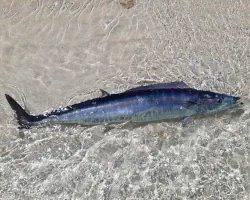
The wahooDiscover the wahoo (Acanthocybium solandri), a powerful pelagic predator found in tropical and subtropical oceans. Recognizable by its streamlined body and distinctive blue vertical stripes, it is a fast swimmer that feeds mainly on fish and squid.Read more
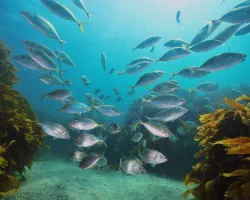
The white trevallyDiscover the white trevally (Pseudocaranx dentex), a silvery fish with a blue-green back that schools near reefs and rocky bottoms.Read more

Morrocoy National ParkDiscover Morrocoy National Park in Venezuela, with white-sand beaches, turquoise waters, coral reefs, mangroves, scenic cayos, and remarkable marine biodiversity.Read more
Photo of the Day
Brochet de mer
(Centropomus undecimalis)
(Centropomus undecimalis)
 Copyright © 2007-2026 auxBulles.com - All rights reserved. Legal notices.
Photo credits - Our partners