

Sealife guideThe frilled sharkChlamydoselachus anguineus
Last updated on 09/16/2026 at 09:58 PM
The frilled shark (Chlamydoselachus anguineus) is a deep-sea shark with a very unusual appearance. Its elongated body resembles that of an eel, and its six pairs of gill slits give it a silhouette very different from that of other sharks. Elusive and rarely observed alive, it generally inhabits the deep waters of the world's oceans.
Found in several regions around the world, the frilled shark mainly lives near the seafloor, where it feeds on squid and fish. It remains poorly known because it inhabits great depths that are difficult to explore.
Taxonomy
- Common name: Frilled shark, lizard shark, scaffold shark
- French name: Requin lézard
- Spanish name: Tiburón anguila
- Scientific name: Chlamydoselachus anguineus (Garman, 1884)
- Family name: Chlamydoselachidae
- Order name: Hexanchiformes
- Class name: Elasmobranchii
Description
The frilled shark has a very long, flexible body that gives it an eel-like appearance. Its head is flattened and its snout is very short. Its coloration is generally dark brown to grayish, sometimes lighter on the belly. Like some primitive shark species, it has 6 pairs of gill slits, compared with 5 in most other shark species. The first two pairs are connected beneath the throat by a fold of skin, a particularly distinctive characteristic of the frilled shark. Its nostrils are located on the top of its head.
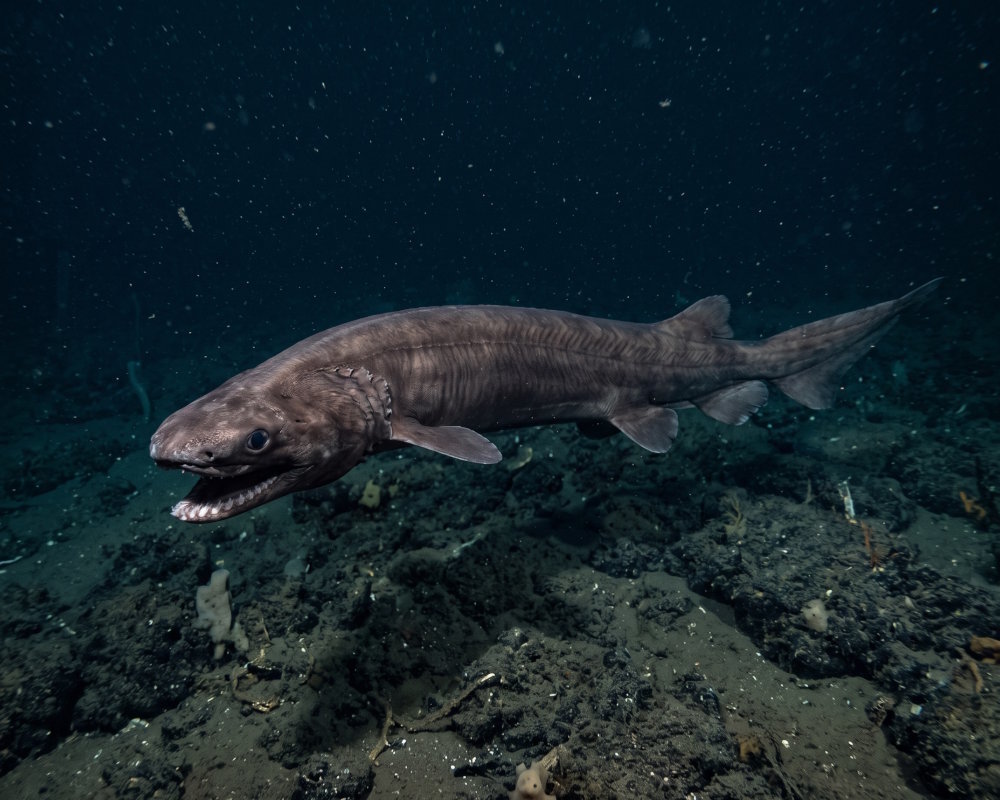
The frilled shark (Chlamydoselachus anguineus) is a deep-sea shark with a very unusual appearance Image generated by AI
The frilled shark has a wide mouth lined with numerous small, trident-shaped teeth that are particularly well suited for holding the prey it captures. Its pectoral fins are small and rounded, while its single dorsal fin is located far back on the body, close to the tail. Its anal fin is larger than its dorsal fin. In the frilled shark, the female is larger than the male, and its maximum size can reach up to 6.6 feet in length.
With its very elongated body, numerous gill slits, and flattened head, the frilled shark has an appearance very different from that of most other sharks.
Geographic range
Long considered endemic to Japanese waters, the frilled shark is found in the Atlantic Ocean, from Norway to northern Namibia, as well as in the western Pacific, from Japan to New Zealand. In the eastern Pacific, it occurs from southern California to northern Chile, and it is also found in the western Indian Ocean, off the coast of South Africa.
The frilled shark remains difficult to document because it generally lives at great depths and is difficult to observe in its natural habitat.
Habitat
The frilled shark mainly lives offshore, on the seafloor near continents and islands, along the edge of areas that descend into the deep ocean. It generally stays close to the bottom and is very rarely observed in open water. It is usually found between 394 and 4,265 feet deep, but may sometimes occur at depths of up to 4,921 feet.
Diet
The frilled shark mainly feeds on squid, but it also catches fish and other small sharks. Its very wide mouth allows it to easily seize its prey, while its long, slender, widely spaced teeth prevent them from escaping.
Its hunting technique remains poorly understood, but the frilled shark appears to slowly approach its prey before suddenly attacking by rapidly thrusting its head toward them, much like a snake.
Reproduction
The frilled shark is an ovoviviparous shark species. The male frilled shark has 2 long claspers that it uses to transfer sperm to the female during mating. The female retains the eggs inside her body for a very long gestation period that is still poorly understood but is estimated to last between one and two years. At the end of this period, she gives birth to several frilled shark pups, usually between 2 and 10.
Did you know ?
The frilled shark is a shark species that reproduces infrequently and is therefore listed on the IUCN Red List of Threatened Species!
Tips for observing
In January 2007, a frilled shark was observed near the surface and captured off the coast of Japan. Unfortunately, this specimen died shortly after being placed in captivity.
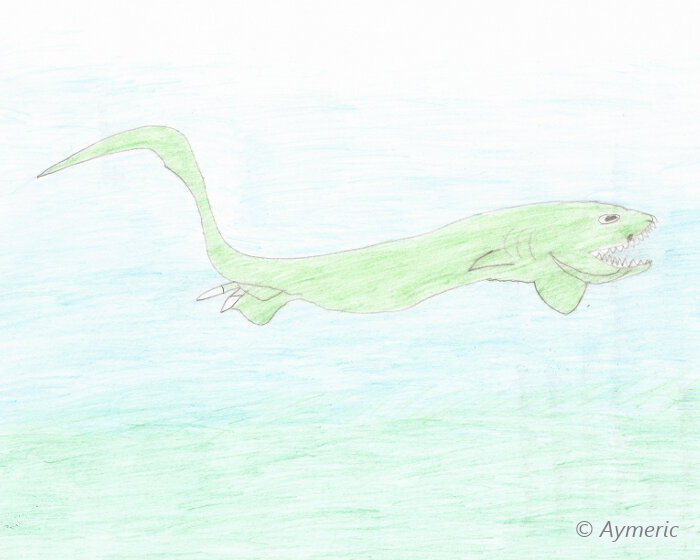
Drawing of a frilled shark by a child
Discover also
Caribbean reef shark
(Carcharhinus perezi)
(Carcharhinus perezi)
Dusky shark
(Carcharhinus obscurus)
(Carcharhinus obscurus)
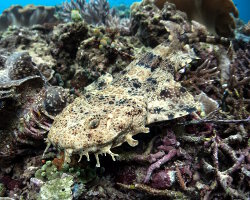
Japanese wobbegong
(Orectolobus japonicus)
(Orectolobus japonicus)

Pacific angelshark
(Squatina californica)
(Squatina californica)

Scalloped hammerhead
(Sphyrna lewini)
(Sphyrna lewini)
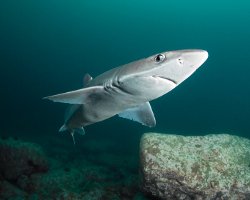
Spiny dogfish
(Squalus acanthias)
(Squalus acanthias)
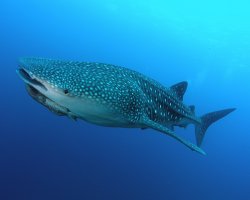
Whale shark
(Rhincodon typus)
(Rhincodon typus)
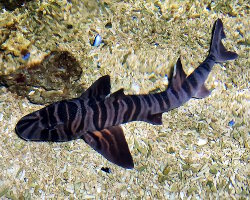
Zebra bullhead shark
(Heterodontus zebra)
(Heterodontus zebra)
Our latestUpdates

Monday, September 14th 2026
The striped remora
Discover the striped remora (Echeneis naucrates), a marine fish easily recognized by the suction disc on its head, which allows it to attach to large marine animals and travel with them.
Saturday, September 12th 2026
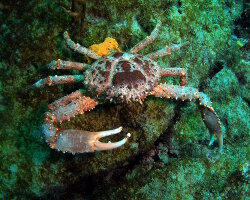
The Caribbean king crab
Discover the Caribbean king crab (Maguimithrax spinosissimus), an impressive reef crab found throughout the Caribbean and western Atlantic.
Thursday, September 10th 2026
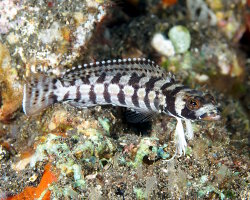
The reticulated sandperch
Discover the reticulated sandperch (Parapercis tetracantha), a small Indo-Pacific fish known for its elongated body and distinctive brown and white pattern.
Photo of the Day
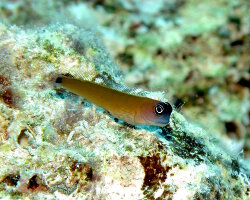
Blennie d'Aron
(Ecsenius aroni)
(Ecsenius aroni)
 Copyright © 2007-2026 auxBulles.com - All rights reserved. Legal notices.
Photo credits - Our partners