Sealife guideThe royal sea starAstropecten articulatus
Last updated on 08/10/2026 at 10:24 PM
Taxonomy
English names
Royal sea star Atlantic beaded sea starSand sifting sea star
French namesEtoile de mer royale
Scientific nameAstropecten articulatus (Say, 1825)
Description
The royal sea star is easily recognizable by its flattened body and five long, narrow arms that gradually taper toward their tips. Its upper surface is covered with small calcareous structures called paxillae, giving it a granular appearance. Its margins are lined with rows of spiny plates, particularly well developed along the sides of the arms and adapted to life in sandy sediments.
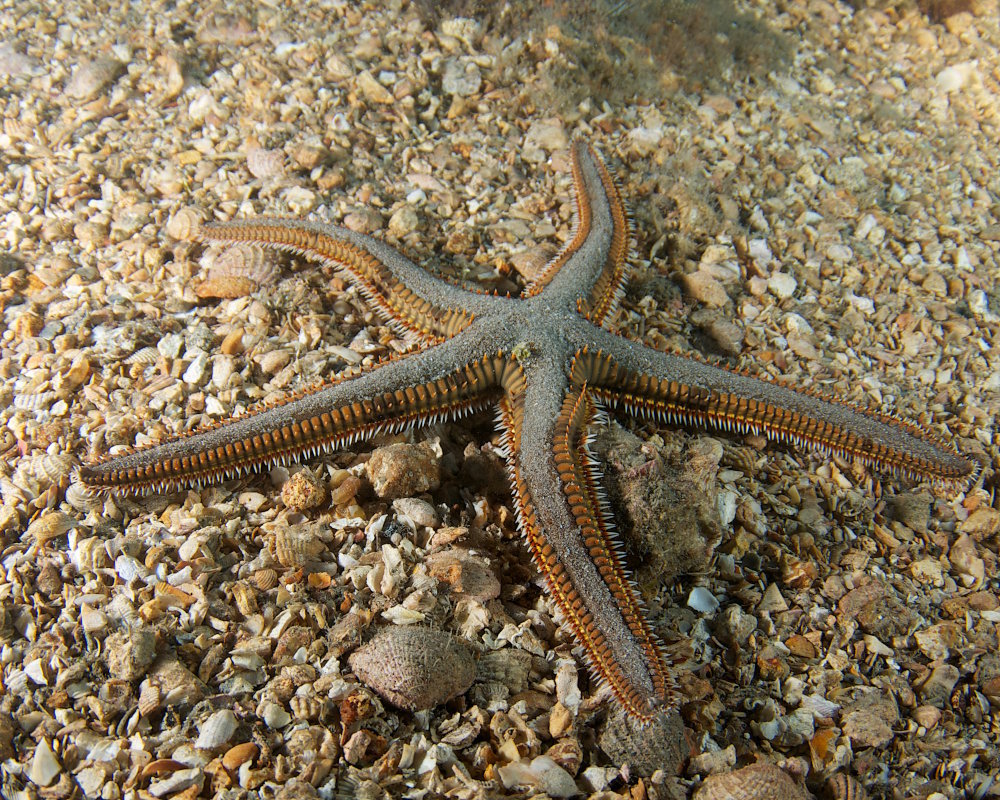
A royal sea star (Astropecten articulatus) beneath the Blue Heron Bridge in Palm Beach, Florida
© Peter Leahy | Dreamstime.comIts coloration is distinctive, with a dorsal surface that can range from dark blue to purplish, while the marginal plates are generally white or orange. The underside is lighter in color and bears the mouth and tube feet.
Geographic range
The royal sea star is widely distributed throughout the western Atlantic ocean, from the eastern coast of the United States, particularly North Carolina and
Florida, to the
Bahamas, the Gulf of Mexico and the Caribbean sea. It is also found along the coasts of Central and South America, with records extending as far south as Brazil and Uruguay. In
Florida, it occurs along the Atlantic coast, including Palm Beach, as well as around the
Florida Keys in southern
Florida.
Habitat
The royal sea star lives mainly on soft, sandy bottoms of the continental shelf. It is particularly well adapted to life in sediments, where its flattened body and marginal spines allow it to move and burrow.
The royal sea star is found from nearshore waters to depths of several hundred feet, but it is particularly common between about 16 and 66 feet. It is especially common on sandy bottoms in the southeastern United States.
Diet
The royal sea star is an active carnivorous predator on sandy bottoms. It searches for small animals living in or on the surface of the sediment and feeds mainly on
mollusks, including
gastropods,
bivalves and scaphopods.
Small
crustaceans and other invertebrates may also supplement its diet. Unlike many
sea stars that evert their stomach over their prey, the royal sea star swallows its prey directly.
Reproduction
Like other
sea stars, the royal sea star reproduces primarily through sexual reproduction. Gametes are released into the seawater, where fertilization takes place. The fertilized egg develops into a planktonic larva that drifts in the water column before undergoing metamorphosis. The young sea star then gradually develops its characteristic five-armed body and becomes a small sea star living on the seafloor.
Discover also
Black sea urchin
(Arbacia lixula)
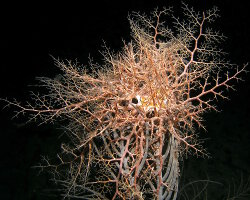
Giant basket star
(Astrophyton muricatum)
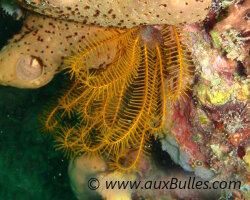
Golden crinoid
(Davidaster rubiginosus)
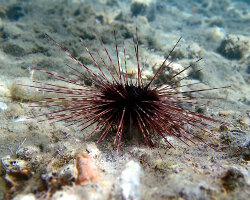
Hatpin sea urchin
(Centrostephanus longispinus)
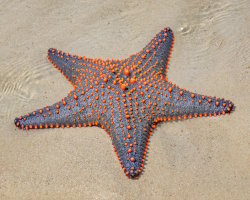
Multicolored knobbed starfish
(Pentaceraster mammillatus)
Pin cushion sea star
(Culcita schmideliana)
Pineapple sea cucumber
(Thelenota ananas)
Red sea urchin
(Mesocentrotus franciscanus)
The marine species in the Western Atlantic
Atlantic horseshoe crab
(Limulus polyphemus)
Bar jack
(Caranx ruber)
Biscuit sea star
(Peltaster placenta)
Bonnethead shark
(Sphyrna tiburo)
Golden crinoid
(Davidaster rubiginosus)
Horse-eye jack
(Caranx latus)
Sand diver
(Synodus intermedius)

Yellowhead jawfish
(Opistognathus aurifrons)