

Sealife guideThe Sea stars classThe taxonomy of marine species
Explore the taxonomy of marine echinoderms with a dedicated focus on starfish and sea urchins !
The class Asteroidea, commonly known as starfish, includes more than 1,600 known species. These marine animals can reach over one meter in span with their arms fully extended and typically have five arms or a multiple of five, with the number potentially varying due to regeneration after an arm is lost. Their skeleton is made up of adjacent but not fused calcareous plates.
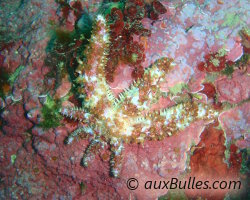
Blue spiny starfish
(Coscinasterias tenuispina)
(Coscinasterias tenuispina)
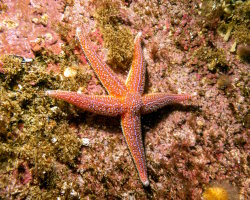
Common starfish
(Asterias rubens)
(Asterias rubens)
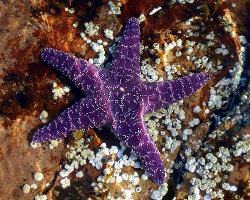
Ochre sea star
(Pisaster ochraceus)
(Pisaster ochraceus)
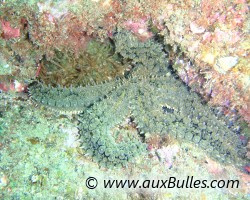
Spiny starfish
(Marthasterias glacialis)
(Marthasterias glacialis)
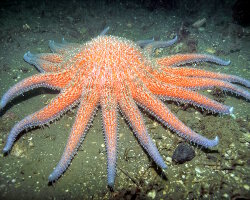
Sunflower sea star
(Pycnopodia helianthoides)
(Pycnopodia helianthoides)

Royal sea star
(Astropecten articulatus)
(Astropecten articulatus)
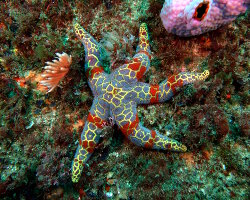
Mosaic sea star
(Plectaster decanus)
(Plectaster decanus)
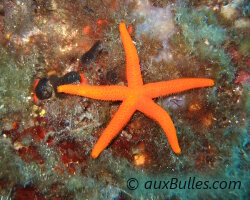
Red starfish
(Echinaster sepositus)
(Echinaster sepositus)

Crown of thorns starfish
(Acanthaster planci)
(Acanthaster planci)
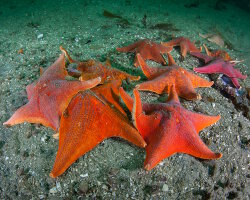
Bat sea star
(Patiria miniata)
(Patiria miniata)
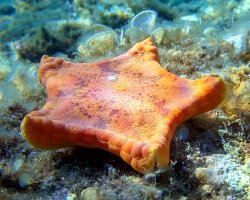
Biscuit sea star
(Peltaster placenta)
(Peltaster placenta)
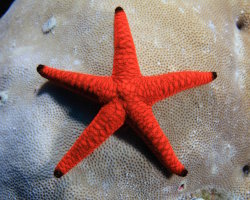
Indian sea star
(Fromia indica)
(Fromia indica)
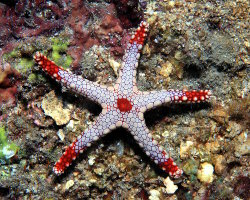
Necklace sea star
(Fromia monilis)
(Fromia monilis)
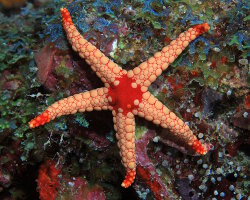
Noduled sea star
(Fromia nodosa)
(Fromia nodosa)
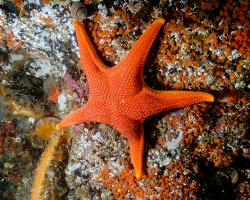
Vermillion sea star
(Mediaster aequalis)
(Mediaster aequalis)
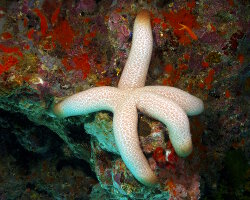
Heavy starfish
(Thromidia catalai)
(Thromidia catalai)
Our latestUpdates
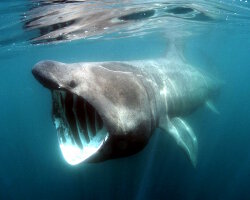
The basking sharkDiscover the basking shark (Cetorhinus maximus), the world's second-largest fish. This huge shark feeds on plankton by filtering large amounts of water.Read more
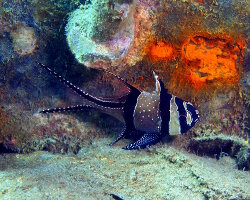
The Banggai cardinalfishDiscover the Banggai cardinalfish (Pterapogon kauderni), a small marine fish endemic to the Banggai Islands, known for its black-and-white stripes and unique reproductive behavior.Read more
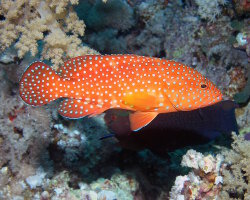
The coral hindDiscover the coral hind (Cephalopholis miniata), a colorful Indo-Pacific grouper known for its reddish-orange body covered with small blue spots.Read more
Photo of the Day
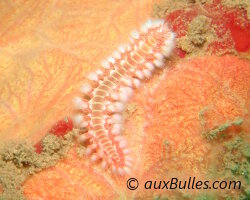
Ver de feu
(Hermodice carunculata)
(Hermodice carunculata)
 Copyright © 2007-2026 auxBulles.com - All rights reserved. Legal notices.
Photo credits - Our partners