

Sealife guideThe horse-eye jackCaranx latus
Last updated on 05/28/2026 at 11:23 AM
Taxonomy
English names
Horse-eye jack
French namesCarangue mayoleCarangue gros yeux
Spanish namesJurel blanco
Scientific nameCaranx latus (Agassiz, 1831)
FamilyCarangidae
OrderCarangiformes
ClassActinopterygii
Description
The horse-eye jack has an elongated body that is laterally compressed and particularly hydrodynamic, allowing it to swim quickly in open water. Its coloration is mainly silvery with bluish or greenish reflections on the back.
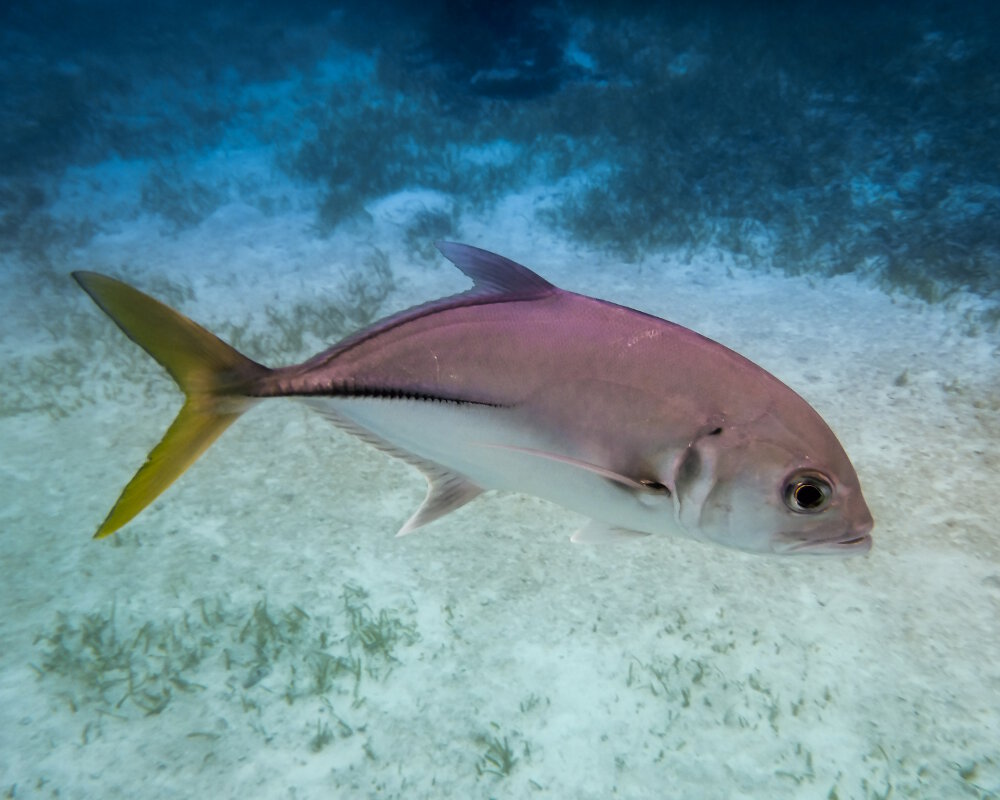
The horse-eye jack (Caranx latus) © Diego Grandi | Dreamstime.com
The horse-eye jack is distinguished by its large eyes, which are the origin of its common name, as well as by its deeply forked tail adapted for rapid acceleration. The fins may show yellowish to dark tones depending on age and environment. Juveniles often have dark vertical bands that gradually disappear in adults.
The horse-eye jack measures on average around 24 inches in length, but some individuals can reach up to 3.3 feet in length.
Geographic range
The horse-eye jack mainly inhabits the tropical and subtropical waters of the western Atlantic ocean, from the coasts of New Jersey and Bermuda down to southern Brazil, including the Gulf of Mexico and the Caribbean sea.
Populations are also observed in certain regions of the eastern Atlantic, particularly near the Gulf of Guinea and some tropical oceanic islands such as Ascension island.
Habitat
The horse-eye jack mainly inhabits warm, clear coastal waters. Adults are often found near coral reefs, rocky drop-offs, and in open water from the surface down to depths of over 330 feet.
Juveniles prefer sheltered areas such as lagoons, seagrass beds, sandy bottoms, and sometimes brackish estuaries. The horse-eye jack can form large mobile schools that move around reefs in search of food.
Diet
The horse-eye jack is an active predator whose diet mainly consists of small fish, crustaceans such as shrimp, and various marine invertebrates.
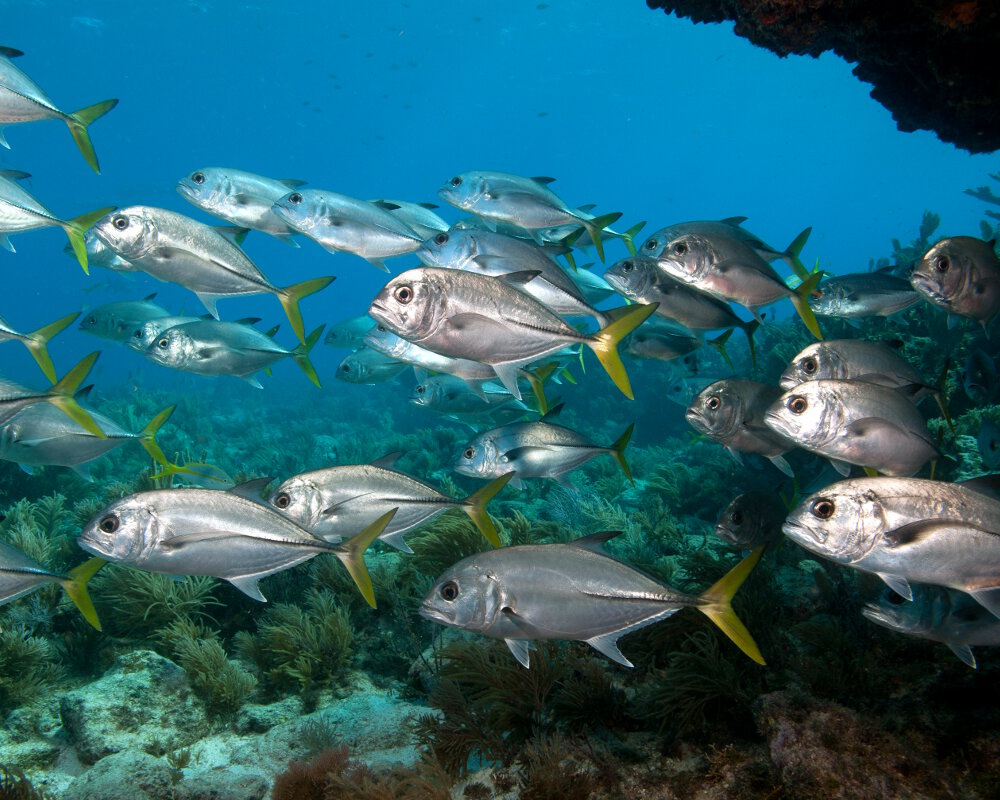
A school of horse-eye jacks (Caranx latus) © Timgimages | Dreamstime.com
The horse-eye jack often hunts in groups to increase the efficiency of attacks on schools of fish. Thanks to its speed and developed vision, it is able to catch fast-moving prey in open water around reefs.
Reproduction
The horse-eye jack is oviparous. Adults gather in large schools, generally during the warmest periods of the year. Eggs and sperm are released directly into open water, where fertilization takes place. The fertilized eggs then drift in ocean currents before hatching into larvae.
The young fish then move into protected coastal areas where they continue their growth before moving to reefs and deeper waters as adults.
Did you know ?
The horse-eye jack is listed as many other marine species within The IUCN Red List of threatened species. The horse-eye jack appears in the IUCN Red List since 2019 within the category Least Concern !
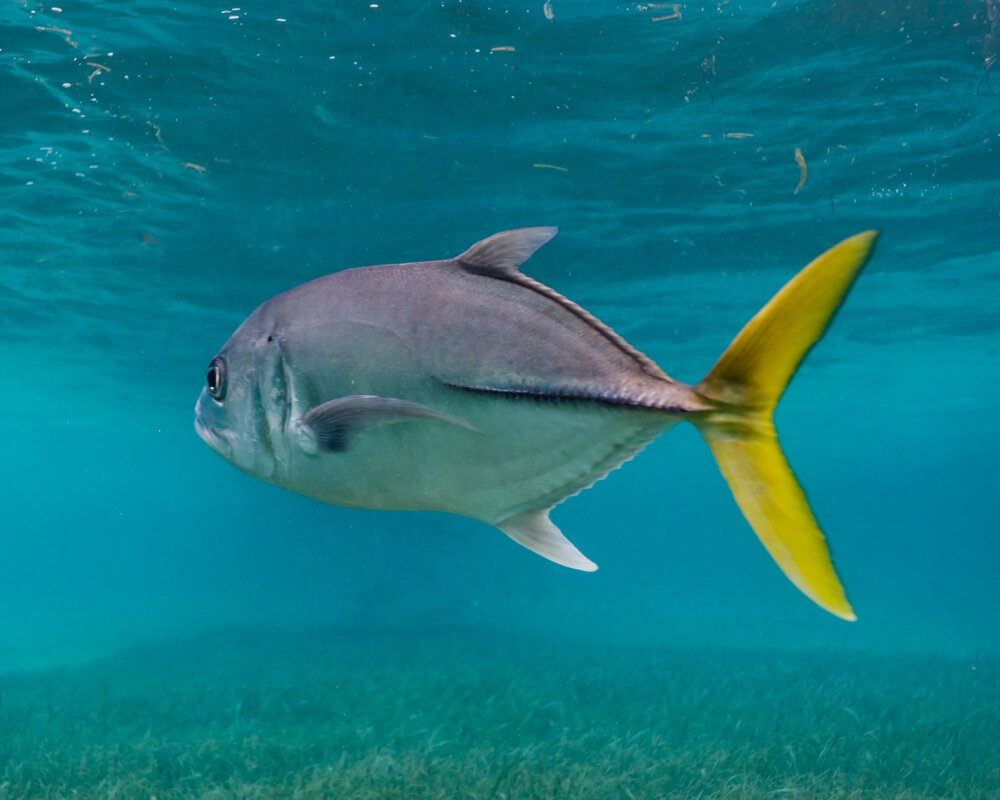
The horse-eye jack (Caranx latus) © Pniesen | Dreamstime.com
Within the same genus
Within the same family


Discover also
The marine species in the Western Atlantic

Our latestUpdates
The neon gobyDiscover the neon goby (Elacatinus oceanops), a small western Atlantic reef fish known for its brilliant blue stripe and its role as a cleaner fish that removes parasites from other fish.Read more
The poison gobyDiscover the poison goby (Gobiodon citrinus), a tiny reef fish with a bright yellow body and distinctive blue markings. It lives among branching Acropora corals in the tropical waters of the Indo-Pacific.Read more
The wahooDiscover the wahoo (Acanthocybium solandri), a powerful pelagic predator found in tropical and subtropical oceans. Recognizable by its streamlined body and distinctive blue vertical stripes, it is a fast swimmer that feeds mainly on fish and squid.Read more
Photo of the Day

Fou à pieds rouges
(Sula sula)
(Sula sula)
 Copyright © 2007-2026 auxBulles.com - All rights reserved. Legal notices.
Photo credits - Our partners