Sealife guideThe yellowhead jawfishOpistognathus aurifrons
Last updated on 09/24/2026 at 12:11 AM
Taxonomy
English names
Yellowhead jawfish
French namesMarionnette tête d'or
Spanish namesBocón cabeza amarilla
Scientific nameOpistognathus aurifrons (Jordan & Thompson, 1905)
Description
The yellowhead jawfish is a small fish, reaching only about 3.9 inches in length. Its elongated body is gray with a slight bluish tint and covered with numerous pale blue spots. A pair of black spots is also often present on the chin.
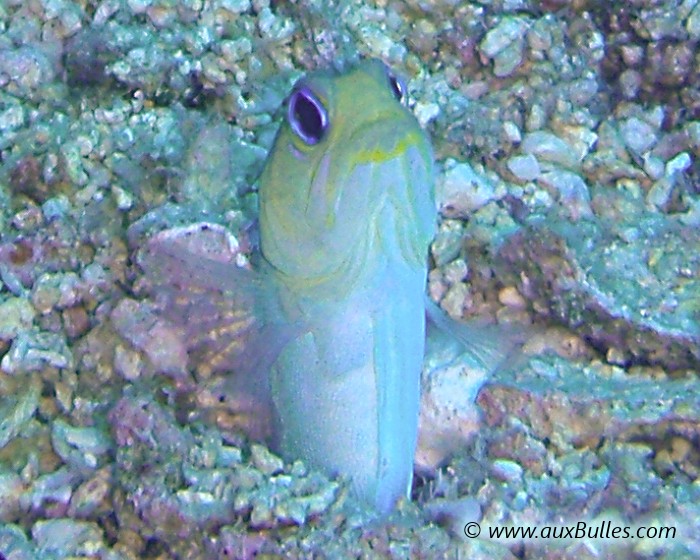
The yellowhead jawfish has large, bulging eyes and a wide mouth
This small fish is easy to recognize by its golden-yellow head. It holds its body upright above the seafloor, like a puppet suspended by strings. It has large, bulging eyes and a wide mouth for its size, and its dorsal fin is particularly long.
Geographic range
The yellowhead jawfish is found mainly in tropical waters of the western Atlantic, from southern
Florida in the north to the northern coast of South America in the south, including the many islands scattered between the
Bahamas and
Barbados, such as
Guadeloupe. The yellowhead jawfish is also found in the Caribbean Sea and the Gulf of Mexico.
Habitat
The yellowhead jawfish is found from the surface to depths of about 131 feet. It lives near coral reefs, among coral rubble or on sandy bottoms, where it can dig a burrow for shelter.
Diet
The yellowhead jawfish feeds on zooplankton, which it captures while hovering above its burrow and, more rarely, nearby in open water.
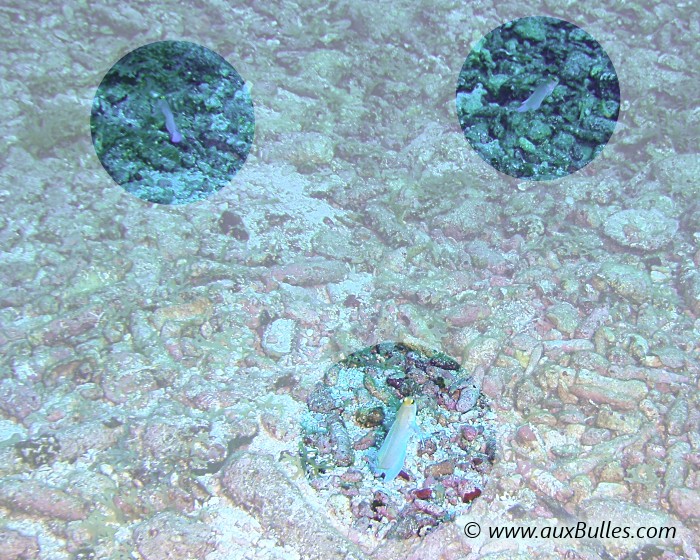
The yellowhead jawfish rarely lives alone, so you may have the chance to see other individuals nearby
Reproduction
The male incubates the eggs in his wide-open mouth for about a week. After hatching, the young need several weeks before they are able to dig their own burrow and live independently of their parent.
Did you know ?
At night, the yellowhead jawfish disappears into its burrow for shelter and carefully closes the entrance with a shell or another piece of coral rubble.
The yellowhead jawfish is listed as many other marine species within The
IUCN Red List of threatened species. The yellowhead jawfish appears in the
IUCN Red List since 2015 within the category Least Concern !
Tips for observing
The yellowhead jawfish holds its body upright at varying heights above the entrance to its burrow. At the slightest noise, it retreats tail first into its burrow and soon reappears head first when the surroundings become quiet again. Wait motionless near the entrance for a few moments, and you will soon see its little golden head emerge !
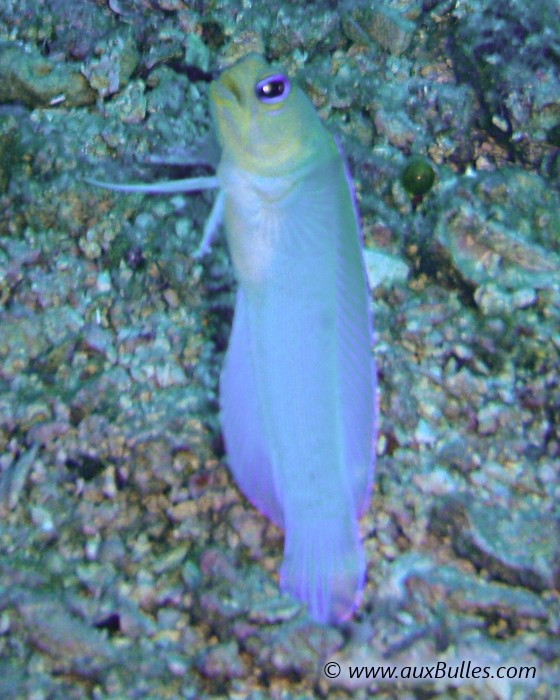
The yellowhead jawfish holds its body upright, hovering at varying heights above the entrance to its burrow
The yellowhead jawfish rarely lives alone, so you may have the chance to see other individuals nearby, each with its own burrow !
Discover also
Blackbelt hogfish
(Bodianus mesothorax)
Brown-marbled grouper
(Epinephelus fuscoguttatus)
Coney
(Cephalopholis fulva)
Guineafowl puffer
(Arothron meleagris)
Indian mackerel
(Rastrelliger kanagurta)
Ocean tang
(Acanthurus bahianus)
Scalyhead sculpin
(Artedius harringtoni)
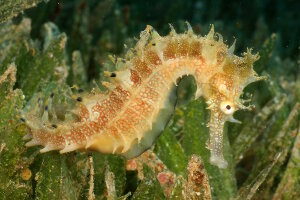
Spiny seahorse
(Hippocampus histrix)
The marine species in the Western Atlantic
Atlantic horseshoe crab
(Limulus polyphemus)
Bar jack
(Caranx ruber)
Biscuit sea star
(Peltaster placenta)
Bonnethead shark
(Sphyrna tiburo)
Golden crinoid
(Davidaster rubiginosus)
Horse-eye jack
(Caranx latus)

Royal sea star
(Astropecten articulatus)
Sand diver
(Synodus intermedius)