Sealife guideThe whale sharkRhincodon typus
Last updated on 08/14/2026 at 12:17 AM
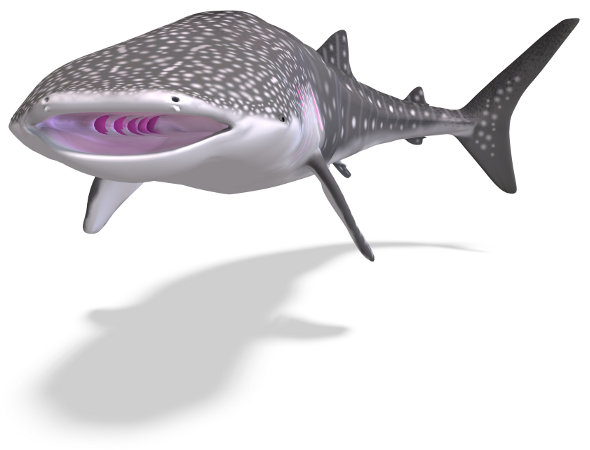
The whale shark (Rhincodon typus)
The whale shark (Rhincodon typus) is the largest living fish on Earth. Despite its name and impressive size, it is not a whale but a shark. This ocean giant feeds mainly by filtering seawater to capture tiny organisms, but it can also consume small fish and fish eggs. Generally peaceful, it travels great distances in search of areas where food is particularly abundant.
Taxonomy
English names
Whale shark
French namesRequin baleine
Spanish namesTiburón dama
Scientific nameRhincodon typus (Smith, 1828)
Description
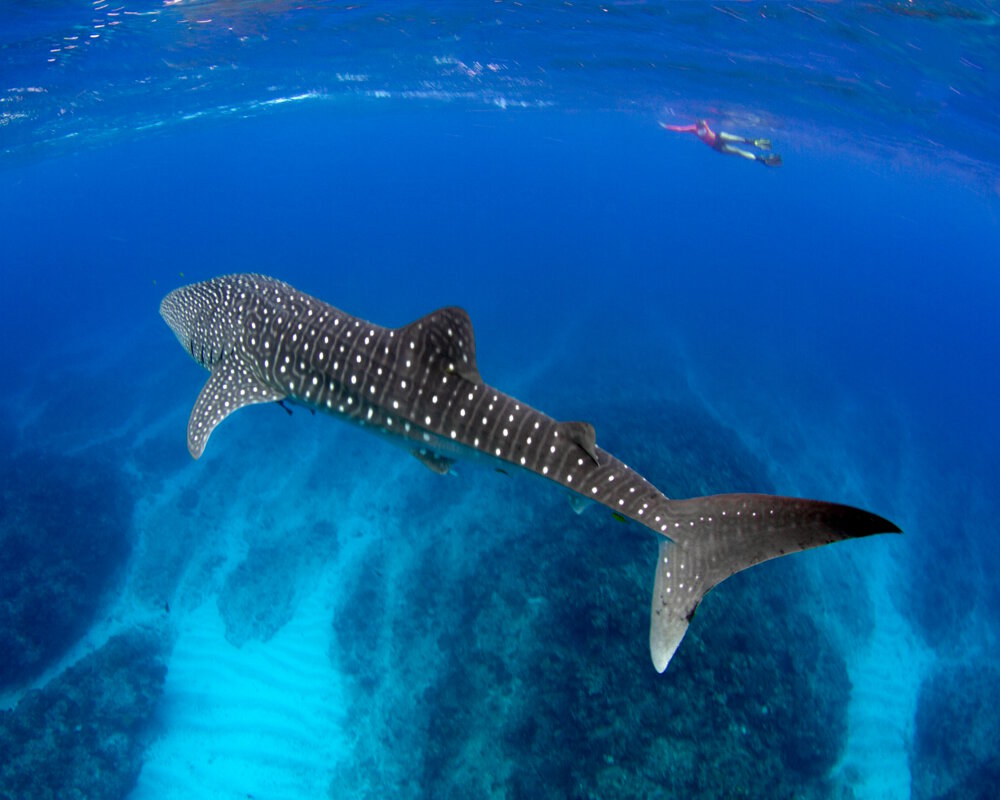
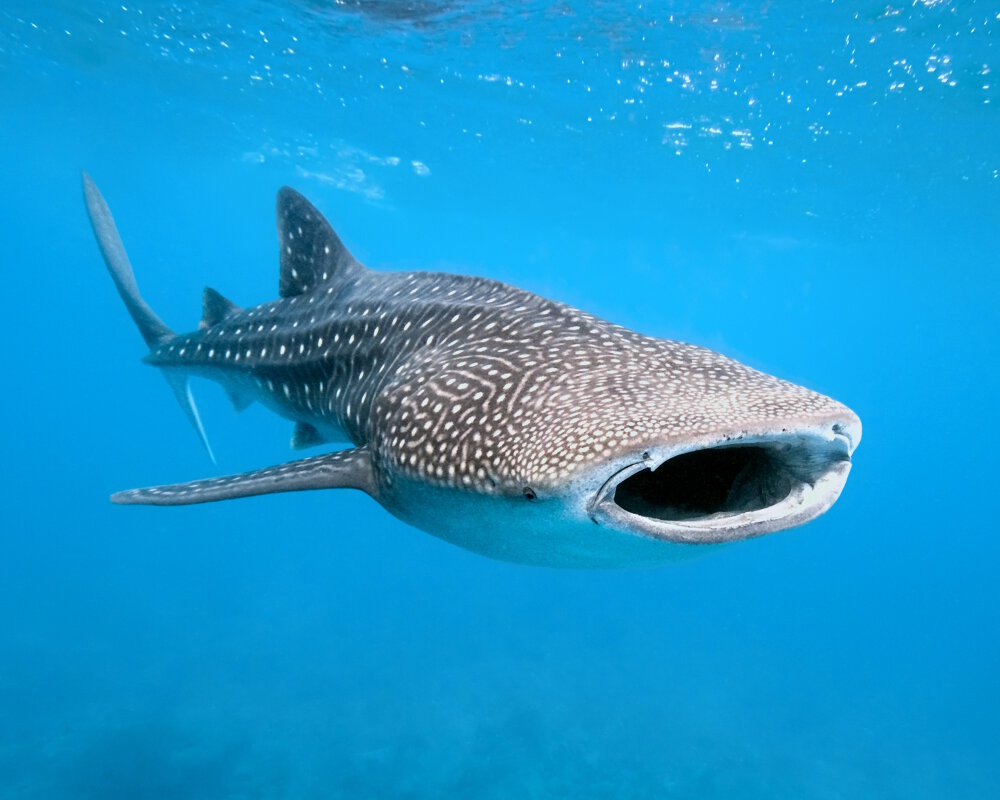
The whale shark has a massive, elongated body, a very broad head, and an impressive mouth located at the front of the head. Its skin is generally bluish gray to brownish gray and covered with numerous light-colored spots and patterns distributed across its back and sides. These markings are unique to each individual and can be used to identify them and track their movements.
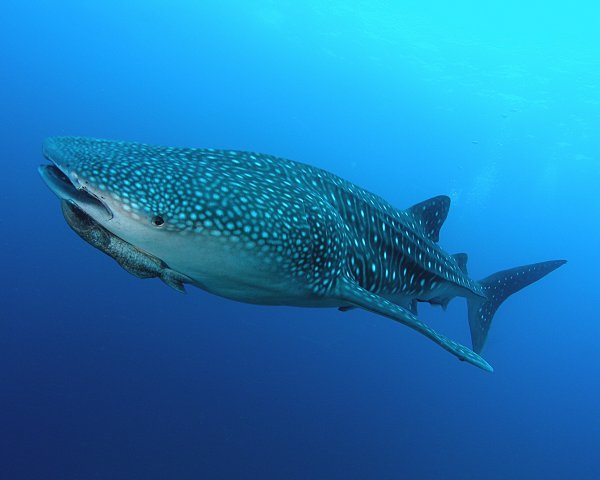
The whale shark is the largest fish currently living on Earth
Its mouth can measure more than 3.3 feet wide, but this impressive appearance does not correspond to that of a predator that hunts large prey: its tiny teeth play only a secondary role in feeding, which relies mainly on filtration.
The whale shark is the largest living fish in the world. The largest individuals can exceed 59 feet in length and weigh several dozen tons.
Geographic range
The whale shark has a very wide distribution in tropical and warm-temperate seas around the world, except for the Mediterranean. It is found in all three major ocean basins and can travel very long distances during its movements. Its migrations are often linked to the search for food-rich areas, particularly when certain times of year favor concentrations of plankton, fish eggs, or small fish.
This is particularly the case at
Ningaloo Reef in
Australia, where whale sharks gather seasonally, but also in other regions known for their abundant food sources, such as the waters around Isla Mujeres and Holbox in Mexico and the
Galapagos islands.
Whale sharks in the Atlantic and those in the Indian and Pacific oceans form two major population groups that develop largely independently.
Habitat
The whale shark inhabits both coastal waters and the open ocean. It is often observed near the surface when feeding in areas where prey are abundant, particularly around reefs and islands, as well as in areas where currents concentrate plankton, fish eggs, and small fish.
The whale shark does not always remain near the surface, however. It can dive to several hundred feet deep, and sometimes much deeper during certain dives. These movements allow it to search for food at different depths, depending on where it is most abundant.
Diet
The whale shark is a filter feeder that captures food by taking in large quantities of water and then retaining food organisms with its gill-filtering apparatus. Plankton makes up an important part of its diet, particularly small planktonic
crustaceans such as
copepods. It can also take advantage of seasonal concentrations of fish eggs, larvae, and small schooling fish.
The whale shark therefore does not simply filter seawater passively while swimming: it can also actively suck in large quantities of water containing its prey, particularly when it encounters a major concentration of food. This ability allows it to take advantage of temporary areas where food is exceptionally abundant.
Reproduction
Whale shark reproduction remains relatively poorly understood. The species is
ovoviviparous: the eggs develop inside the female's body, and the embryos initially obtain nourishment from the reserves contained within their eggs. The young then continue developing in the uterus before being born as fully formed young sharks that are already capable of swimming.
A female examined off the coast of Taiwan contained approximately 300 embryos, with the most developed measuring between 1.9 and 2.1 feet. The available data also suggest slow growth and relatively late sexual maturity, which contributes to making the species particularly vulnerable to high mortality among adults.
Did you know ?
Despite its enormous size, the whale shark can feed on tiny organisms. Its diet includes plankton, as well as fish eggs and larvae and small fish. It can therefore find itself in the middle of true « food soups », where plankton, fish eggs, and small fish occur in large concentrations.
The whale shark is listed as many other marine species within The
IUCN Red List of threatened species. The whale shark appears in the
IUCN Red List since 2016 within the category Endangered !
Tips for observing
Ningaloo Reef, Western Australia
In
Australia,
Ningaloo Reef in Western
Australia is one of the best places in the world to observe whale sharks. Every year, these giants gather in the reef's coastal waters, mainly between March and July, when food becomes particularly abundant. This period coincides with a strong presence of zooplankton and small fish, encouraged by nutrient-rich upwellings and, early in the season, by the mass spawning of corals.
Isla Mujeres and Holbox, Mexico
Off the islands of Isla Mujeres and Holbox, Mexico, whale sharks gather seasonally in waters particularly rich in food. The observation season generally runs from May through September, with peak numbers during the summer. These aggregations are linked to seasonal abundance of plankton and fish eggs, which sometimes attract numerous individuals to the same area.
Galapagos, Ecuador
In the
Galapagos archipelago, the waters around Darwin and Wolf islands provide an exceptional site for observing whale sharks, particularly during their seasonal passage through the archipelago. Whale sharks frequent
Galapagos waters between June and December, with a strong presence of females.
Discover also

Blind shark
(Brachaelurus waddi)

Blue shark
(Prionace glauca)

Frilled shark
(Chlamydoselachus anguineus)

Port Jackson shark
(Heterodontus portusjacksoni)
Short fin mako
(Isurus oxyrinchus)

Silky Shark
(Carcharhinus falciformis)

Spiny dogfish
(Squalus acanthias)

Tawny nurse shark
(Nebrius ferrugineus)
The marine species in Australia

Brownbanded bamboo shark
(Chiloscyllium punctatum)

Eastern clown anemonefish
(Amphiprion percula)

False clownfish
(Amphiprion ocellaris)
Giant barrel sponge
(Xestospongia testudinaria)
John dory
(Zeus faber)

Lemonpeel angelfish
(Centropyge flavissima)

Long-finned pilot whale
(Globicephala melas)
White spotted wedgefish
(Rhynchobatus australiae)