Sealife guideThe john doryZeus faber
Last updated on 09/16/2026 at 09:58 PM
Taxonomy
English names
John doryDory
French namesPoisson Saint PierreDoré
Spanish namesPez de San Pedro
Scientific nameZeus faber (Linnaeus, 1758)
Description
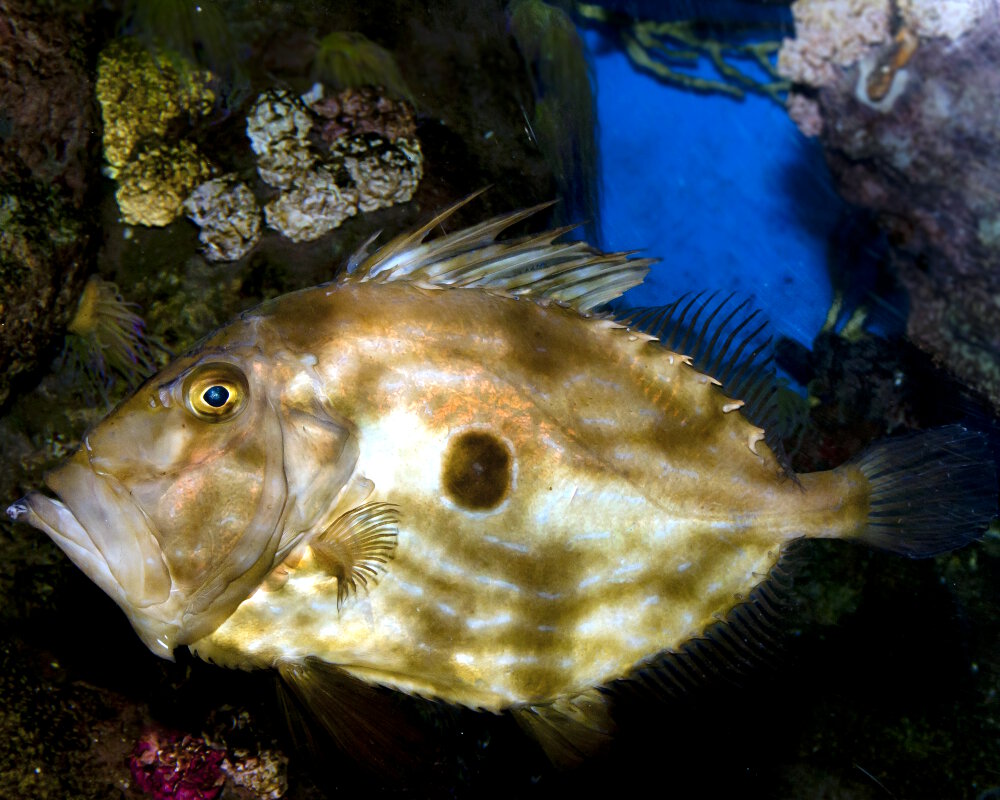
The John Dory has a very flat, disk-shaped body, like a « pancake ».
The John Dory averages about 16 inches in length, but the largest specimens can reach up to twice that size.
At first glance, you will quickly notice the features that characterize this fish:
- a large black spot surrounded by a pale halo in the middle of its body,
- large, elongated fins equipped with long spines
- and a large head with a wide mouth.
The John Dory's dorsal fin has long spines that give the fish a «ruffled appearance».
The John Dory has a greenish body with broad, darker longitudinal marbling and silvery reflections, which have earned it the name «dory».
Geographic range
The John Dory is found in the western Indian Ocean, the eastern Atlantic Ocean (from Norway to South Africa), the Mediterranean Sea, along the English Channel coast, the Black Sea, and the western Pacific Ocean (Japan, Korea,
Australia, and New Zealand).
Habitat
The John Dory is a pelagic fish that is particularly associated with waters close to the seafloor. It occasionally comes close to the surface but prefers greater depths, and you are more likely to encounter it at depths of around 164 feet or more.
The John Dory's preferred depth range is between 164 and 492 feet. In addition, you will most often encounter it alone, as the John Dory is a solitary fish.
Diet
The John Dory feeds in the area where it lives, close to the seafloor. It ambushes smaller fish, sucking them into its large mouth, and occasionally feeds on cephalopods or
crustaceans such as crabs.
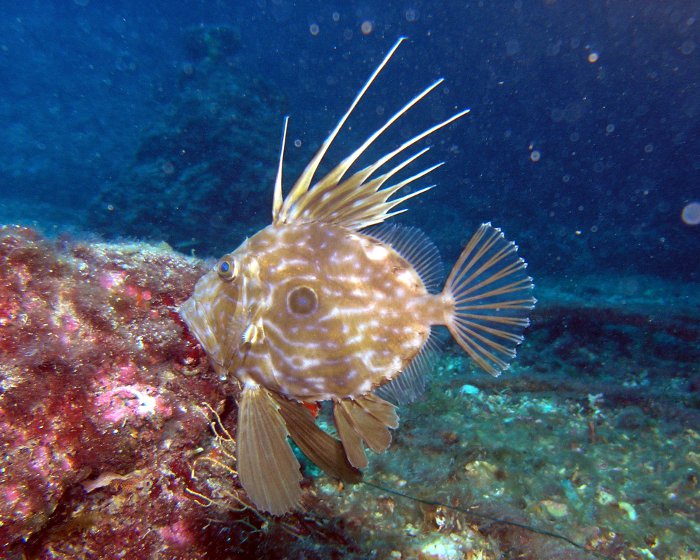
The John Dory is easily recognizable by its distinctive black spot and large fins
© Opossum sous licence Creative CommonsReproduction
The John Dory reproduces sexually and reaches sexual maturity at around 4 years of age. The female releases her eggs into the open water.
Did you know ?
According to legend, the French name Saint Pierre comes from the black spot found on each side of the fish, which is said to represent the imprint of the apostle Peter's thumb when he caught this fish and removed a stater, a gold coin of the time, from its mouth.
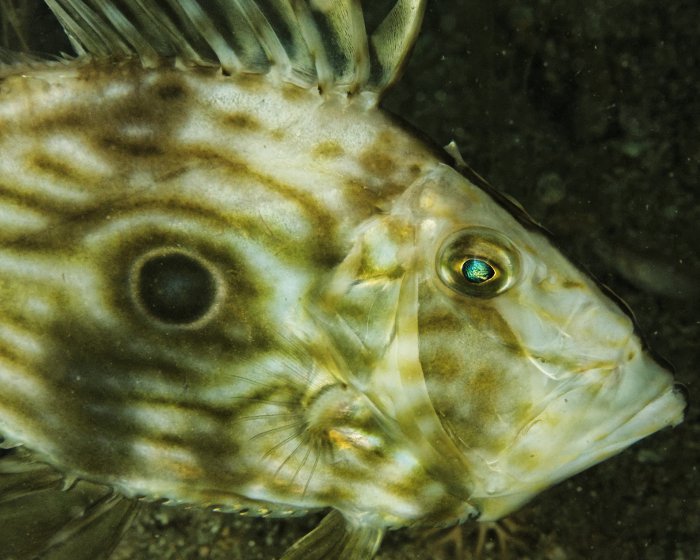
The John Dory gets its name from the black spot said to represent the imprint of the apostle Peter's thumb
Jesus said to him, « … go to the sea and cast a hook and take the first fish that comes up, and when you open its mouth you will find a shekel. …»
Excerpt from the Gospel according to Matthew, Chapter 17, verse 27
This distinctive mark is therefore said to have been passed down from generation to generation through the ages.
The john dory is listed as many other marine species within The
IUCN Red List of threatened species. The john dory appears in the
IUCN Red List since 2015 within the category Data Deficient !
Discover also
African coris
(Coris cuvieri)
Fourhorn poacher
(Hypsagonus quadricornis)
Longspine squirrelfish
(Holocentrus rufus)
Ocean triggerfish
(Canthidermis sufflamen)
Sharptail eel
(Myrichthys breviceps)
Singular bannerfish
(Heniochus singularius)
Undulated moray
(Gymnothorax undulatus)
Yellowtail damselfish
(Microspathodon chrysurus)
The marine species in the Mediterranean Sea
Dusky grouper
(Epinephelus marginatus)
European conger eel
(Conger conger)
Five-spotted wrasse
(Symphodus roissali)
Moon jellyfish
(Aurelia aurita)
Noble pen shell
(Pinna nobilis)
Purple-striped jelly
(Pelagia noctiluca)
Red starfish
(Echinaster sepositus)
Wide-eyed flounder
(Bothus podas)