Sealife guideThe horn sharkHeterodontus francisci
Last updated on 05/07/2026 at 10:12 PM
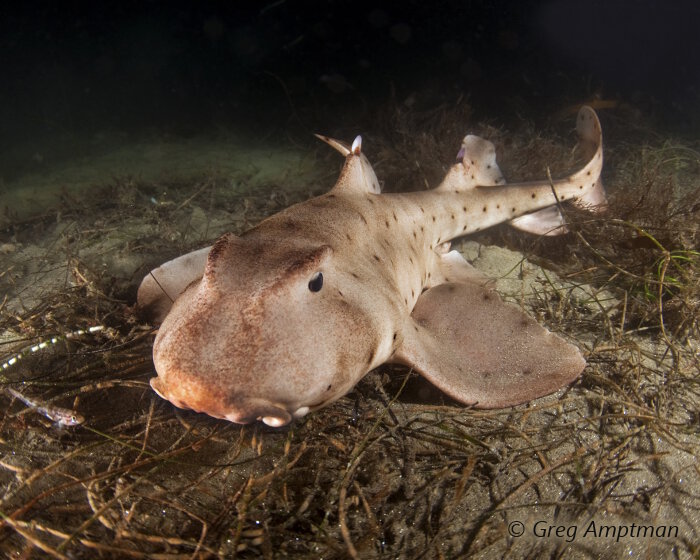
The horn shark is a small, discreet bottom-dwelling shark. Little known to the general public, it is one of the oldest shark species still living today, with a body shape very different from that of large ocean predators. Its name comes from the strong spines located in front of its dorsal fins, which serve as a natural defense against predators. Harmless to humans, it spends most of its time motionless on the seafloor or hidden in rocky crevices.
Taxonomy
- Common name: Horn shark, California horn shark
- French name: Requin dormeur cornu
- Spanish name: Dormilón cornudo
- Scientific name: Heterodontus francisci (Girard, 1855)
- Family name: Heterodontidae
- Order name: Heterodontiformes
- Class name: Elasmobranchii
Description
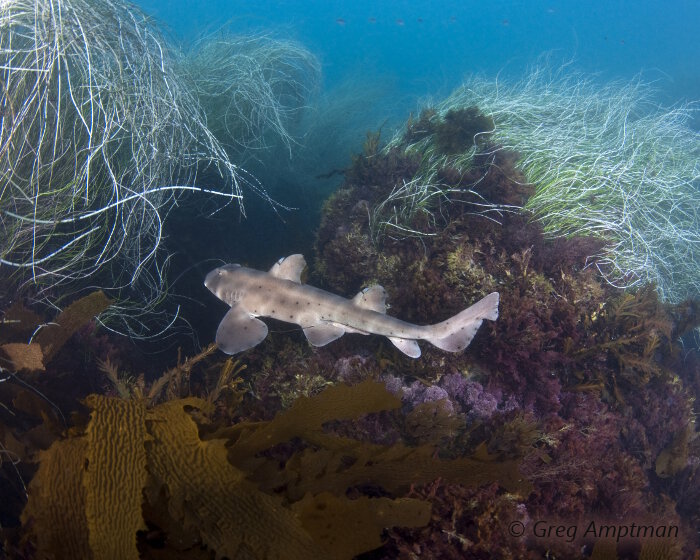
The horn shark has a stocky, robust body, usually brown or grayish-brown, covered with small dark spots that help it blend effectively into rocky bottoms. Its head is short, wide, and rounded, with prominent bony ridges above the eyes that give it a distinctive appearance.
It averages around 3.3 ft in length and weighs about 22 lb. Its mouth is equipped with specialized teeth: the front teeth are sharp for grabbing prey, while the back teeth are broad and flattened for crushing hard shells.
Its two dorsal fins are preceded by a rigid spine, a distinctive characteristic of the species.
Geographic range
The horn shark is found exclusively in the temperate and subtropical waters of the eastern Pacific ocean. It is mainly found along the west coasts of the United States and Mexico, from central California to the Gulf of California, with rarer sightings farther south toward Ecuador and Peru.
Habitat
The horn shark mainly inhabits rocky bottoms, coastal reefs, kelp forests, and sandy areas near rocks. It usually lives in shallow water, often at depths of less than 33 ft, although it can move much deeper depending on the season.
Nocturnal and rather sedentary, the horn shark spends its days hidden in caves, crevices, or under rocky ledges before coming out at night to feed.
Diet
The horn shark mainly feeds on animals living on the seafloor, such as sea urchins, crabs, shrimp,
mollusks, and sometimes small fish.
Thanks to its powerful jaws and crushing teeth, it can break the hard shells of its prey, which it mainly hunts at night while slowly moving across the seafloor in search of food.
Reproduction
The horn shark is an egg-laying shark. After mating, which takes place in winter, the female lays spiral-shaped egg cases that she wedges into rocky crevices for protection. These eggs take several months to develop before hatching. At birth, the young sharks are fully independent and immediately begin their lives on the seafloor. A female can lay up to about twenty eggs per breeding season.
Did you know ?
The horn shark is one of the few shark species capable of remaining motionless on the seafloor without having to swim constantly to breathe, a trait that allows it to conserve energy and live a discreet life on rocky reefs.
Within the same genus

Crested hornshark
(Heterodontus galeatus)
Japanese bullhead shark
(Heterodontus japonicus)

Port Jackson shark
(Heterodontus portusjacksoni)
Zebra bullhead shark
(Heterodontus zebra)
Discover also

Blotchy swell shark
(Cephaloscyllium umbratile)
Bonnethead shark
(Sphyrna tiburo)

Galapagos shark
(Carcharhinus galapagensis)
Greenland shark
(Somniosus microcephalus)

Oceanic whitetip shark
(Carcharhinus longimanus)

Silky Shark
(Carcharhinus falciformis)
Spotted wobbegong
(Orectolobus maculatus)
Tiger shark
(Galeocerdo cuvier)
The marine species from eastern Pacific ocean
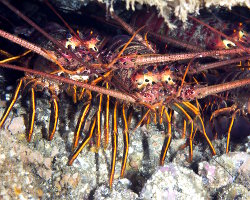
California spiny lobster
(Panulirus interruptus)
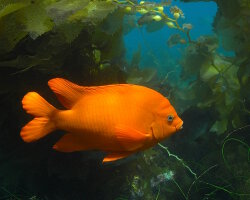
Garibaldi
(Hypsypops rubicundus)

Giant kelp
(Macrocystis pyrifera)

Giant tube worm
(Riftia pachyptila)
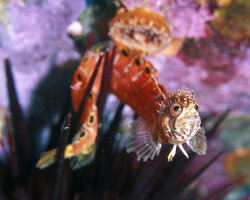
Mosshead warbonnet
(Chirolophis nugator)
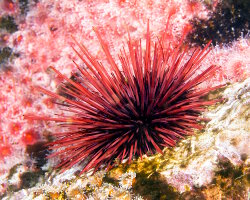
Red sea urchin
(Mesocentrotus franciscanus)

Sheep crab
(Loxorhynchus grandis)
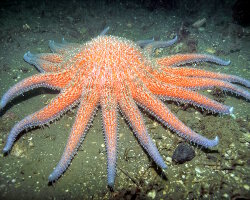
Sunflower sea star
(Pycnopodia helianthoides)