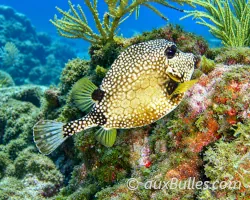
Sealife guideThe masked rabbitfishSiganus puellus
Last updated on 11/21/2026 at 12:51 AM
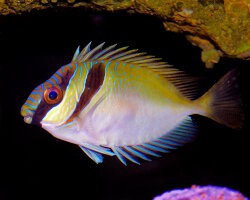
The masked rabbitfish (Siganus puellus) is a tropical fish recognizable by its yellow body adorned with blue lines and dark markings on its head. It inhabits Indo-Pacific coral reefs, where juveniles sometimes gather in schools, while adults generally live in pairs.
Taxonomy
English names
Masked rabbitfishMasked spinefoot
French namesPoisson-lapin masqué
Spanish namesConejo enmascarado
Scientific nameSiganus puellus (Schlegel, 1852)
Description
The masked rabbitfish has an elongated, oval-shaped body that is compressed laterally. Its yellow-orange coloration along the back gradually fades toward its belly, which has silvery-white tones. Its head features a distinctive dark band that helps identify the species.
Its dorsal and anal fins are equipped with venomous spines capable of inflicting painful injuries. These spines provide an effective defense against predators and are a good reason to avoid handling this fish.
Geographic range
The masked rabbitfish inhabits tropical waters of the Indo-Pacific region, from the Cocos (Keeling) Islands and the South China Sea to the Gilbert Islands. Its range extends north to the Ryukyu Islands and south to the southern
Great Barrier Reef and New Caledonia.
Habitat
The masked rabbitfish inhabits shallow waters, including lagoons, reef flats, and exposed offshore coral reefs. Juveniles prefer sheltered areas, often near branching corals of the genus Acropora, while adults also inhabit reef slopes and the edges of drop-offs at depths ranging from a few feet to around 100 feet.
Juvenile masked rabbitfish generally live in small groups before gradually pairing up as they reach adulthood. Adults then inhabit coral reefs in pairs, moving among coral formations in search of food.
Diet
Juvenile masked rabbitfish feed primarily on filamentous algae, which they graze on the substrate. As they grow, their diet becomes more varied, but
sponges become their main food source, supplemented by algae and tunicates.
Reproduction
The reproduction of the masked rabbitfish is still poorly understood. Available information does not allow researchers to determine its spawning seasons or the specifics of its embryonic development with certainty.
Did you know ?
Behind its brilliant colors and peaceful appearance, the masked rabbitfish hides a formidable defense ! Its dorsal and anal fin spines are venomous and can inflict particularly painful stings. It is best to admire this fish without trying to touch it.
Within the same genus
Discover also
The marine species in the Indo-Pacific