

Sealife guideThe blue blubber jellyfishCatostylus mosaicus
Last updated on 11/17/2026 at 10:25 PM
The mosaic jellyfish (Catostylus mosaicus) is a species found in tropical and warm-temperate waters of the western Indo-Pacific. It is recognized by its rounded, dome-shaped bell, which ranges in color from blue to creamy white, and its eight thick, branched oral arms, which give it a distinctive appearance.
Frequently spotted in Australian bays, lagoons and estuaries, it can form large aggregations near the coast. With no tentacles along the edge of its bell, it captures planktonic prey using the stinging cells found on its oral arms.
Taxonomy
English names
Blue blubber jellyfishJelly blubberBlue blubber
French namesMéduse de mer mosaïque
Scientific nameCatostylus mosaicus (Quoy & Gaimard, 1824)
FamilyCatostylidae
OrderRhizostomeae
ClassScyphozoa
Description
The mosaic jellyfish has a thick, rounded, dome-shaped bell resembling a mushroom. It can reach approximately 12 inches in diameter, with some individuals measuring up to 14 inches. Its coloration varies from bright blue to creamy white, sometimes with brownish or yellowish shades.

The blue blubber jellyfish (Catostylus mosaicus) © Irko Van Der Heide | Dreamstime.com
Hanging beneath its bell are eight thick, textured oral arms, each bearing several wing-shaped, branched appendages. Unlike many other jellyfish, it has no tentacles along the edge of its bell. Its stinging cells are mainly concentrated on the oral arms, which also capture food and transport it toward numerous small mouth openings.
Geographic range
The mosaic jellyfish is found throughout the western Indo-Pacific, from the waters of Pakistan and Southeast Asia to Australia. Its range includes the Torres Strait and extends along Australia's eastern coast as far south as Lord Howe Island.
It is particularly common along the coasts of Queensland, New South Wales and Victoria, where it can form large aggregations.
Habitat
The mosaic jellyfish mainly inhabits shallow coastal waters, sheltered bays, lagoons, harbors and estuaries. It is particularly abundant in semi-enclosed environments, especially near the mouths of rivers and streams.
It generally drifts in the upper layers of the water column, but can also be found offshore in open water. It tolerates variations in salinity and changes in environmental conditions commonly found in estuarine habitats.
Diet
The mosaic jellyfish feeds on small planktonic organisms, including copepods, fish larvae and eggs, as well as other small crustaceans. It captures its prey using stinging cells called nematocysts, located on its eight oral arms.
Food particles are then transported to numerous small mouth openings distributed along these arms. Unlike jellyfish with a single mouth opening in the center of their underside, rhizostome jellyfish such as this species have multiple openings through which they ingest food.
Reproduction
The mosaic jellyfish has a life cycle typical of jellyfish in the class Scyphozoa, alternating between sexual and asexual stages. Adult jellyfish reproduce sexually and produce larvae called planulae. In this species, observations suggest that the larvae are brooded by the adults before being released. They then attach to an underwater surface and develop into small polyps called scyphistomae.

The blue blubber jellyfish (Catostylus mosaicus) © Aleksandar Varbenov | Dreamstime.com
Scyphistomae reproduce asexually through budding, division or the formation of small resistant structures called podocysts. When conditions are favorable, the polyp transforms into a strobila and releases young jellyfish known as ephyrae. These gradually grow in the water column until they become reproductive adults.
Discover also

Acropora cythereacoralAcropora cytherea

Blue jellyfishCyanea lamarckii

Common sea fanGorgonia ventalina

Magnificent sea anemoneRadianthus magnifica
Portuguese man of warPhysalia physalis
Purple-striped jellyPelagia noctiluca
Purple gorgonianParamuricea clavata

Slimy sea plumeAntillogorgia americana
The marine species in the western Indo-Pacific

Best scuba diving destinations

Our latestUpdates

Miami, in the footsteps of Vice City and GTA VIDiscover Miami, the real-life inspiration behind GTA Vice City and GTA VI. Explore South Beach, Ocean Drive, Brickell, Wynwood, the Florida Keys, and the Everglades, from iconic landmarks and vibrant neighborhoods to tropical landscapes.Read more
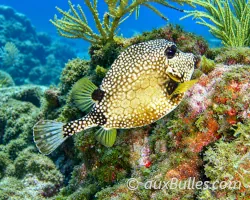
The smooth trunkfishDiscover the smooth trunkfish (Rhinesomus triqueter), a reef-dwelling fish from the tropical western Atlantic. Its angular body, protected by a bony carapace, features a dark coloration with white spots and distinctive honeycomb patterns.Read more
A tense finish in the CaribbeanA look back at the 2026 Route du Rhum finish: Tom Laperche wins the Ultim class as the leading boats arrive and close battles continue across the other fleets.Read more
Photo of the Day

Lamantin de Floride
(Trichechus manatus latirostris)
(Trichechus manatus latirostris)
 Copyright © 2007-2026 auxBulles.com - All rights reserved. Legal notices.
Photo credits - Our partners