Sealife guideThe halfspotted grouperCephalopholis hemistiktos
Last updated on 09/18/2026 at 11:46 PM
The halfspotted grouper (Cephalopholis hemistiktos) is a small grouper found on reefs in the Red Sea and the waters surrounding the Arabian Peninsula. Its yellowish-brown to reddish body is covered with small blue spots, mainly concentrated on the lower part of the body and on the head, which helps distinguish it from several closely related species.
This territorial species generally lives alone or in pairs and mainly feeds on small fish and crustaceans.
Taxonomy
- Common name: Halfspotted grouper
- French name: Vieille d'Arabie
- Spanish name: Cherna arábiga
- Scientific name: Cephalopholis hemistiktos (Rüppell, 1830)
- Family name: Epinephelidae
- Order name: Perciformes
- Class name: Actinopterygii
Description
The halfspotted grouper has a robust body that is slightly compressed from side to side, a large head, and a wide mouth. Its coloration ranges from yellowish brown to light red or dark brown. It has numerous small blue spots surrounded by a thin dark border on the head and lower part of the body, while the upper part of the body is almost devoid of them. Its rounded caudal fin is also covered with blue spots and edged with a bright blue margin.
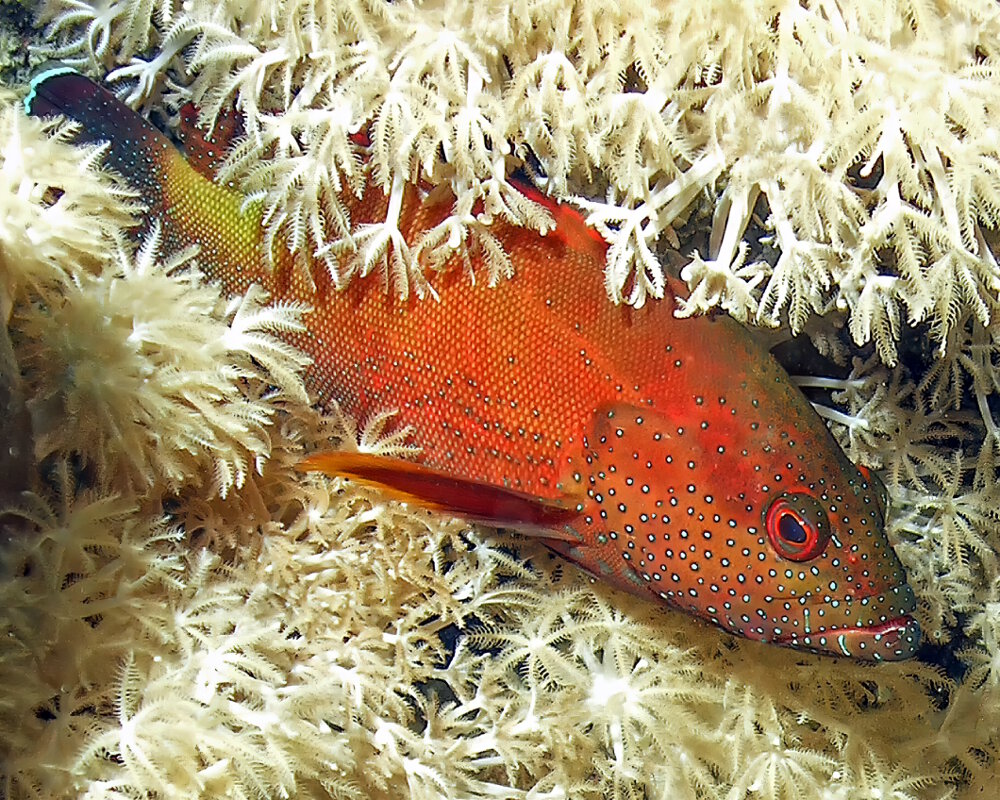
Small blue spots surrounded by a thin dark border, characteristic of the halfspotted grouper (Cephalopholis hemistiktos)
© Rob Atherton | Dreamstime.comColoration can vary from one individual to another. Some have a large yellowish area toward the rear of the body, while others display several faint dark bands. The halfspotted grouper averages around 9 inches in length, but the largest individuals can reach up to 14 inches in total length.
Geographic range
The halfspotted grouper inhabits the tropical waters of the northwestern Indian Ocean, from the northern end of the Red Sea, particularly the Gulf of Aqaba and Gulf of Suez, to the Gulf of Aden and Arabian Sea, along the coasts of Djibouti, Somalia, and Oman. It is also found in the Persian Gulf and extends eastward to the coast of Pakistan.
It is found in particular in the Red Sea, Egypt, Saudi Arabia, Yemen, Oman, the waters of the United Arab Emirates and Qatar, as well as the Persian Gulf.
Habitat
The halfspotted grouper lives on coral reefs and rocky seafloors, where it inhabits areas combining corals with open spaces. It is generally found between 49 and 66 feet deep, but can be observed down to depths of around 180 feet.
The halfspotted grouper is sedentary and generally remains within the same area of the reef, which it defends against other fish. Adults often live in pairs, although some individuals may be observed alone.
Diet
The halfspotted grouper mainly feeds during the day, mostly on small fish, which account for about two-thirds of its diet, as well as
crustaceans such as shrimp and crabs.
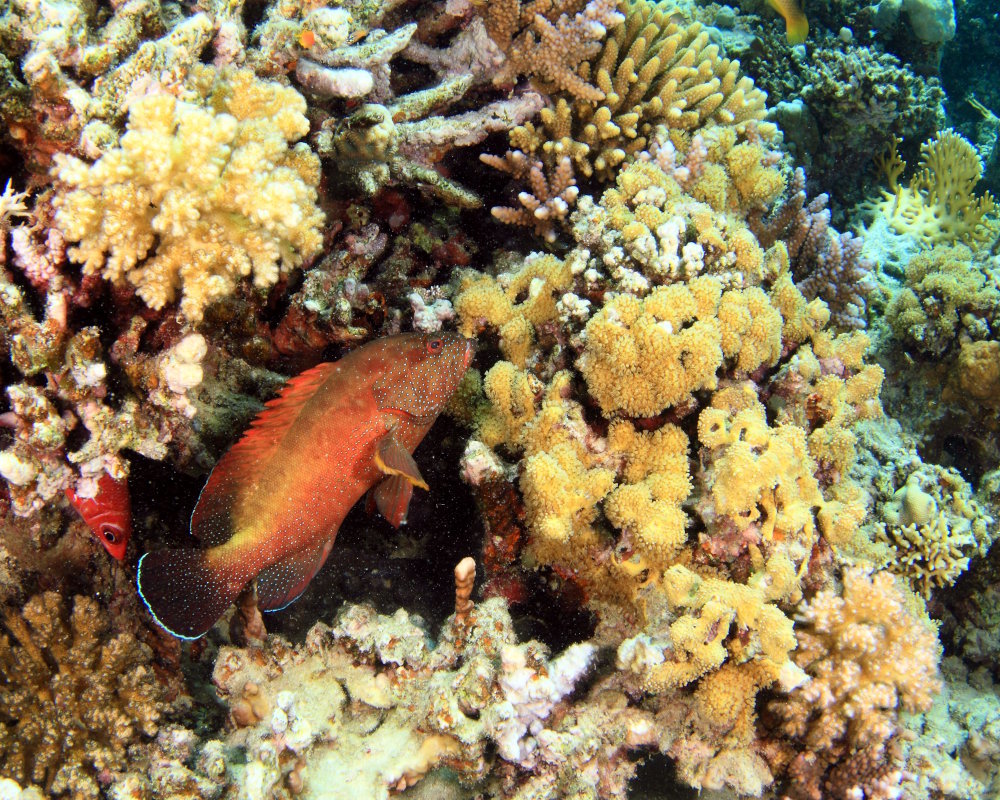
A halfspotted grouper (
Cephalopholis hemistiktos) hiding in a crevice in the coral reef in Marsa Alam, Red Sea, Egypt
© Petr Zamecnik | Dreamstime.comIt hunts near the reef and captures prey that comes within reach.
Reproduction
The halfspotted grouper displays an unusual reproductive behavior among groupers: it is monogamous, meaning that a male and female form a pair that remains together. The two partners defend their territory together rather than living in a harem like some other species of the same genus.
Did you know ?
The halfspotted grouper is monogamous. It lives as a pair, with a male and female defending the same territory together. This lifestyle differs from that of some closely related species, which live in groups consisting of one male and several females.
Tips for observing
The halfspotted grouper can easily be distinguished from the
coral hind (
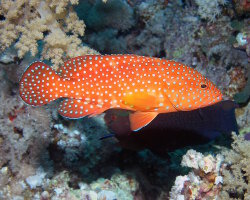
Cephalopholis miniata) when observed up close: its blue spots are mainly concentrated on the head and lower part of the body, whereas those of the coral grouper are found across the entire body and fins. This difference is particularly useful for distinguishing the two species in the Red Sea.
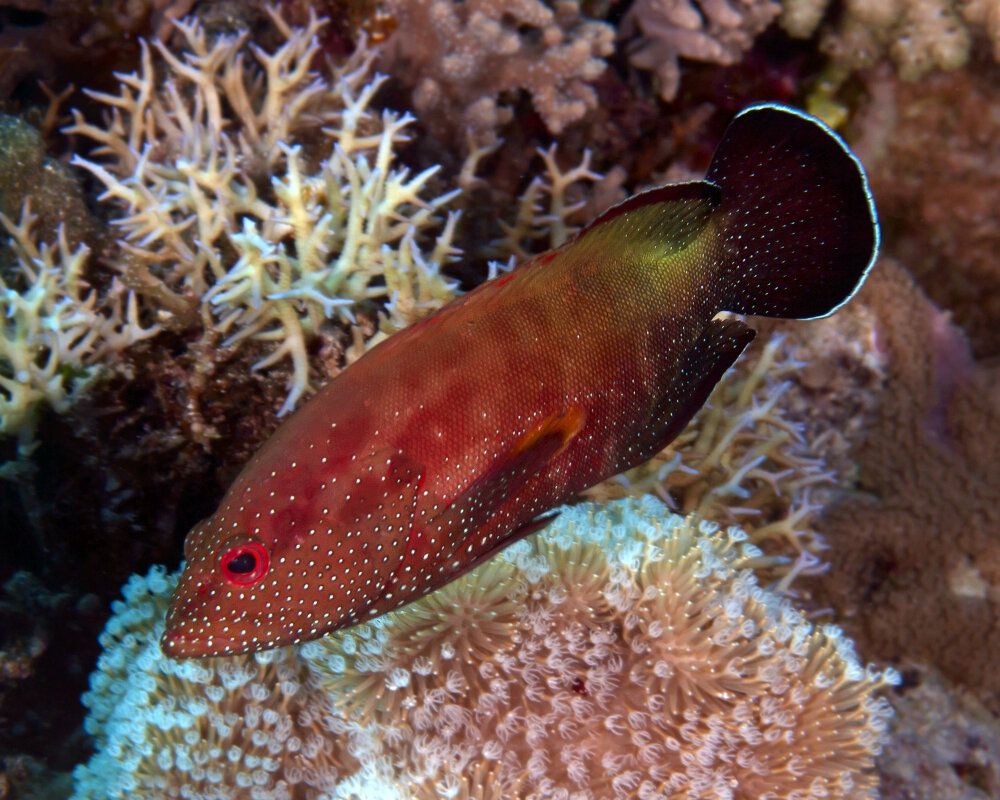
The halfspotted grouper can be distinguished from the coral grouper by its blue spots, which are mainly concentrated on the head and lower part of the body
© Orlandin | Dreamstime.comWithin the same genus
Bluespotted grouper
(Cephalopholis cyanostigma)
Coney
(Cephalopholis fulva)
Coral hind
(Cephalopholis miniata)
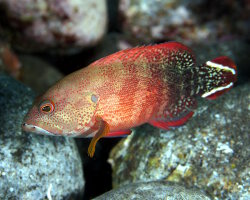
Darkfin hind
(Cephalopholis urodeta)

Graysby
(Cephalopholis cruentata)
Pacific creolefish
(Cephalopholis colonus)
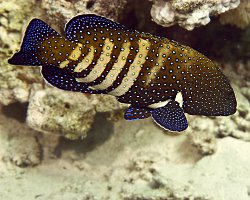
Peacock grouper
(Cephalopholis argus)
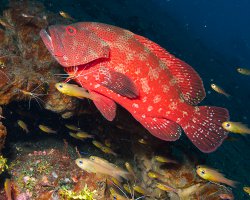
Tomato grouper
(Cephalopholis sonnerati)
Within the same family
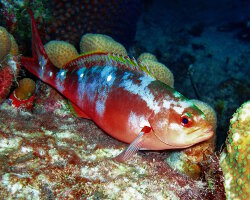
Atlantic creolefish
(Paranthias furcifer)
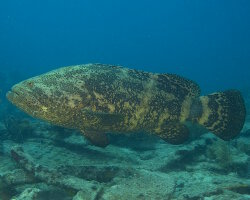
Atlantic Goliath Grouper
(Epinephelus itajara)

Gag grouper
(Mycteroperca microlepis)
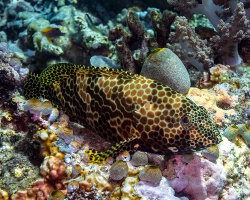
Honeycomb grouper
(Epinephelus merra)
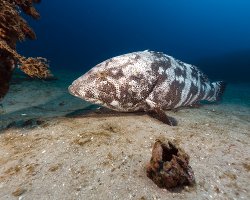
Malabar grouper
(Epinephelus malabaricus)
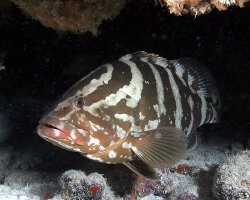
Nassau grouper
(Epinephelus striatus)
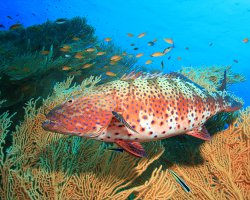
Roving coral grouper
(Plectropomus pessuliferus)
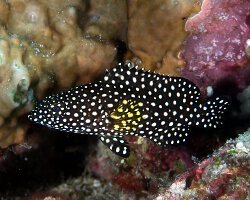
Speckledfin grouper
(Epinephelus ongus)
Discover also
Aron's blenny
(Ecsenius aroni)
Blackspot razorfish
(Iniistius dea)
Garibaldi damselfish
(Hypsypops rubicundus)
Manybar goatfish
(Parupeneus multifasciatus)
Orangespine unicornfish
(Naso lituratus)
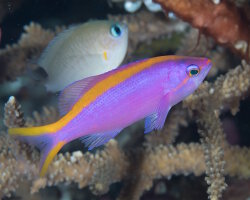
Purple anthias
(Pseudanthias tuka)

Roman seabream
(Chrysoblephus laticeps)
Saddled seabream
(Oblada melanurus)
The marine species in the Red Sea
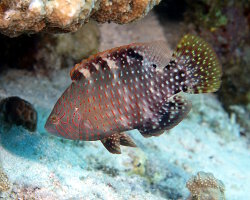
Abudjubbe wrasse
(Cheilinus abudjubbe)
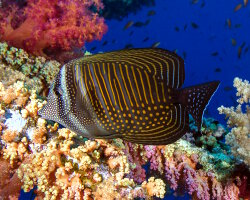
Indian sailfin surgeonfish
(Zebrasoma desjardinii)
Moon jellyfish
(Aurelia aurita)
Orangespine unicornfish
(Naso lituratus)
Red sea thicklip wrasse
(Hemigymnus sexfasciatus)
Scrawled filefish
(Aluterus scriptus)
Yellow-spotted triggerfish
(Pseudobalistes fuscus)
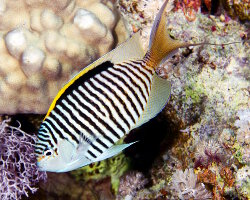
Zebra angelfish
(Genicanthus caudovittatus)