

Sealife guideThe tomato grouperCephalopholis sonnerati
Last updated on 08/24/2026 at 10:41 PM
The tomato grouper (Cephalopholis sonnerati) is a widely distributed fish found in the tropical waters of the Indo-Pacific. Despite its name, its coloration is not always bright red: adults can display reddish, orange-brown, or yellowish-brown tones, often covered with numerous small, darker spots. This grouper mainly lives around reefs and rocky seafloors, where it leads a rather solitary life and ambushes small fish and crustaceans.
The tomato grouper is a reef predator that spends much of its life in relatively deep areas, making it less frequently observed while diving than many other reef fish. Its biology also has a remarkable characteristic: like several other grouper species, it is capable of changing sex during its lifetime.
Taxonomy
English names
Tomato grouper
French namesMérou tomate
Spanish namesCherna piña
Scientific nameCephalopholis sonnerati (Valenciennes, 1828)
FamilyEpinephelidae
OrderPerciformes
ClassActinopterygii
Description
The tomato grouper has a robust, relatively deep body that is laterally compressed, with a large head and a wide mouth characteristic of groupers. Its dorsal fin has nine spines followed by 14 to 16 soft rays, while its anal fin has three spines and nine soft rays. Its rounded caudal fin is also a recognizable feature. In adults, coloration ranges from orange-red to reddish brown or yellowish brown depending on the region, with numerous small red, brown, whitish, or purplish spots on the head, body, and fins. Juveniles are generally much darker, sometimes almost black, with pale markings toward the rear of the caudal fin.
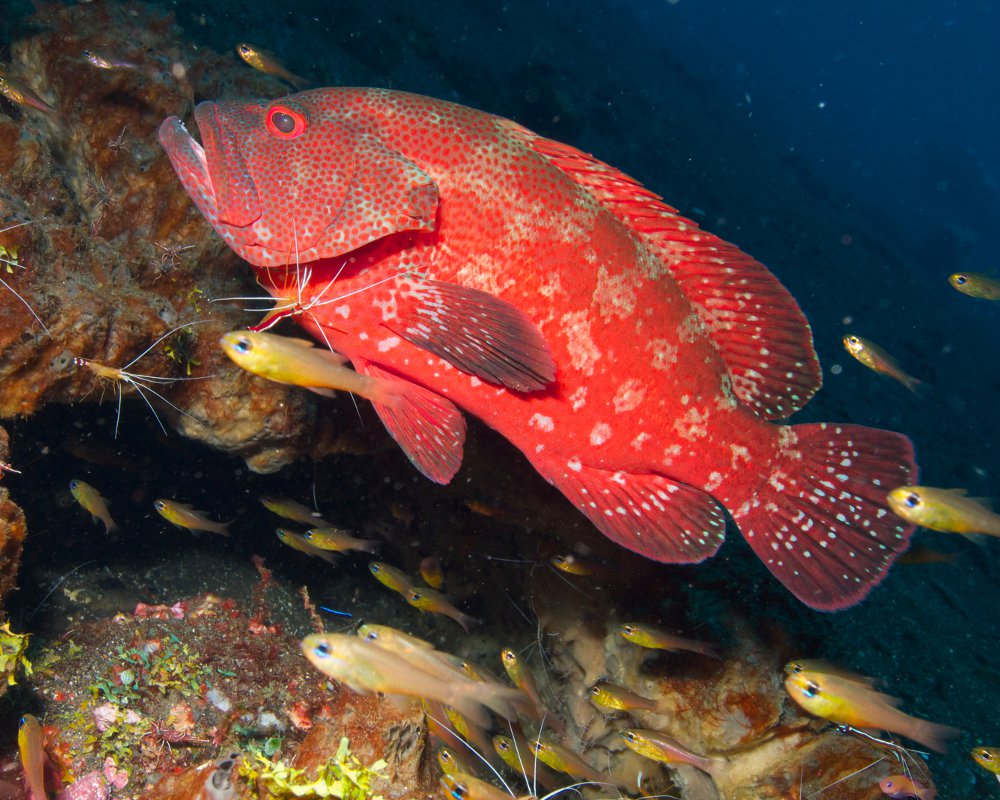
A tomato grouper being cleaned by a skunk cleaner shrimp, surrounded by cardinalfish at a cleaning station in Tulamben, Bali © Stephankerkhofs | Dreamstime.com
The tomato grouper can reach a maximum length of about 20 inches. Its powerful body and large mouth allow it to quickly capture prey that passes nearby. As in many groupers, its morphology is particularly well adapted to ambush hunting from a cavity or shelter on the reef.
Geographic range
The tomato grouper is found in tropical and subtropical waters of the Indo-Pacific, from the eastern coast of Africa, particularly from Djibouti and Socotra south to South Africa, and eastward to the Line Islands. To the north, it occurs as far as southern Japan and, to the south, as far as Queensland, Australia. It is found in many regions of Indonesia, the Philippines, and the western Pacific.
Habitat
The tomato grouper mainly inhabits coral reefs in deep lagoons, steep outer reef slopes, and rocky coastal areas. It generally lives between 98 and 328 feet deep, but it can be found down to about 492 feet and, in some regions such as Madagascar, in shallower waters between 33 and 66 feet.
Adults generally live alone and seek out areas of the reef where they can shelter in large cavities. These shelters can also serve as cleaning stations, where cleaner shrimp remove parasites and debris from their bodies. Juveniles tend to live near sponges or corals, which provide suitable shelter for their smaller size.
Diet
The tomato grouper is a carnivorous predator that mainly feeds on small fish and crustaceans. Its diet includes shrimp and crabs, which it generally captures near its shelter. Like other groupers, it can use its camouflage and concealed position to approach prey before capturing it by surprise.
The tomato grouper uses a particularly effective hunting technique: its large mouth allows it to rapidly suck in prey located nearby.
Reproduction
The tomato grouper is a protogynous hermaphrodite: individuals begin their reproductive lives as females, and some later become males. This characteristic allows a population to maintain enough females while still having breeding males as individuals reach a larger size.
Reproduction takes place in open water, with gametes released into the water, where fertilization occurs. The fertilized eggs then drift in the water column, where they continue to develop.
Did you know ?
The tomato grouper is listed as many other marine species within The IUCN Red List of threatened species. The tomato grouper appears in the IUCN Red List since 2018 within the category Least Concern !
Within the same genus


Within the same family




Discover also



The marine species in the Indo-Pacific




Our latestUpdates
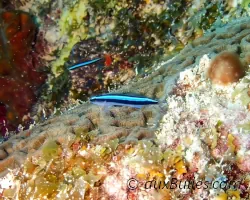
The neon gobyDiscover the neon goby (Elacatinus oceanops), a small western Atlantic reef fish known for its brilliant blue stripe and its role as a cleaner fish that removes parasites from other fish.Read more
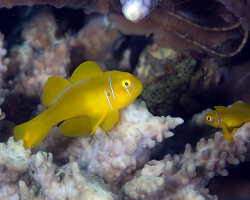
The poison gobyDiscover the poison goby (Gobiodon citrinus), a tiny reef fish with a bright yellow body and distinctive blue markings. It lives among branching Acropora corals in the tropical waters of the Indo-Pacific.Read more
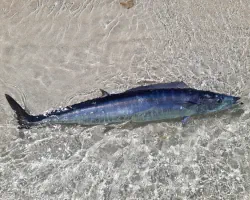
The wahooDiscover the wahoo (Acanthocybium solandri), a powerful pelagic predator found in tropical and subtropical oceans. Recognizable by its streamlined body and distinctive blue vertical stripes, it is a fast swimmer that feeds mainly on fish and squid.Read more
Photo of the Day

Fou à pieds rouges
(Sula sula)
(Sula sula)
 Copyright © 2007-2026 auxBulles.com - All rights reserved. Legal notices.
Photo credits - Our partners