

Sealife guideThe gilthead seabreamSparus aurata
Last updated on 09/22/2026 at 12:17 AM
The gilthead seabream (Sparus aurata) is a coastal fish easily recognized by the golden band between its eyes. Very common in the Mediterranean and found along the eastern Atlantic coast, it inhabits sandy and rocky bottoms as well as seagrass beds. Thanks to its powerful teeth, it crushes shellfish, crustaceans, and other small animals living on the seafloor.
Taxonomy
English names
Gilthead seabream
French namesDaurade royale
Spanish namesDorada
Scientific nameSparus aurata (Linnaeus, 1758)
FamilySparidae
OrderPerciformes
ClassActinopterygii
Description
The gilthead seabream averages about 8 to 20 in in length and weighs between 4.2 oz and 4.9 lb. Its oval-shaped body is compressed and fairly broad in relation to its length. Its head is characterized by small eyes, a rounded forehead, and a low-set mouth with sharp teeth.

The gilthead seabream (Sparus aurata) is a coastal fish easily recognized by the golden band between its eyes © Seadam | Dreamstime.com
The gilthead seabream is silvery gray, with a large black spot on each side of its body at the base of the lateral line and extending onto the upper part of its gill cover. Finally, a golden band edged in black separates its two eyes and has earned it the nickname « the beauty with golden eyebrows ».
Geographic range
The gilthead seabream is found in the temperate waters of the northeastern Atlantic, from Senegal in the south to Great Britain in the north, along the coasts of Morocco, Portugal, Spain, and France, including the Bay of Biscay. It is also found throughout the Mediterranean Sea and is rather rare in the Black Sea.
Habitat
The gilthead seabream can be found both offshore and close to shore, including in the brackish waters of lagoons and estuaries, particularly during its juvenile stage.
The gilthead seabream inhabits Posidonia seagrass beds as well as rocky and sometimes sandy areas at depths of up to about 98 ft and occasionally as deep as 164 ft.
Diet
The gilthead seabream feeds on small fish as well as small crustaceans and shellfish, whose shells and exoskeletons it can crush with its specialized teeth.

The gilthead seabream is silvery gray, with a large black spot on each side of its body at the base of the lateral line © Seadam | Dreamstime.com
Reproduction
The gilthead seabream is a hermaphroditic fish that is born male and later becomes female depending on the social conditions of the group in which it lives. In particular, the presence of young males triggers older males to change sex and become females, while an excess of older females slows this change in males.
The female lays her eggs offshore in the open sea. After hatching, the juveniles move into coastal waters, where they can find shelter and more easily access food resources.
Did you know ?
The gilthead seabream is commercially fished and is also farmed in the Mediterranean Sea because it quickly adapts to aquaculture conditions. Global gilthead seabream aquaculture production reached about 205 million lb in 2016, with Greece as the leading producer.

The gilthead seabream has a distinctive head with small eyes, a rounded forehead, and a low-set mouth with sharp teeth © Seadam | Dreamstime.com
The female can lay up to 80,000 eggs per day for a period lasting up to 4 months.
The gilthead seabream can reach up to 27.6 in in length and weigh up to 17.6 lb.
The gilthead seabream is listed as many other marine species within The IUCN Red List of threatened species. The gilthead seabream appears in the IUCN Red List since 2014 within the category Least Concern !
Within the same family

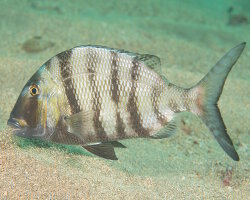
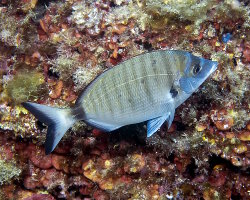

Discover also




The marine species in the Northeastern Atlantic

Our latestUpdates
The neon gobyDiscover the neon goby (Elacatinus oceanops), a small western Atlantic reef fish known for its brilliant blue stripe and its role as a cleaner fish that removes parasites from other fish.Read more
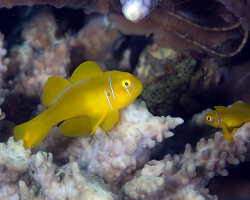
The poison gobyDiscover the poison goby (Gobiodon citrinus), a tiny reef fish with a bright yellow body and distinctive blue markings. It lives among branching Acropora corals in the tropical waters of the Indo-Pacific.Read more
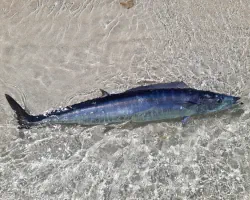
The wahooDiscover the wahoo (Acanthocybium solandri), a powerful pelagic predator found in tropical and subtropical oceans. Recognizable by its streamlined body and distinctive blue vertical stripes, it is a fast swimmer that feeds mainly on fish and squid.Read more
Photo of the Day

Fou à pieds rouges
(Sula sula)
(Sula sula)
 Copyright © 2007-2026 auxBulles.com - All rights reserved. Legal notices.
Photo credits - Our partners