Sealife guideThe common European lobsterHomarus gammarus
Last updated on 08/24/2026 at 10:41 PM
The common European lobster (Homarus gammarus) is a large crustacean, recognizable by its mottled dark blue shell and two powerful claws. Highly prized for its meat, it mainly lives on the rocky seafloors of European coasts, where it generally remains hidden in a cavity during the day before emerging at night to search for food. It is a rather solitary and territorial species that can reach an impressive size.
The common European lobster mainly inhabits the cold and temperate waters of the Northeast Atlantic, but it is also found in the Mediterranean Sea and some areas of the Black Sea. Its secretive lifestyle and nocturnal habits make it fairly difficult to observe in its natural environment.
Taxonomy
English names
Common European lobster
French namesHomard européen
Scientific nameHomarus gammarus (Linnaeus, 1758)
Description
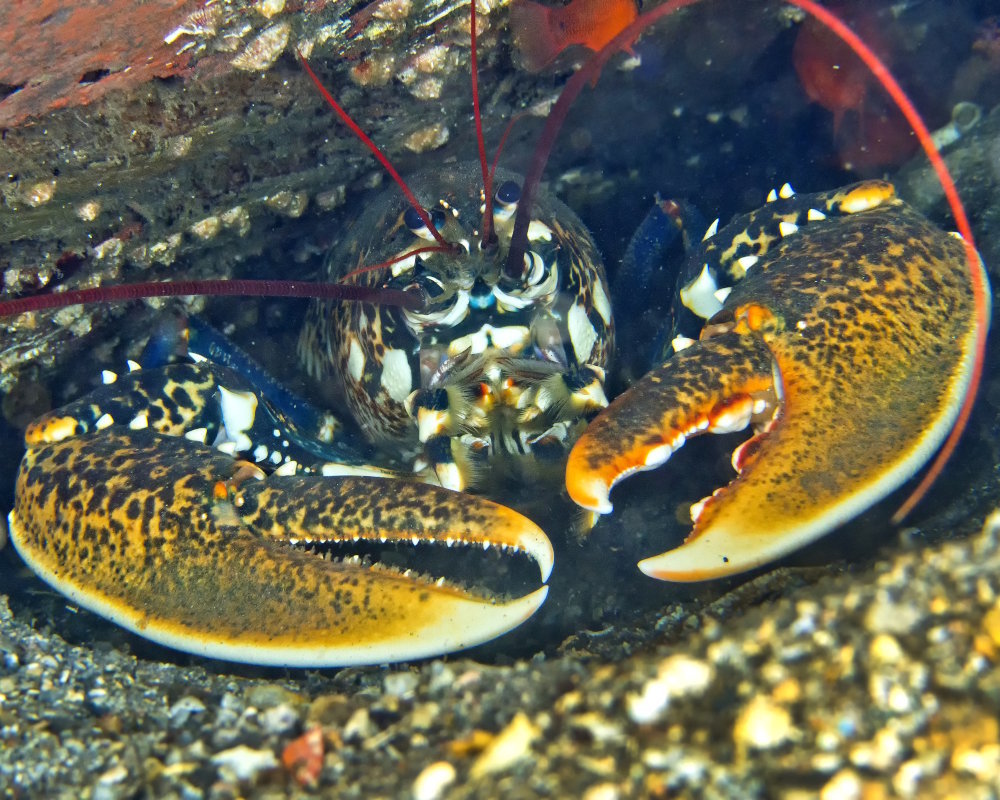
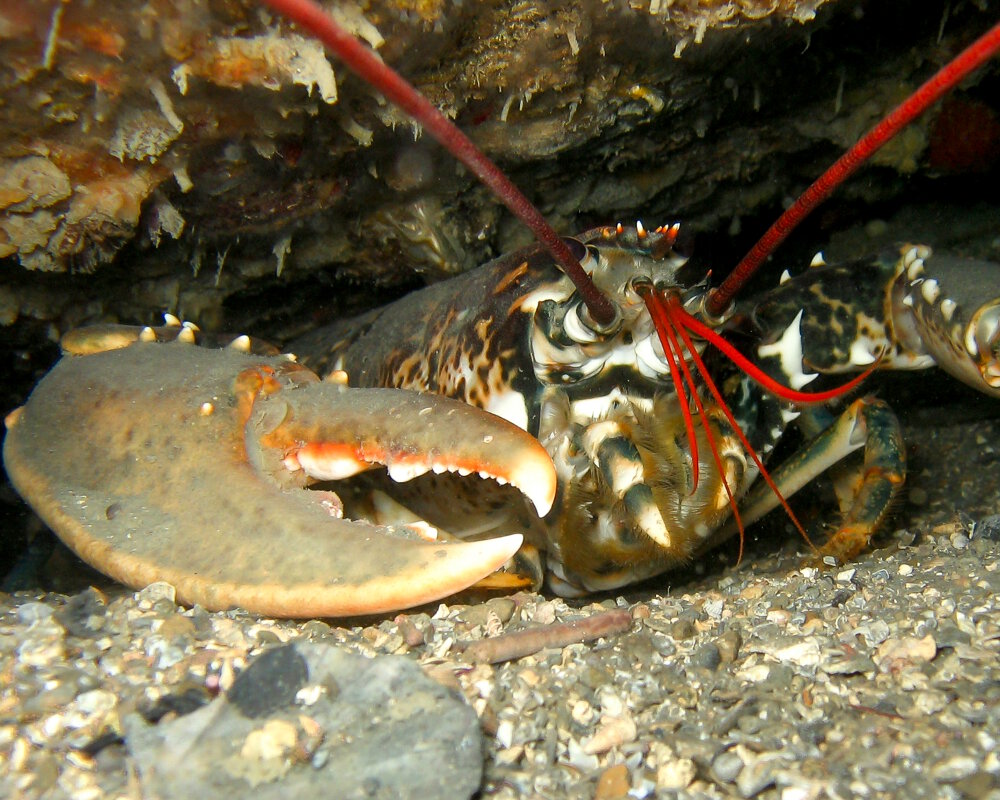
The common European lobster has an elongated body protected by a robust shell, generally dark blue to bluish black and mottled with lighter shades. Its first pair of legs bears two large asymmetrical claws, one primarily adapted for cutting and the other for crushing. Long antennae allow it to explore its surroundings, while its tapered rostrum, located between the eyes, bears several teeth along its edges. The segments of its abdomen are smooth and end in a broad fan-shaped tail. Adults generally measure several dozen centimeters in length, and the largest individuals can reach about 24 inches in total length.
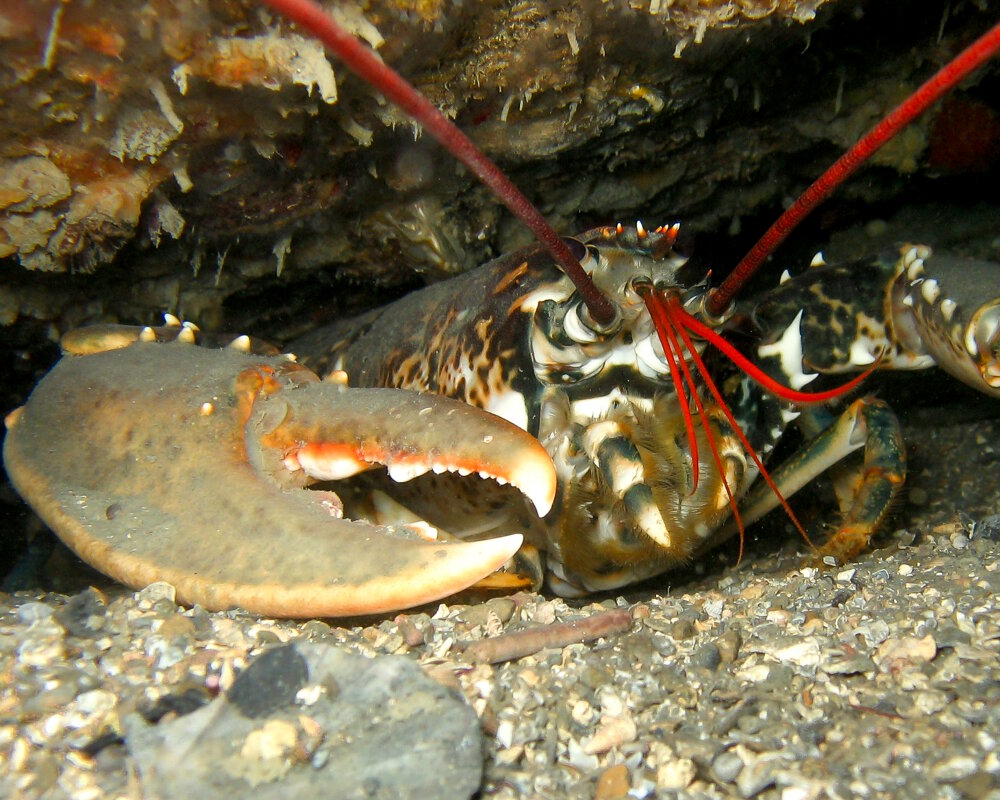
The common European lobster (Homarus gammarus) is a large crustacean, recognizable by its mottled dark blue shell and two powerful claws © Erik Junberger
The characteristic blue coloration of the common European lobster can nevertheless vary between individuals and depending on viewing conditions. Like all crustaceans, it must regularly shed its old shell to grow, a process called molting. Immediately after molting, its body is particularly vulnerable because its new shell is still soft.
Geographic range
The common European lobster inhabits the cold and temperate coastal waters of the Northeast Atlantic, from the coast of Norway to Morocco, including the British Isles, the North Sea, and the French coast. It is also found in the Azores, the Mediterranean Sea, mainly in its western and central regions, as well as the northwestern Black Sea. However, it is absent from the easternmost parts of the Mediterranean, beyond Crete.
Habitat
The common European lobster mainly lives on rocky seafloors, where cracks, cavities, and crevices provide shelter. It can also inhabit sufficiently firm soft-bottom areas, but it generally seeks places where it can hide and defend its territory. It is mainly observed from a few feet down to 164 feet, although it can be found at depths of up to about 492 feet.
The common European lobster is a sedentary and territorial species that spends much of the day sheltered in a cavity or crevice. It becomes most active at night, when it leaves its refuge to roam the seafloor in search of food. This nocturnal and secretive behavior makes it difficult to observe, particularly while diving.
Diet
The common European lobster is an opportunistic predator that feeds mainly on animals living on the seafloor. Its diet includes
crustaceans,
mollusks, and
marine worms, but it may also consume
echinoderms such as
sea urchins and starfish, as well as fish or dead animals. It may also ingest small amounts of plant material.
Its powerful claws play an essential role in feeding. The cutting claw allows it to grasp and cut certain prey, while the crushing claw is particularly well suited to organisms protected by a shell or exoskeleton. It then uses its mouthparts to break the food into smaller pieces before ingesting it.
Reproduction
common European lobster breeding generally takes place in summer, shortly after the female molts, while her new shell is still soft. After mating, the female carries the eggs beneath her abdomen, where they remain attached to her appendages for about 10 to 11 months. The eggs develop gradually, meaning that egg-bearing females can be observed during much of the year.
When they hatch, young lobsters are very different from adults. The larvae initially live in the plankton and pass through three successive stages during which they grow and molt. They then transform into postlarvae that move closer to the seafloor and gradually begin their benthic life. They become small lobsters and seek out shelters where they can grow protected from predators. Juvenile survival is very low, but a small proportion will eventually reach adulthood.
Did you know ?
The common european lobster is listed as many other marine species within The
IUCN Red List of threatened species. The common european lobster appears in the
IUCN Red List since 2011 within the category Least Concern !
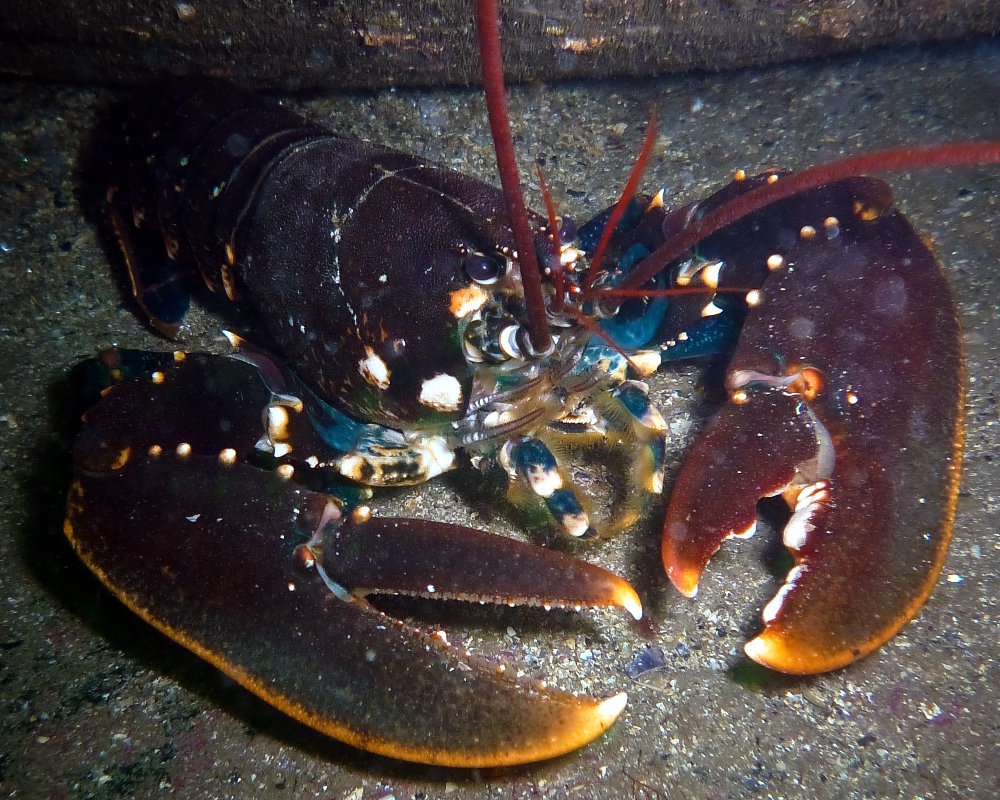
The common European lobster (Homarus gammarus) fully visible © Erik Junberger
Discover also
Atlantic horseshoe crab
(Limulus polyphemus)
Calling fiddler crab
(Uca vocans)
Corallimorph decorator crab
(Cyclocoeloma tuberculata)
Feather star squat lobster
(Allogalathea elegans)
Green clinging crab
(Mithraculus sculptus)
Red-spotted guard crab
(Trapezia tigrina)
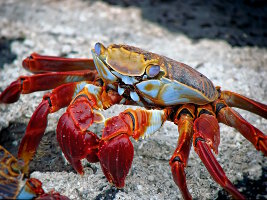
Red rock crab
(Grapsus grapsus)
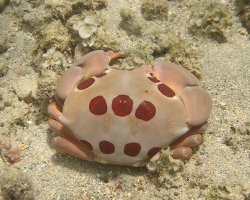
Seven-eleven crab
(Carpilius maculatus)
The marine species in the Northeastern Atlantic
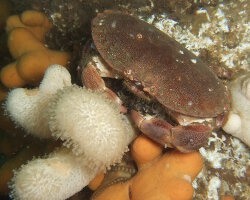
Edible crab
(Cancer pagurus)
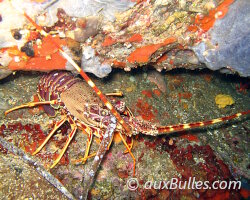
European spiny lobster
(Palinurus elephas)
Gilthead seabream
(Sparus aurata)

Great Atlantic scallop
(Pecten maximus)
Portuguese man of war
(Physalia physalis)
Thornback ray
(Raja clavata)