

Sealife guideThe Atlantic mackerelScomber scombrus
Last updated on 10/16/2026 at 12:25 AM

The Atlantic mackerel (Scomber scombrus) © Marina And Anna Luisa Durante | Dreamstime.com
The Atlantic mackerel (Scomber scombrus) is a pelagic marine fish in the mackerel family, Scombridae, which also includes tunas and bonitos. Recognizable by its blue-green back marked with black stripes and its silvery sides, it lives in schools in the temperate waters of the North Atlantic.
Fast and active, it moves with the seasons and changes in water temperature, sometimes forming large schools near the surface. It plays an important role in marine food webs, both as a predator of small animals and as prey for larger fish and marine mammals.
Taxonomy
English names
Atlantic mackerel
French namesMaquereau commun
Spanish namesCaballa del Atlántico
Scientific nameScomber scombrus (Linnaeus, 1758)
FamilyScombridae
OrderPerciformes
ClassActinopterygii
Description
The Atlantic mackerel has a streamlined body that tapers at both ends, allowing it to move quickly through the water. Its metallic blue-green back is marked with dark, wavy or slanted lines, while its sides and belly are silvery and unspotted. It commonly measures around 12 inches in length, but the largest individuals can reach 20 to 24 inches.
Its two dorsal fins are widely separated, and its tail fin is deeply forked. Small additional fins, called finlets, extend along the back and underside behind the dorsal and anal fins toward the tail. Unlike many fish, it does not have a swim bladder.
Geographic range
The Atlantic mackerel inhabits the North Atlantic Ocean, from the cold waters near Canada and Greenland to the temperate waters of Europe and North Africa. It occurs on both sides of the ocean and in some neighboring seas, including the North Sea and the Mediterranean Sea.
Its distribution changes throughout the year. Populations migrate between wintering grounds, often offshore in deeper waters, and feeding or spawning grounds, which are generally closer to shore as the water warms.
Habitat
The Atlantic mackerel is a pelagic fish that lives mainly in open water over the continental shelf, in cold to temperate waters. It often forms large schools near the surface, grouping individuals of similar size. Depending on the season and environmental conditions, it may also move into deeper waters, particularly in winter.
Diet
The Atlantic mackerel feeds mainly on small organisms in the water column, particularly planktonic crustaceans such as copepods and krill. It also eats shrimp, squid, and small fish, including herring, sardines, and sprats.
Reproduction
The Atlantic mackerel is an egg-laying fish that spawns in open water. During spawning, females release their eggs into the sea, where they are fertilized by males. The eggs then drift in the water column, and their development depends in part on water temperature.
Spawning generally takes place in spring and summer in the North Atlantic, although the timing varies by region and population. Females release several batches of eggs during a single season. After hatching, the larvae initially live among the plankton before growing and gradually joining schools of young mackerel.
Did you know ?
The Atlantic mackerel does not have a swim bladder, a gas-filled organ that helps many fish regulate their buoyancy. As a result, it must keep swimming actively to remain in the water column.
The atlantic mackerel is listed as many other marine species within The IUCN Red List of threatened species. The atlantic mackerel appears in the IUCN Red List since 2011 within the category Least Concern !
Within the same family
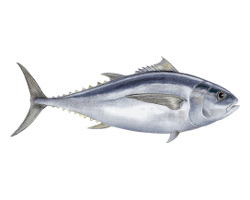
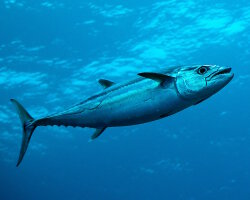
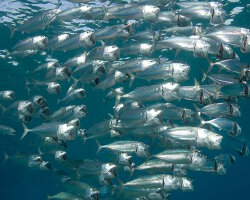
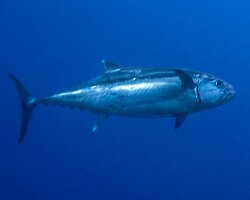

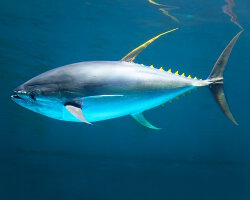
Discover also

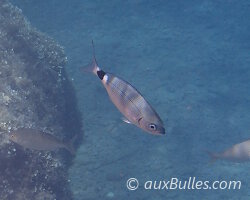
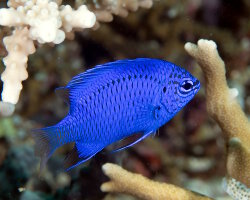
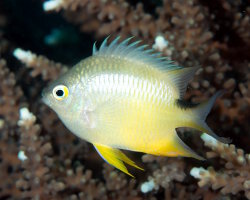
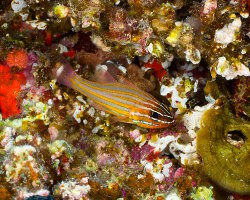
The marine species in the North Atlantic

Our latestUpdates
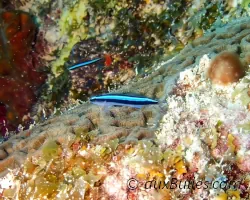
The neon gobyDiscover the neon goby (Elacatinus oceanops), a small western Atlantic reef fish known for its brilliant blue stripe and its role as a cleaner fish that removes parasites from other fish.Read more
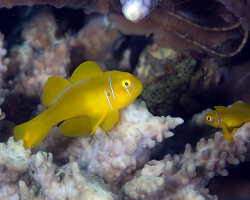
The poison gobyDiscover the poison goby (Gobiodon citrinus), a tiny reef fish with a bright yellow body and distinctive blue markings. It lives among branching Acropora corals in the tropical waters of the Indo-Pacific.Read more
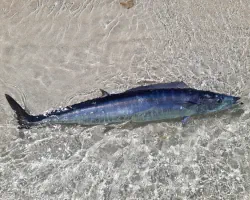
The wahooDiscover the wahoo (Acanthocybium solandri), a powerful pelagic predator found in tropical and subtropical oceans. Recognizable by its streamlined body and distinctive blue vertical stripes, it is a fast swimmer that feeds mainly on fish and squid.Read more
Photo of the Day

Fou à pieds rouges
(Sula sula)
(Sula sula)
 Copyright © 2007-2026 auxBulles.com - All rights reserved. Legal notices.
Photo credits - Our partners