Sealife guideThe queen angelfishHolacanthus ciliaris
Last updated on 03/02/2026 at 11:01 PM

The queen angelfish (Holacanthus ciliaris)
Taxonomy
English names
Queen angelfish
French namesPoisson ange royal, ange royal
Spanish namesAngel reina
Scientific nameHolacanthus ciliaris (Linnaeus, 1758)
Description
The
queen angelfish has a morphology similar to the
French angelfish and the
gray angelfish, but with some of the most vibrant colors. The queen angelfish is a large fish that averages about 12 inches in length, with a maximum size of around 16 inches.
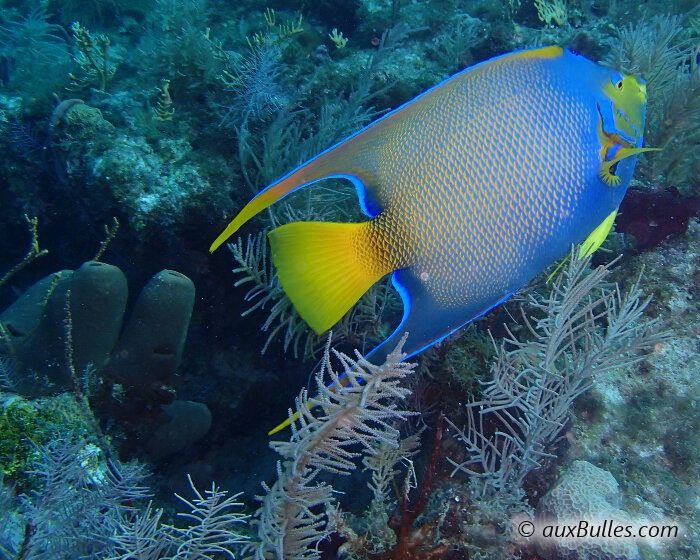
Le poisson ange royal est le poisson ange aux couleurs les plus éclatantes !
The queen angelfish has a flattened, disk-shaped body extended by a single continuous dorsal fin and an anal fin, both ending in a long, sharply pointed yellow tip.
The queen angelfish is the most majestic of the angelfishes, with its golden-yellow coloration and bluish highlights. A bluish edging enhances its silhouette and outlines various parts of its body. In contrast, its tail, pectoral fins, and pelvic fins are entirely yellow. The front of its head is bright blue.
But beware, the queen angelfish only wears this splendid coloration as an adult! As a juvenile, it looks completely different! A wide deep-blue band, several bright blue vertical stripes, and a yellow area on the lower part of its body at the level of the pectoral and pelvic fins are present, but these markings gradually fade with age.
Geographic range
The queen angelfish is found in the warm tropical waters of the western Atlantic ocean, from
Florida in the north down to the coasts of Brazil in the south. It is also present in the Gulf of Mexico and along the shores of the many islands bordering the Caribbean sea, such as the
Bahamas and
Guadeloupe.
Habitat
The queen angelfish inhabits shallow waters — from the surface down to about 65 feet — of coral reefs, where it roams in search of its favorite food, sponges. At nightfall, the reef provides shelter from predators. The queen angelfish can also be found at depths of up to about 230 feet.
The queen angelfish lives alone or in pairs.
Diet
The queen angelfish feeds mainly on
sponges but also supplements its diet with algae and invertebrates such as gorgonian polyps.
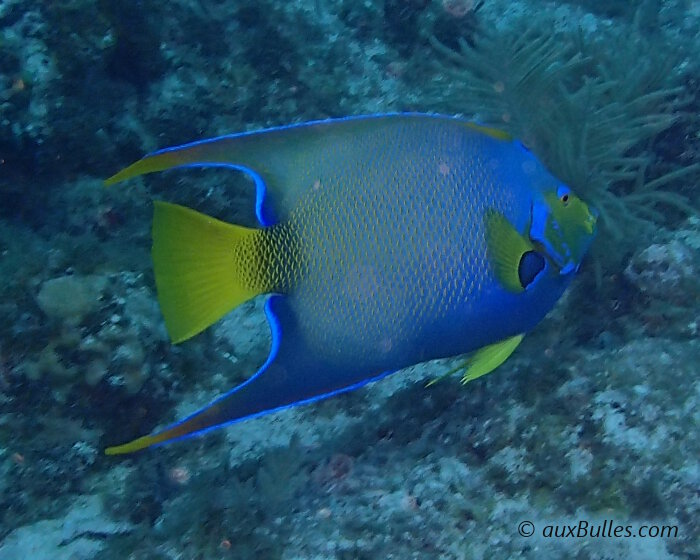
Notez la couleur jaune de la queue, des nageoires pectorales et pelviennes du poisson ange royal !
Reproduction
The queen angelfish is
oviparous and reproduces sexually.
Did you know ?
This angelfish owes its « royal » status to the bluish ring on the top of its head, which resembles a crown! At its center, bright blue spots illuminate the deep blue background that fills it.
The queen angelfish is listed as many other marine species within The
IUCN Red List of threatened species. The queen angelfish appears in the
IUCN Red List since 2010 within the category Least Concern !
Tips for observing
The queen angelfish is much less approachable than the
French angelfish or the
gray angelfish. Move gently and avoid sudden movements if you hope to see it up close !
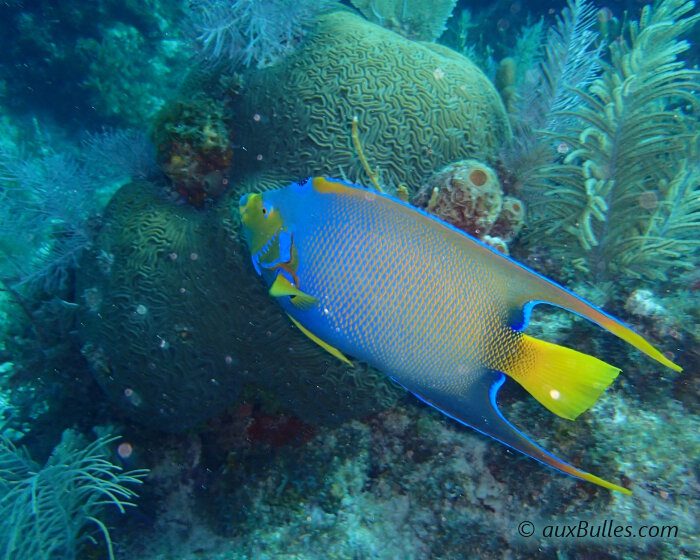
Le poisson ange royal vagabonde dans les détours du récif corallien à la recherche de sa nourriture favorite, les éponges !
Within the same genus
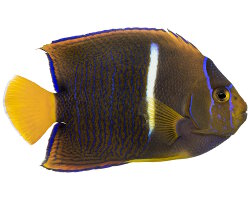
Passer angelfish
(Holacanthus passer)
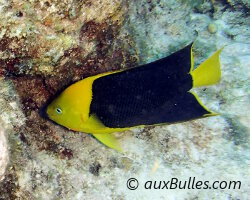
Rock beauty
(Holacanthus tricolor)
Within the same family
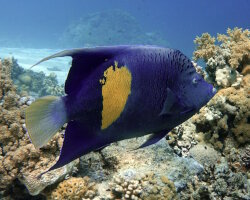
Arabian angelfish
(Pomacanthus asfur)
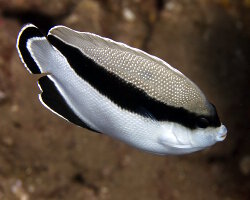
Banded angelfish
(Apolemichthys arcuatus)
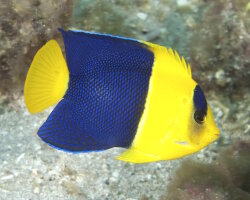
Bicolor angelfish
(Centropyge bicolor)
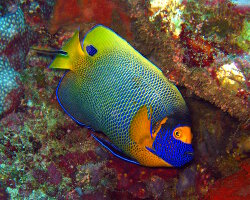
Blueface angelfish
(Pomacanthus xanthometopon)
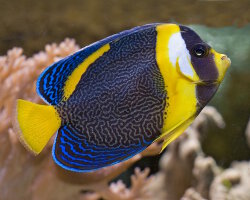
Scribbled angelfish
(Chaetodontoplus duboulayi)
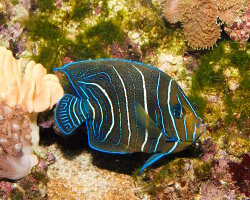
Semicircle angelfish
(Pomacanthus semicirculatus)
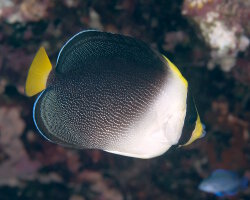
Vermiculated angelfish
(Chaetodontoplus mesoleucus)
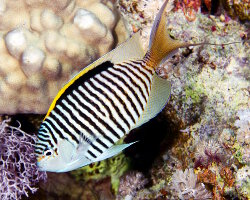
Zebra angelfish
(Genicanthus caudovittatus)
Discover also
Banggai cardinalfish
(Pterapogon kauderni)
Blackspotted puffer
(Arothron nigropunctatus)
Dusky damselfish
(Stegastes fuscus)
Midnight snapper
(Macolor macularis)
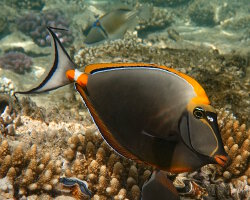
Orangespine unicornfish
(Naso lituratus)
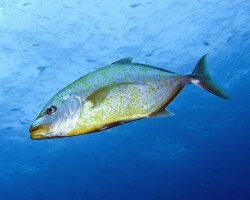
Orangespotted trevally
(Carangoides bajad)
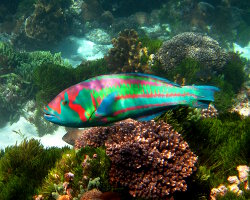
Surge wrasse
(Thalassoma purpureum)
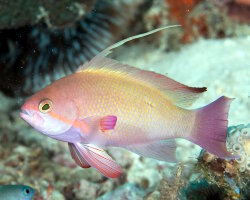
Threadfin anthias
(Pseudanthias huchtii)
The marine species in the Caribbean
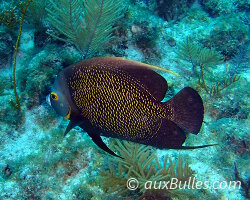
French angelfish
(Pomacanthus paru)
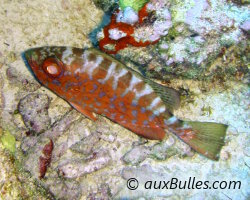
Glasseye snapper
(Heteropriacanthus cruentatus)
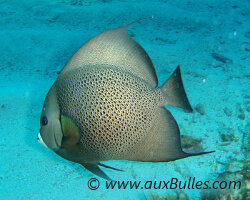
Gray angelfish
(Pomacanthus arcuatus)

Graysby
(Cephalopholis cruentata)
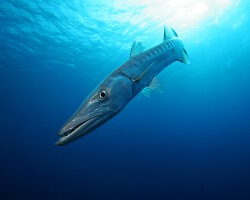
Great barracuda
(Sphyraena barracuda)
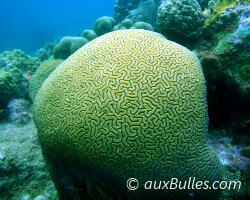
Labyrinthine brain coral
(Diploria labyrinthiformis)
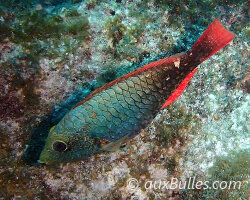
Redband parrotfish
(Sparisoma aurofrenatum)
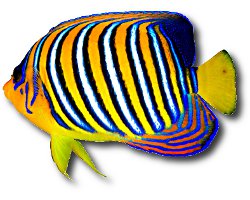
Royal angelfish
(Pygoplites diacanthus)
Dive centers
'Les Ilets' dive center
Noa dive center