Sealife guideThe blueface angelfishPomacanthus xanthometopon
Last updated on 03/02/2026 at 11:01 PM
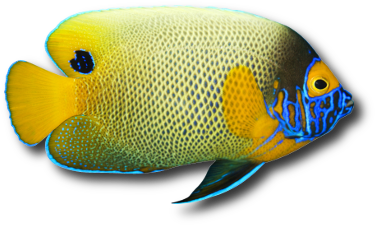
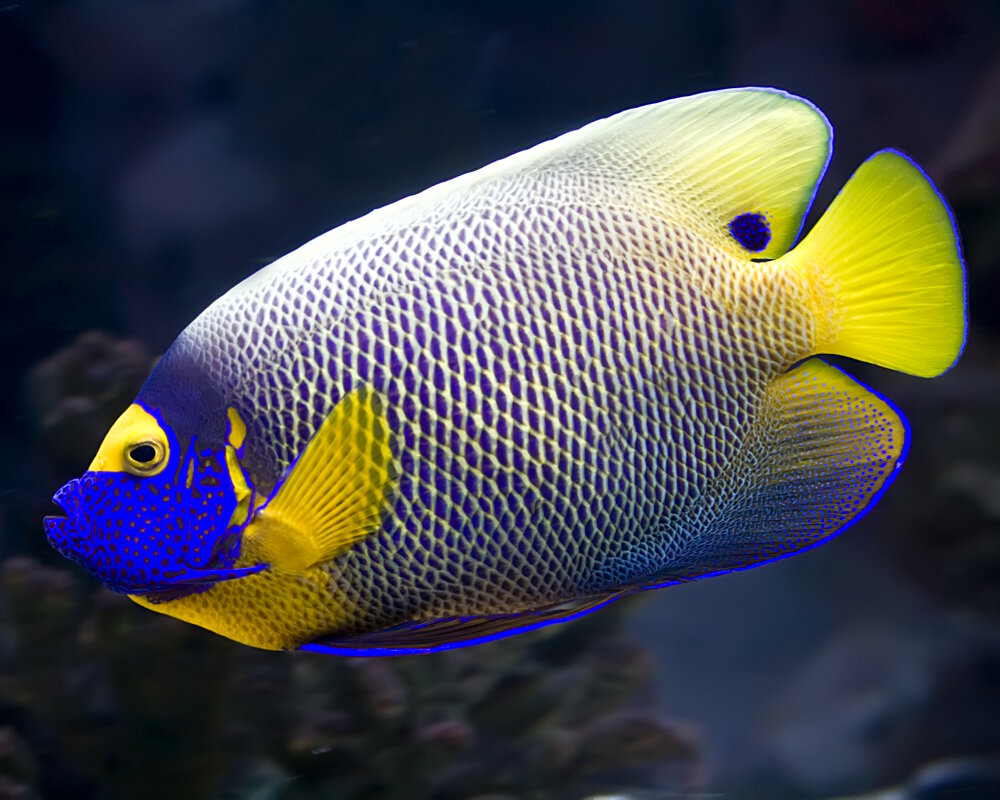
Le poisson ange à tête bleue (Pomacanthus xanthometopon) © Tatus | Dreamstime.com
The blueface angelfish is one of the most spectacular fish of the tropical Indo-Pacific coral reefs. Admired by divers for its vibrant colors, it also plays an important ecological role in maintaining reef balance.
Taxonomy
- Common name: Blueface angelfish
- French name: Poisson ange à tête bleue
- Spanish name: Pez ángel de cara azul
- Scientific name: Pomacanthus xanthometopon (Bleeker, 1853)
- Family name: Pomacanthidae
- Order name: Acanthuriformes
- Class name: Actinopterygii
Description
The blueface angelfish reaches about 15 inches in length as an adult. Its body is oval and strongly laterally compressed, with long dorsal and anal fins that give it an elegant and majestic silhouette.
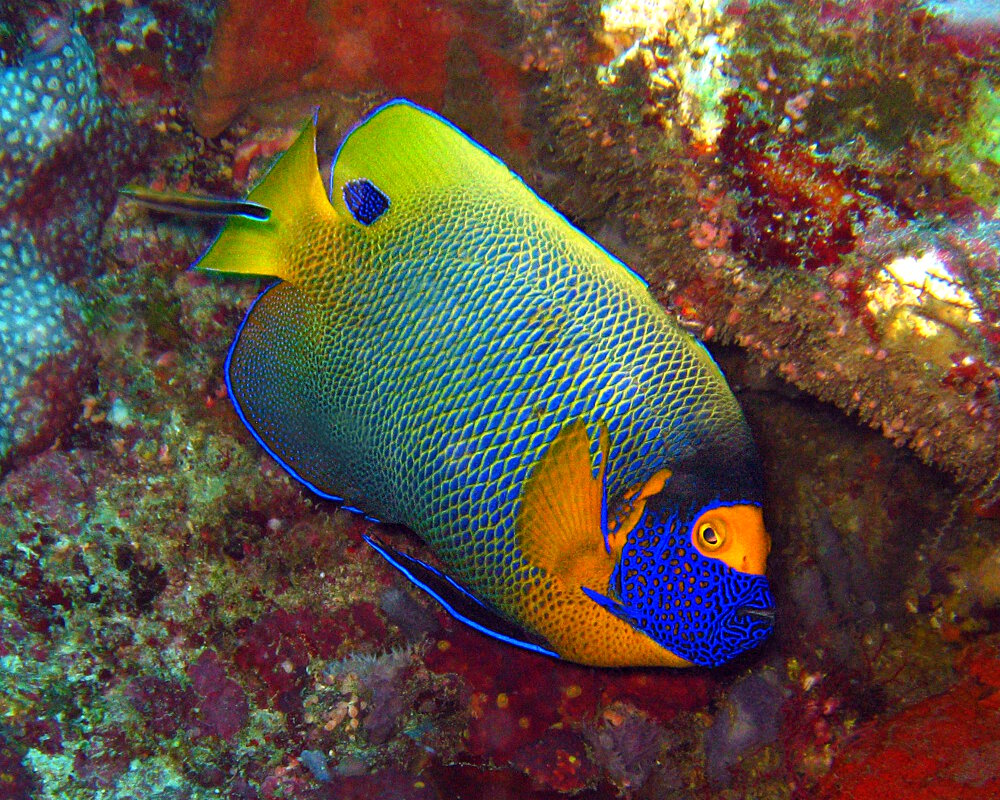
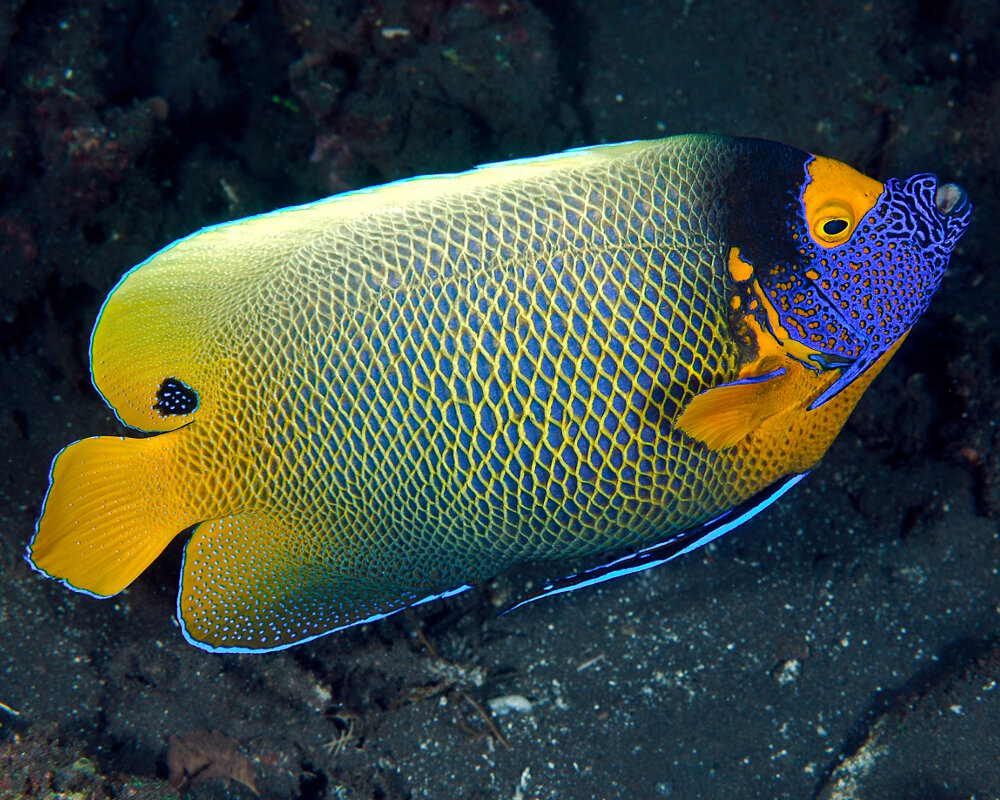
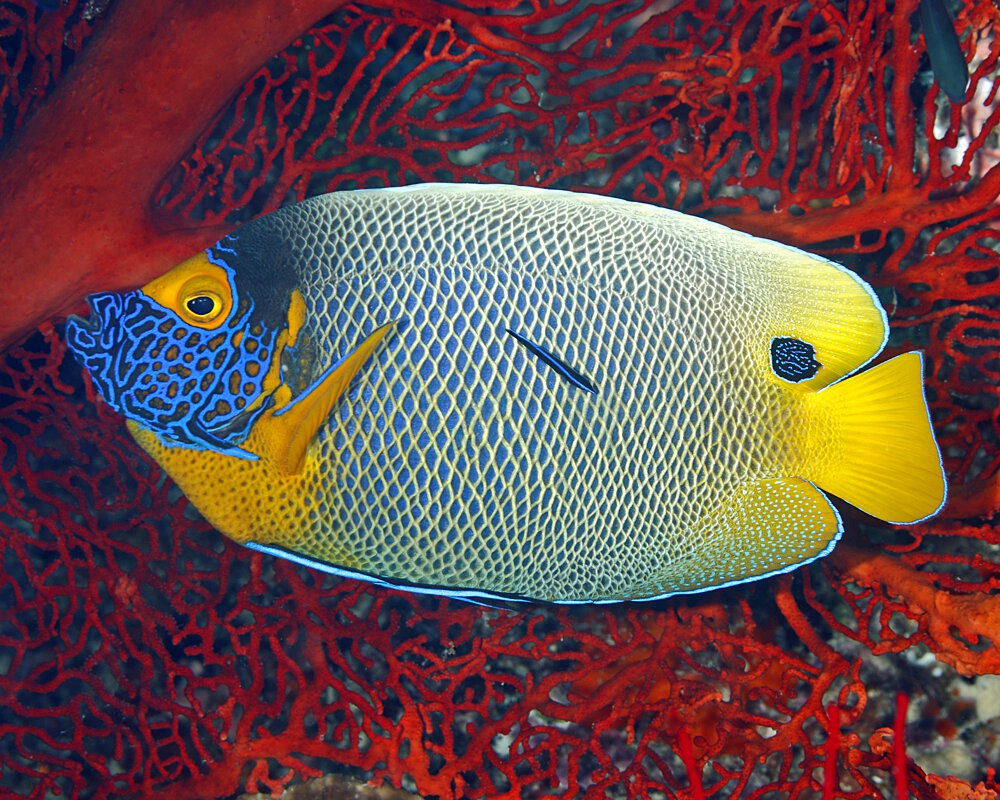
As an adult, the blueface angelfish displays particularly striking coloration: its head is covered with fine, bright blue interwoven lines, with a yellowish to orange area around the eyes and a dark band above them, while the body features yellow-edged scales forming a reticulated pattern. The dorsal and anal fins are yellow, highlighted with a thin blue margin, and a round bluish spot appears on the rear portion of the dorsal fin.
Juveniles, on the other hand, look completely different, with a dark blue body decorated with curved pale yellow bands.
Geographic range
The blueface angelfish inhabits tropical Indo-Pacific waters and is found in the
Maldives, Indonesia, the Philippines, Malaysia, Taiwan, Japan, Micronesia, and northern
Australia.
Its distribution is closely tied to the presence of well-developed coral reefs, which are essential for feeding and protection.
Habitat
The blueface angelfish is mainly found on coral reefs down to depths of about 100 feet. It inhabits coral-rich lagoons, outer reef slopes, and areas with rocky overhangs.
The blueface angelfish lives alone or in pairs within a well-defined territory. Juveniles prefer sheltered areas such as caves or reef crevices to reduce the risk of predators.
Diet
The blueface angelfish feeds primarily on
marine sponges, which make up a significant portion of its diet. It also consumes tunicates and occasionally algae.
Its specialized diet contributes to reef ecological balance by regulating certain sponge species and limiting their competition with corals. This feeding behavior partly explains its almost exclusive presence in tropical reef environments.
Reproduction
Like many angelfish, the blueface angelfish is
oviparous and reproduces by releasing
gametes into open water. Pairs rise into the water column during spawning and simultaneously release eggs and sperm, usually at the end of the day.
The fertilized eggs drift with ocean currents until hatching. The planktonic larvae live in open water before settling onto reefs to undergo metamorphosis into juveniles.
This reproductive strategy promotes wide dispersal over long distances through ocean currents, contributing to its broad geographic distribution.
Did you know ?
The blueface angelfish undergoes a complete change in appearance between the juvenile and adult stages. This phenomenon, known as
ontogenetic metamorphosis, is common among angelfish and may help reduce aggression from adults toward juveniles by making them visually distinct.
The blueface angelfish is highly sought after in marine aquariums because of its spectacular colors, but keeping it in captivity is challenging due to its specialized diet.
The blueface angelfish is listed as many other marine species within The
IUCN Red List of threatened species. The blueface angelfish appears in the
IUCN Red List since 2010 within the category Least Concern !
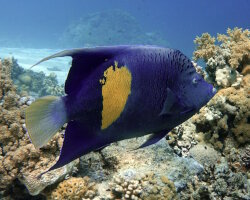
Arabian angelfish
(Pomacanthus asfur)
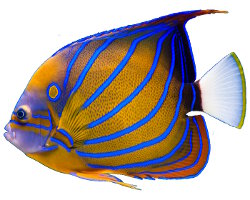
Bluering angelfish
(Pomacanthus annularis)
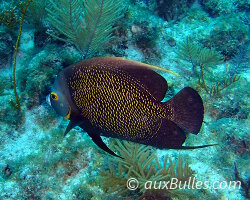
French angelfish
(Pomacanthus paru)
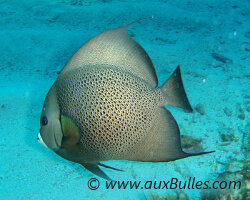
Gray angelfish
(Pomacanthus arcuatus)
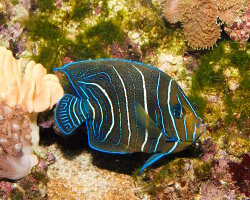
Semicircle angelfish
(Pomacanthus semicirculatus)
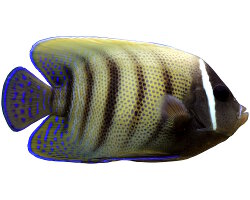
Sixbar angelfish
(Pomacanthus sexstriatus)
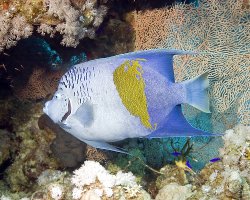
Yellow blotch angelfish
(Pomacanthus maculosus)
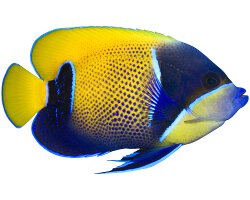
Yellow lemonpeel angelfish
(Pomacanthus navarchus)
Within the same family
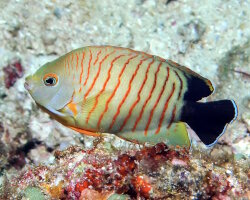
Blacktail angelfish
(Centropyge eibli)
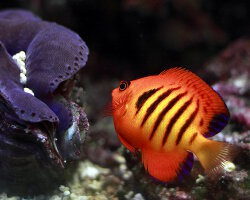
Flame angelfish
(Centropyge loriculus)
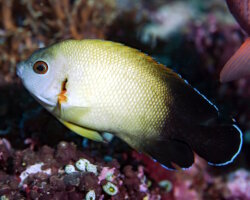
Pearl-scaled angelfish
(Centropyge vrolikii)
Queen angelfish
(Holacanthus ciliaris)
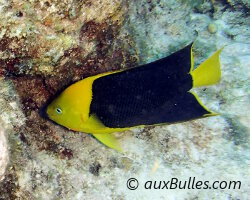
Rock beauty
(Holacanthus tricolor)
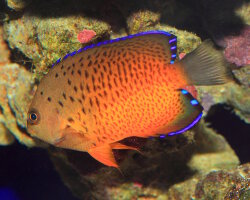
Rusty angelfish
(Centropyge ferrugata)
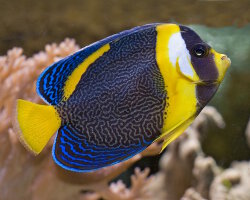
Scribbled angelfish
(Chaetodontoplus duboulayi)
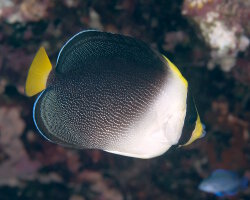
Vermiculated angelfish
(Chaetodontoplus mesoleucus)
Discover also
Banggai cardinalfish
(Pterapogon kauderni)
Black and gold chromis
(Neoglyphidodon nigroris)
Eightband butterflyfish
(Chaetodon octofasciatus)
Giant grouper
(Epinephelus lanceolatus)
Golden damselfish
(Amblyglyphidodon aureus)
Lumpfish
(Cyclopterus lumpus)
Pearlscale butterflyfish
(Chaetodon xanthurus)
Spotband butterflyfish
(Chaetodon punctatofasciatus)
The marine species in the Indo-Pacific
Bicolor angelfish
(Centropyge bicolor)
Bobbitt worm
(Eunice aphroditois)
Brownbanded bamboo shark
(Chiloscyllium punctatum)
Copperbanded butterfly
(Chelmon rostratus)

Crown of thorns starfish
(Acanthaster planci)
Gray reef shark
(Carcharhinus amblyrhynchos)
Honeycomb filefish
(Cantherhines pardalis)

Lemonpeel angelfish
(Centropyge flavissima)