Sealife guideThe spotted wobbegongOrectolobus maculatus
Last updated on 08/08/2026 at 01:42 AM
Taxonomy
English names
Spotted wobbegongSpotted wobbegong shark
French namesRequin tapis tacheté
Spanish namesTapicero manchado
Scientific nameOrectolobus maculatus (Bonnaterre, 1788)
Description
The
spotted wobbegong commonly measures between 5 and 6 feet in length, with the largest individuals reaching a maximum length of about 10.5 feet. Like the
tasselled wobbegong, its head is broad, flattened and fringed with numerous fleshy skin lobes, some of which are branched, although they are much less abundant !
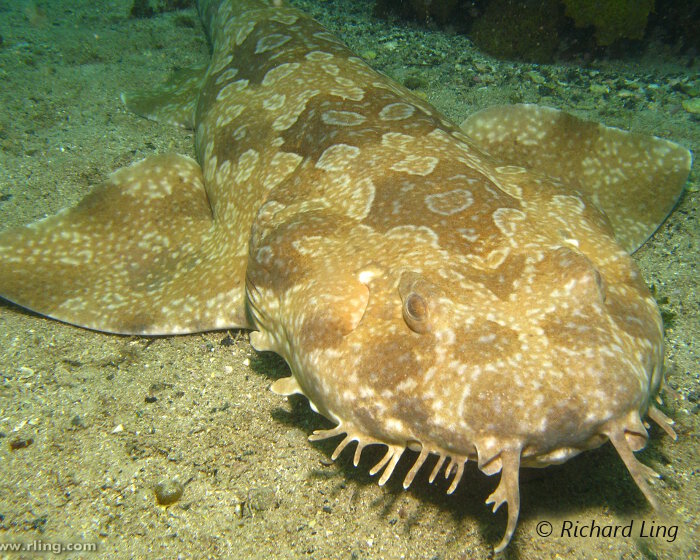
The spotted wobbegong is predominantly brown in color with patches of lighter and darker shades throughout its body
© Richard LingThe spotted wobbegong has a darker and less contrasting coloration than most other wobbegongs. Its overall color is brown, with patches ranging from lighter yellowish-green areas to darker brown regions. The spotted wobbegong is distinguished by numerous spots surrounded by an irregular whitish border covering its entire body. A closer look reveals that each whitish border is actually made up of many tiny adjoining spots !
The spotted wobbegong is often confused with the banded wobbegong (Orectolobus halei) and the dwarf spotted wobbegong (Orectolobus parvimaculatus), a species only recently described in 2008 that differs mainly by its smaller adult size.
The spotted wobbegong has two dorsal fins set far back on the body, very large pectoral fins, and an anal fin.
Geographic range
The spotted wobbegong inhabits the shallow waters of the eastern Indian Ocean, particularly along the southern coast of
Australia, from New South Wales in the east to Western
Australia in the west.
The spotted wobbegong is believed to be a wobbegong species endemic to
Australia.
Habitat
The spotted wobbegong is found in shallow coastal waters and around coral reefs, where it spends most of its time resting on the bottom in rocky crevices or beneath rocky or coral overhangs.
Diet
The spotted wobbegong is a nocturnal shark that feeds at night and rests on the bottom during the day. It preys on a wide variety of animals that venture too close. Relying on its remarkable camouflage, it blends perfectly into its surroundings and patiently waits for unsuspecting prey to pass within striking distance before rapidly engulfing it.
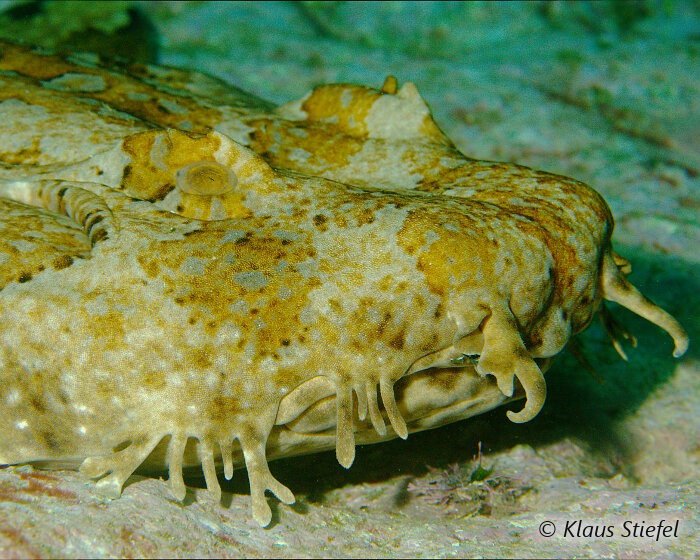
The spotted wobbegong has a broad, flattened head fringed with numerous fleshy skin lobes, some of which are branched
Reproduction
The spotted wobbegong is
ovoviviparous. At birth, young pups measure about 8 inches in length.
Did you know ?
Thanks to the series of symmetrical patterns covering its body like the designs of a carpet, the spotted wobbegong, like all other wobbegongs, blends remarkably well into its surroundings ! The difference lies in the carpet-like patterns, which vary from one species to another and are one of their distinguishing characteristics.
The spotted wobbegong has been listed on the
IUCN Red List since 2003. It is currently classified as
Near Threatened !
Tips for observing
As with nurse sharks, if you encounter a spotted wobbegong, approach it slowly but do not get too close. Always leave it a clear escape route so it can swim away without becoming defensive if it feels cornered !
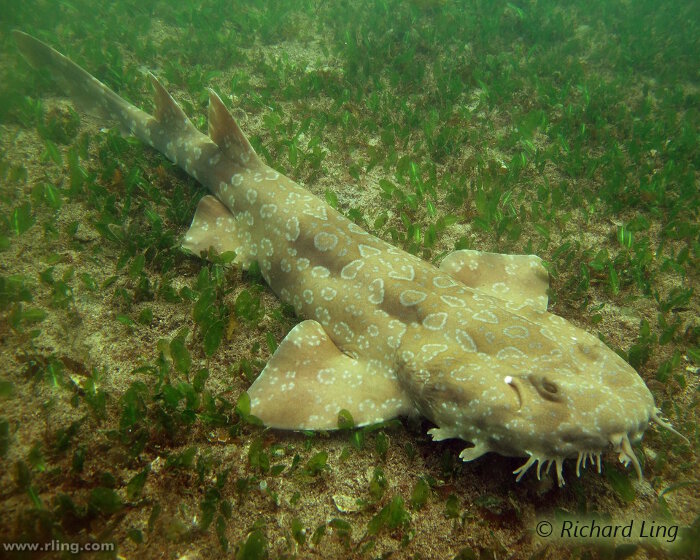
With its body covered in carpet-like patterns, the spotted wobbegong blends remarkably well into its surroundings
© Richard LingWithin the same genus
Japanese wobbegong
(Orectolobus japonicus)
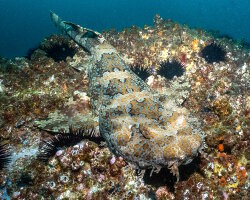
Ornate wobbegong
(Orectolobus ornatus)
Within the same family
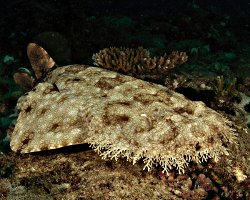
Tasselled wobbegong
(Eucrossorhinus dasypogon)
Discover also
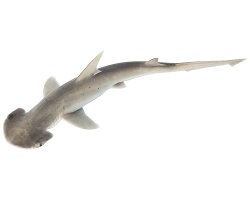
Bonnethead shark
(Sphyrna tiburo)
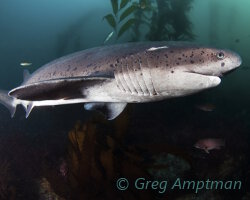
Broadnose sevengill shark
(Notorynchus cepedianus)
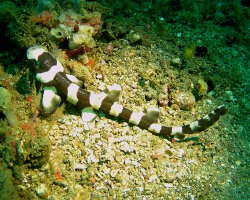
Brownbanded bamboo shark
(Chiloscyllium punctatum)
Dusky shark
(Carcharhinus obscurus)
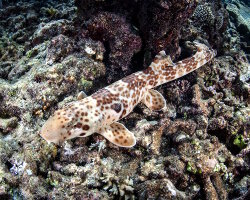
Raja epaulette shark
(Hemiscyllium freycineti)
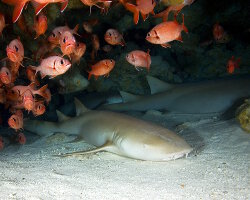
Tawny nurse shark
(Nebrius ferrugineus)
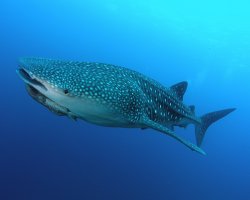
Whale shark
(Rhincodon typus)
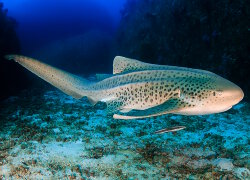
Zebra shark
(Stegostoma fasciatum)
The marine species in Australia

Australian spiny gurnard
(Lepidotrigla papilio)
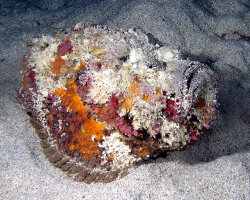
Common stonefish
(Synanceia verrucosa)

Flatback sea turtle
(Natator depressus)
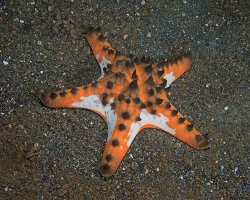
Horned sea star
(Protoreaster nodosus)
John dory
(Zeus faber)

Long-finned pilot whale
(Globicephala melas)
Tawny nurse shark
(Nebrius ferrugineus)
White spotted wedgefish
(Rhynchobatus australiae)