

Sealife guideThe panther electric rayTorpedo panthera
Last updated on 10/13/2026 at 12:52 AM
With its brown back covered in small whitish spots, the panther electric ray (Torpedo panthera) easily blends into the seafloor. Yet this inconspicuous ray has a remarkable feature: it can produce electric shocks to capture prey and defend itself.
It inhabits the warm waters of the Red Sea, the Persian Gulf, and the Arabian Sea, around the Arabian Peninsula, where it generally stays close to the seabed.
Taxonomy
English names
Panther electric ray
French namesRaie torpille panthère
Scientific nameTorpedo panthera (Olfers, 1831)
FamilyTorpedinidae
OrderTorpediniformes
ClassElasmobranchii
Description
The panther electric ray has a flattened body forming a rounded disc, with its pectoral fins fused to its head. Its eyes are located on the upper surface, while its mouth and gill slits are on the underside. The panther electric ray has small, irregular whitish spots on a light brown to reddish-brown back.

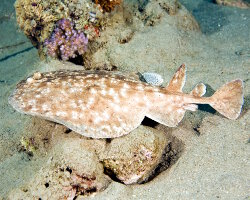
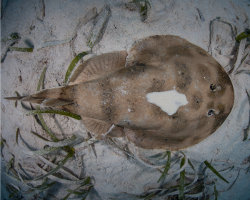
The panther electric ray (Torpedo panthera) © Serg_dibrova | Dreamstime.com
The panther electric ray typically averages around 13 inches in length, but the largest individuals can reach up to 25 inches.
Geographic range
The panther electric ray inhabits tropical and subtropical waters of the northern Indian Ocean, from the Red Sea and the Persian Gulf to the coast of Pakistan. It has also been reported off eastern India, near the state of Odisha, in the Bay of Bengal.
The panther electric ray resembles the Persian torpedo ray (Torpedo sinuspercisi), making it difficult to determine the exact boundaries of its range.
Habitat
The panther electric ray lives close to the seabed along coastlines and across the continental shelf. It inhabits various environments, including coral reefs and sandy or muddy bottoms. It is found mainly in shallow waters, but can also occur at depths of up to 1,150 feet.
Diet
The panther electric ray feeds mainly on small fish and marine invertebrates. It hunts near the seabed and uses electric shocks to immobilize its prey before capturing it.
As in other electric rays, its electric organs serve as tools for both hunting and defense.
Reproduction
The panther electric ray is ovoviviparous: embryos develop inside the female's body, initially relying on the nutrients stored in their eggs and later receiving nutrients produced by the mother. The young are born fully formed and independent.
Tips for observing
Identifying the panther electric ray can be difficult because it resembles other electric rays found in the same region, particularly the variable torpedo ray (Torpedo sinuspercisi).
The main distinguishing feature is the dorsal pattern: the panther electric ray has small, irregular whitish spots, whereas the Persian torpedo ray has a more marbled pattern, with pale lines and markings on a dark brown background.
Within the same genus
Discover also


Our latestUpdates
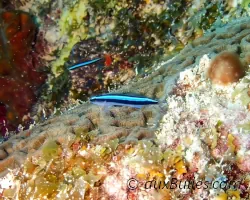
The neon gobyDiscover the neon goby (Elacatinus oceanops), a small western Atlantic reef fish known for its brilliant blue stripe and its role as a cleaner fish that removes parasites from other fish.Read more
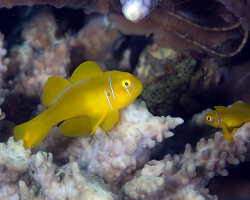
The poison gobyDiscover the poison goby (Gobiodon citrinus), a tiny reef fish with a bright yellow body and distinctive blue markings. It lives among branching Acropora corals in the tropical waters of the Indo-Pacific.Read more
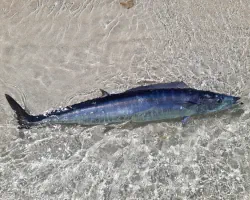
The wahooDiscover the wahoo (Acanthocybium solandri), a powerful pelagic predator found in tropical and subtropical oceans. Recognizable by its streamlined body and distinctive blue vertical stripes, it is a fast swimmer that feeds mainly on fish and squid.Read more
Photo of the Day

Fou à pieds rouges
(Sula sula)
(Sula sula)
 Copyright © 2007-2026 auxBulles.com - All rights reserved. Legal notices.
Photo credits - Our partners