

Sealife guideThe hawksbill sea turtleEretmochelys imbricata
Last updated on 08/06/2026 at 12:15 AM
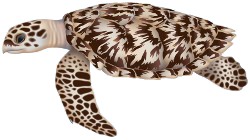
Classification
- Common name: Hawksbill sea turtle
- French name: Tortue imbriquée, tortue caret, tortue à écailles, tortue à bec de faucon, tortue bonne écaille
- Spanish name: Tortuga de carey
- Scientific name: Eretmochelys imbricata (Linnaeus, 1766)
- Family name: Cheloniidae
- Order name: Testudines
- Class name: Sea reptiles
Description
The hawksbill sea turtle can be distinguished from the green sea turtle by the arrangement of the scutes along the rear edge of its shell, which form a distinctive saw-toothed pattern. The hawksbill sea turtle is also distinguished by its narrow, elongated, hooked beak, which resembles that of a hawk and is the origin of its common name.
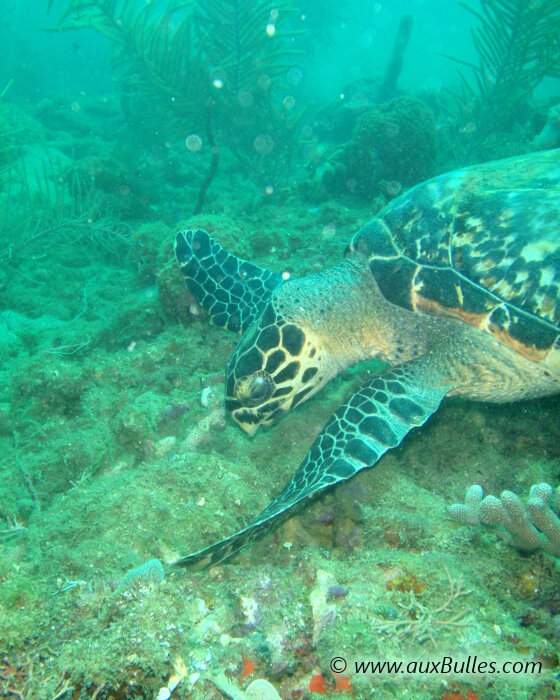
Close-up of a hawksbill sea turtle
The head of the hawksbill sea turtle has two pairs of prefrontal scutes located in the area between its two eyes.
Shell characteristics
The upper surface of the hawksbill sea turtle's shell, known as the carapace, is covered with relatively thick scutes that overlap like the shingles on a roof ! Along the centerline of the carapace are 5 vertebral scutes bordered on each side by 4 pairs of costal scutes. One distinctive feature of the hawksbill sea turtle is that the first pair of costal scutes does not touch the nuchal scute.
Finally, the edge of the shell is bordered by 11 pairs of marginal scutes that begin at the nuchal scute and end with a pair of supracaudal scutes.
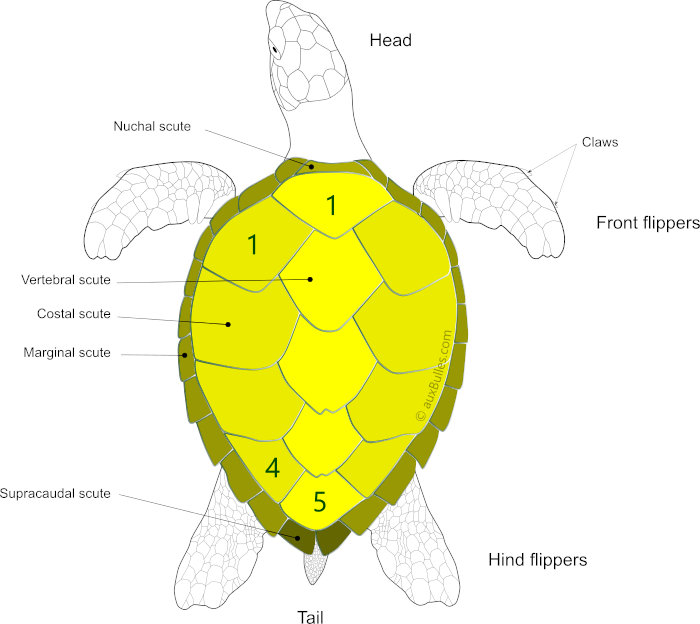
Carapace scutes of a hawksbill sea turtle (Eretmochelys imbricata)
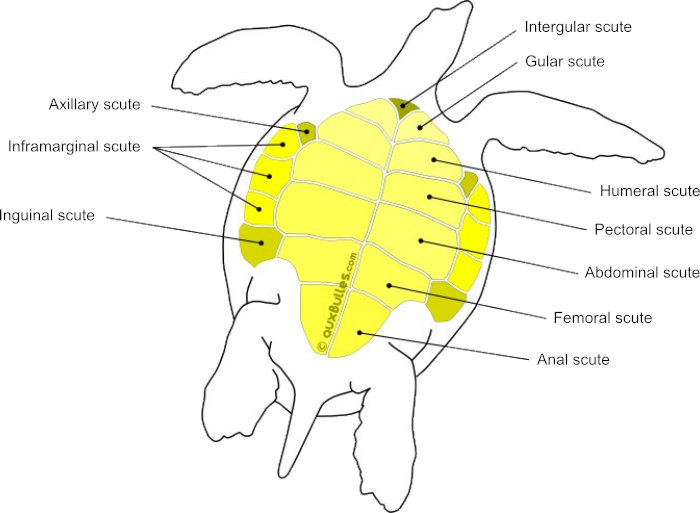
Plastron scutes of a hawksbill sea turtle (Eretmochelys imbricata)
The underside of the shell, known as the plastron, is covered in its central area by 5 pairs of scutes, sometimes with one or two additional pairs. Each side of the plastron has 5 scutes.
Geographic range
The hawksbill sea turtle inhabits the tropical waters of the world's oceans, throughout the tropical Atlantic and Indo-Pacific regions surrounding the equator.
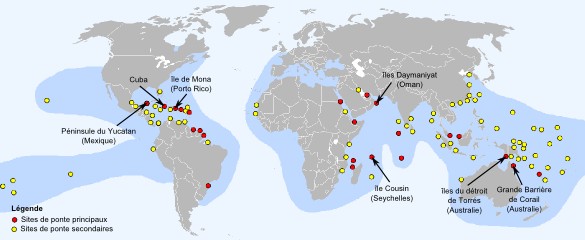
Geographic range and nesting sites of the hawksbill sea turtle
The hawksbill sea turtle is frequently encountered along the coasts of Guadeloupe, particularly within the Cousteau Reserve.
Habitat
The hawksbill sea turtle, the most tropical of all sea turtles, is especially associated with coral reefs. It inhabits shallow coastal waters with seagrass beds or abundant algae. It is also commonly found beneath rocky overhangs and around shipwrecks, where it shelters at night to rest.
Diet
During migration, when hawksbill sea turtles travel through the open ocean to reach their breeding grounds, they feed mainly on jellyfish. Once back along the coast and around coral reefs, however, they adopt a very different diet ! Hawksbill sea turtles become sponge specialists, feeding primarily on marine sponges. In the Caribbean sea, it is common to see the feeding marks they leave along the edges of giant barrel sponges !
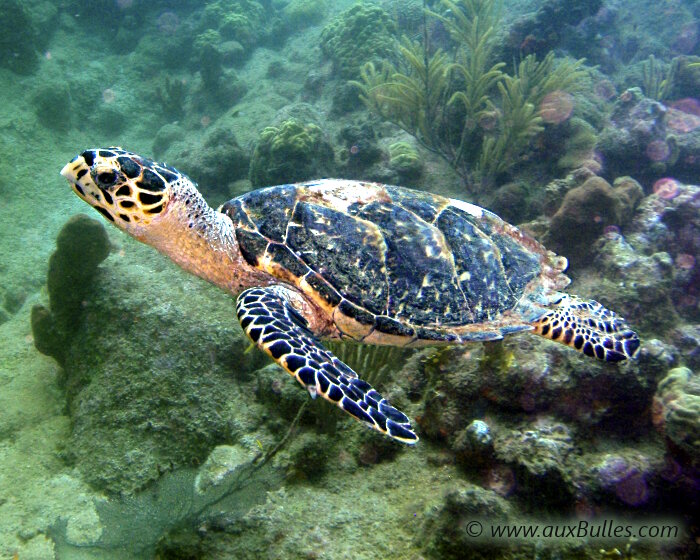
A hawksbill sea turtle gliding effortlessly underwater
To supplement its diet, the hawksbill sea turtle also feeds on mollusks, crustaceans, brown algae, and certain cnidarians such as sea anemones.
Reproduction
Although still not fully understood by scientists, the hawksbill sea turtle reaches sexual maturity relatively late, probably when it reaches a shell length of about 28 inches. Once mature, it generally breeds only every 2 to 3 years, although this interval may vary. During a breeding season, however, a female may lay several clutches, averaging 2 to 3 nests spaced about 2 weeks apart.
The hawksbill sea turtle is oviparous
Hawksbill sea turtles may undertake long migrations during the breeding season, which begins in late spring and continues throughout the summer.
To lay her eggs, the female returns at night to the beach where she was born. She digs a nest in the sand and lays around 100 eggs ! Once the eggs have been deposited, she carefully covers them with sand before returning to the ocean !
Hawksbill sea turtle eggs are about the size of a ping-pong ball, measuring approximately 1.6 inches in diameter and weighing about 0.9 ounces.
A life filled with predators
The eggs are preyed upon by numerous predators, including crabs and terrestrial mammals such as mongooses.
After an incubation period of about 2 months, which varies depending on the surrounding temperature, the eggs hatch during the first hours of the night as the sand begins to cool ! A dangerous journey then begins, filled with predators !
The hatchlings immediately race toward the ocean ! Seabirds are already waiting, and their task is made even easier because this first challenge often takes place during daylight ! Although many hatchlings are lost, their large numbers allow some to survive. But the journey is far from over, as young sea turtles must still evade numerous predators in the water, including fish and sharks !
The main nesting areas are located near coral reef ecosystems.
Did you know ?
Like all sea turtle species, the hawksbill sea turtle is listed on the IUCN Red List. Classified as « Endangered » in 1990, it has been listed as « Critically Endangered » since 1996 !
The hawksbill sea turtle is becoming increasingly rare for several reasons:
- hunting for its meat, eggs, and especially its shell. Because of the exceptional quality of its scutes, the hawksbill sea turtle is the most heavily exploited and threatened of all sea turtle species
- hawksbill sea turtles often mistake drifting plastic bags for their favorite prey, jellyfish, and ingest them !
- the degradation and even destruction of their habitat
Tips for observing
Stay calm and move gently when approaching a hawksbill sea turtle so you can observe it without disturbing its natural behavior !
A hawksbill sea turtle foraging for food
The graceful glide of a hawksbill sea turtle
Within the same family

Flatback sea turtle
(Natator depressus)
(Natator depressus)
Green sea turtle
(Chelonia mydas)
(Chelonia mydas)
Kemp's ridley sea turtle
(Lepidochelys kempii)
(Lepidochelys kempii)

Loggerhead sea turtle
(Caretta caretta)
(Caretta caretta)
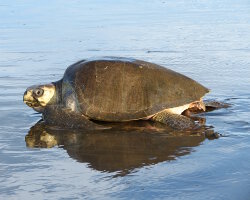
Olive ridley sea turtle
(Lepidochelys olivacea)
(Lepidochelys olivacea)
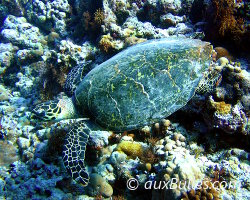
Sea turtles
(7 espèces)
(7 espèces)
Discover also
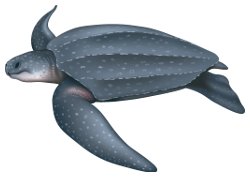
Leatherback sea turtle
(Dermochelys coriacea)
(Dermochelys coriacea)
Our latestUpdates
Monday, August 3rd 2026
The olive ridley sea turtle
Discover the olive ridley sea turtle (Lepidochelys olivacea), the world's most abundant sea turtle, famous for its spectacular mass nesting events, wide tropical distribution, unique behavior, diet, reproduction, and conservation challenges.

Thursday, May 7th 2026
Faroe islands
Discover the Faroe islands, a remote archipelago between Iceland and Norway known for its dramatic cliffs, colorful villages, and untouched Nordic landscapes. Find travel tips, itineraries, hiking guides, local culture, and inspiration to explore this unique destination in the North Atlantic.

Wednesday, May 6th 2026
The short-finned pilot whale
Discover the tropical pilot whale (Globicephala macrorhynchus), a highly social large cetacean from tropical and subtropical waters, specialized in deep dives in search of squid.
Photo of the Day

Poulpe géant du nord du Pacifique
(Enteroctopus dofleini)
(Enteroctopus dofleini)
 Copyright © 2007-2026 auxBulles.com - All rights reserved. Legal notices.
Photo credits - Our partners