

Sealife guideThe olive ridley sea turtleLepidochelys olivacea
Last updated on 08/03/2026 at 11:01 PM
The olive ridley sea turtle is one of the world's seven species of sea turtles. Although it is considered the most abundant sea turtle species, its populations remain vulnerable to human activities. It gets its name from the olive-green color of its shell and is best known for a spectacular nesting phenomenon called an arribada, during which thousands of females come ashore to nest simultaneously on the same beach.
Taxonomy
English names
Olive ridley sea turtlePacific ridley turtle
French namesTortue de mer olivâtre
Scientific nameLepidochelys olivacea (Eschscholtz, 1829)
FamilyCheloniidae
OrderTestudines
Description
The olive ridley is one of the two smallest sea turtle species. Adults typically measure between 22 and 28 inches in carapace length and weigh between 77 and 110 pounds, although some individuals can reach up to 154 pounds. Its shell, which is almost circular and slightly heart-shaped, ranges in color from olive green to olive gray on the upper surface, while the plastron is cream to yellowish.
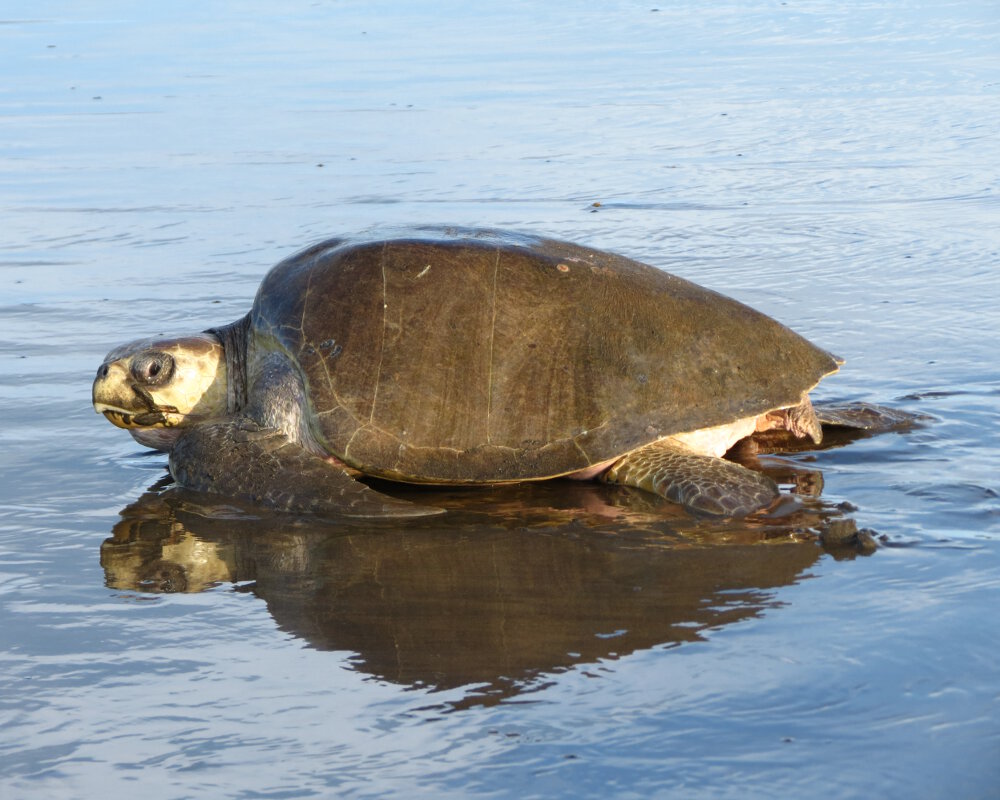
The olive ridley sea turtle (Lepidochelys olivacea) © Mark Watson | Dreamstime.com
A key identifying feature of the olive ridley is its shell, which typically has five to nine pairs of lateral scutes, whereas most other sea turtle species have only four or five. Its head is relatively small and bears two pairs of prefrontal scales located between the eyes.
Geographic range
The olive ridley inhabits the tropical and subtropical waters of the Atlantic, Indian, and Pacific oceans. It is found along the coasts of Africa, Asia, and Oceania, as well as along the Pacific and Atlantic shores of the Americas.
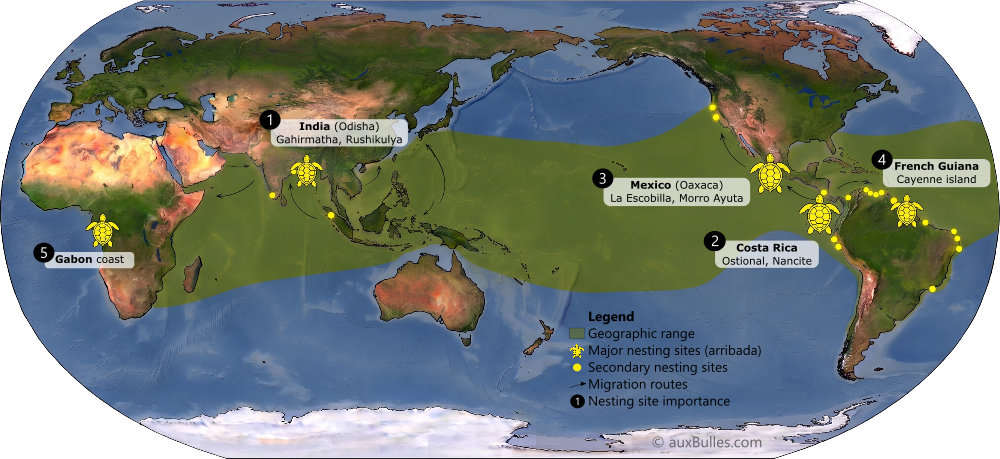
Geographic range and major nesting sites of the olive ridley sea turtle (Lepidochelys olivacea)
The most important nesting beaches are located in India (Gahirmatha and Rushikulya), Costa Rica (Ostional and Nancite), Mexico (La Escobilla and Morro Ayuta), along the coast of Gabon, and on several beaches throughout Central America. In French territories, the species occurs in French Guiana around Cayenne island, the French West Indies, La Réunion, New Caledonia, and the Scattered islands.
Habitat
Primarily a pelagic species, the olive ridley spends much of its life in the open ocean. It also frequents coastal waters, bays, estuaries, and continental shelves where food is abundant. Depending on the region and season, it can dive to depths of about 500 feet in search of prey living on the seafloor.
Adults regularly undertake long migrations between their feeding grounds and nesting beaches, sometimes traveling several hundred to several thousand miles.
Diet
The olive ridley has a highly varied diet. It feeds mainly on crustaceans, mollusks, crabs, shrimp, fish, jellyfish, and tunicates, but also consumes algae depending on food availability.
This opportunistic feeding behavior allows it to adapt to a wide variety of marine habitats, both offshore and in coastal waters. Juveniles feed primarily on small planktonic organisms before gradually broadening their diet as they grow.
Reproduction
The olive ridley's reproductive behavior is famous for the phenomenon known as arribadas, observed on certain beaches such as those in Costa Rica, where thousands or even hundreds of thousands of females come ashore to nest almost simultaneously. Each female digs a nest in the sand above the high-tide line and typically lays between 100 and 120 eggs. A single female may nest one to three times during a breeding season, with nesting events spaced several weeks apart, and repeats the cycle every one to three years.
After an incubation period of about 50 to 60 days, the hatchlings emerge from the sand, usually at night, and quickly make their way to the ocean to reduce the risk of predation. Females reach sexual maturity between 10 and 18 years of age and often return to the very beaches where they were born to lay their eggs.
Did you know ?
Despite its relative abundance, olive ridley populations are threatened by accidental capture in fishing gear, egg harvesting, the development of nesting beaches, plastic pollution, and climate change, which alters sand temperatures and influences the sex ratio of hatchlings.
Numerous international conservation programs aimed at protecting nesting beaches and reducing accidental bycatch are helping to preserve this iconic species of the world's tropical oceans.
The olive ridley sea turtle is listed as many other marine species within The IUCN Red List of threatened species. The olive ridley sea turtle appears in the IUCN Red List since 2008 within the category Vulnerable !
Within the same genus

Kemp's ridley sea turtle
(Lepidochelys kempii)
(Lepidochelys kempii)
Within the same family

Flatback sea turtle
(Natator depressus)
(Natator depressus)
Green sea turtle
(Chelonia mydas)
(Chelonia mydas)

Hawksbill sea turtle
(Eretmochelys imbricata)
(Eretmochelys imbricata)

Loggerhead sea turtle
(Caretta caretta)
(Caretta caretta)
Sea turtles
(7 espèces)
(7 espèces)
Discover also
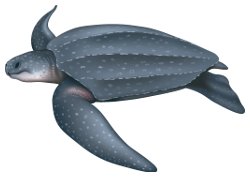
Leatherback sea turtle
(Dermochelys coriacea)
(Dermochelys coriacea)
Our latestUpdates

The basking sharkDiscover the basking shark (Cetorhinus maximus), the world's second-largest fish. This huge shark feeds on plankton by filtering large amounts of water.Read more
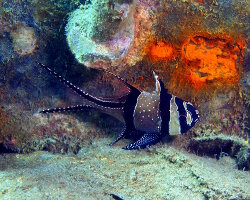
The Banggai cardinalfishDiscover the Banggai cardinalfish (Pterapogon kauderni), a small marine fish endemic to the Banggai Islands, known for its black-and-white stripes and unique reproductive behavior.Read more
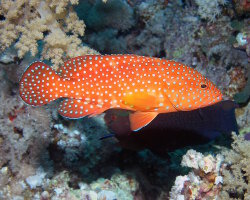
The coral hindDiscover the coral hind (Cephalopholis miniata), a colorful Indo-Pacific grouper known for its reddish-orange body covered with small blue spots.Read more
Photo of the Day
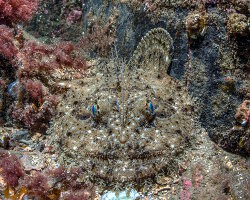
Baudroie commune
(Lophius piscatorius)
(Lophius piscatorius)
 Copyright © 2007-2026 auxBulles.com - All rights reserved. Legal notices.
Photo credits - Our partners