The spotted drum averages about 6 inches in length but can reach a maximum size of 10.6 inches.
The first dorsal fin of the spotted drum features a white edge and stands erect like a flag at the back of its head !
The juvenile spotted drum is easily distinguished from the adult by its two very long and slender fins
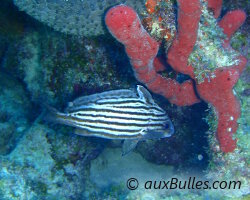
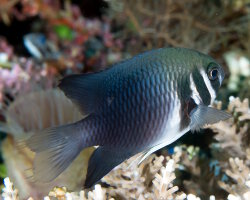
The spotted drum has a black body with fine white stripes: vertical stripes on its head and horizontal stripes on the rest of its body.
Its fins are black. The second dorsal fin, anal fin, and tail are dotted with white spots. The first dorsal fin has a white edge and stands erect like a flag at the back of its head. Finally, a dark, more or less oval spot adorns the top of its mouth.
As a juvenile, the spotted drum can be easily confused with the jackknife fish (Equetus lanceolatus), though a few distinguishing features, such as the mark on the head near the eyes, set them apart.
Geographic range
The spotted drum is found in the tropical waters of the western Atlantic ocean, from the Florida Keys south to the coast of Brazil, including the Bahamas, the Yucatan coast of Mexico, Cuba and the Caribbean islands.
Habitat
The spotted drum is a solitary fish that inhabits crevices in rocks.
The juvenile spotted drum (Equetus punctatus)
The second dorsal fin of the spotted drum as well as its anal fin and tail are dotted with white spots
Diet
Hidden in a shelter and not very active during the day, the spotted drum comes out at night to hunt and feed on small crustaceans and worms.
Did you know ?
The spotted drum is listed as many other marine species within The IUCN Red List of threatened species. The spotted drum appears in the IUCN Red List since 2020 within the category Least Concern !
The spotted drum has a black body with fine white stripes: vertical stripes on its head and horizontal stripes on the rest of its body
A dark, more or less oval spot adorns the top of the mouth of the spotted drum