

Sealife guideThe atlantic blue marlinMakaira nigricans
Last updated on 01/26/2026 at 11:55 PM
The term marlin refers to several giant fish species belonging to the family of Istiophoridae. There are mainly four marlin species: the blue marlin (Makaira nigricans), the black marlin (Istiompax indica), the striped marlin (Kajikia audax) and the white marlin (Tetrapturus albidus).
Each of these species has distinct morphological features, distribution ranges and hunting behaviors. Among them, the blue marlin is the most iconic and largest, renowned for its speed, power and famous leaps out of the water.
Taxonomy
English names
Atlantic blue marlinBlue marlin
French namesMarlin bleu de l'AtlantiqueMakaire bleu de l'Atlantique
Spanish namesAguja azul
Scientific nameMakaira nigricans (Lacepède, 1802)
FamilyIstiophoridae
OrderCarangiformes
ClassActinopterygii
Description
The blue marlin has an elongated, streamlined and highly hydrodynamic body, perfectly adapted for fast swimming. It is recognizable by its very long, pointed, sword-like bill and metallic blue reflections on its body and fins. Its bluish back and silvery flanks provide excellent camouflage in open water.
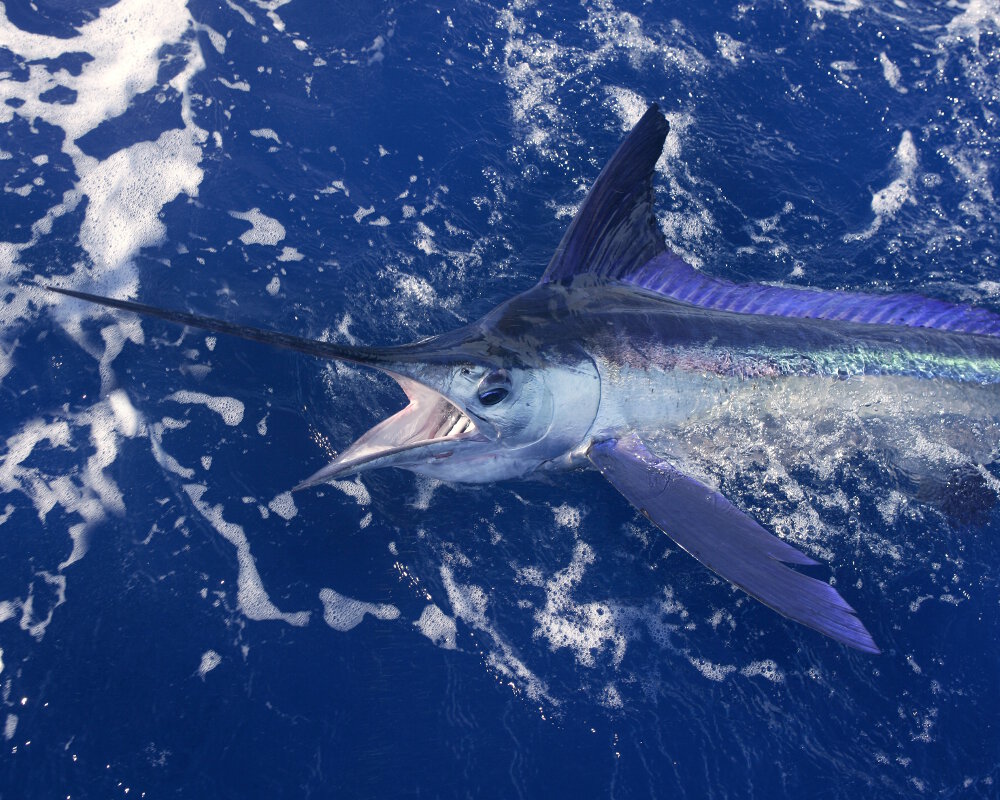
The atlantic blue marlin (Makaira nigricans) © Lunamarina | Dreamstime.com
Blue marlins typically measure between 9.8–11.8 feet in length and weigh 440–880 lbs, while the largest individuals can reach 14.1 feet and weigh up to 1,540 lbs.
Geographic range
Blue marlins are mainly found in the warm tropical and subtropical waters of the Atlantic, Pacific and Indian oceans.
Habitat
The blue marlin is a pelagic species living in the open ocean. Although it mostly stays near the surface, it can dive hundreds of meters deep in search of prey. It often follows nutrient-rich ocean currents, areas where marine life is particularly abundant.
Blue marlins are migratory fish, capable of covering thousands of miles during their oceanic migrations.
Diet
Blue marlins are opportunistic predators that feed mainly on fish such as tuna, mackerel, bonitos and cephalopods like squid.
During hunting, the blue marlin uses its exceptional speed — exceeding 50 mph over short distances — to surprise its prey and strike schools of fish with its bill, disorienting them before capturing weakened individuals.
Reproduction
Blue marlin reproduction occurs in warm waters, primarily in tropical regions. Females can lay several million eggs in a single spawning season, many of which serve as food for predators.
After hatching, strong natural selection occurs and individuals that survive to adulthood can live more than 25 years, becoming true marine super-predators.
Did you know ?
The blue marlin is among the fastest fish in the world along with the Indo-Pacific sailfish (Istiophorus platypterus), the Atlantic sailfish (Istiophorus albicans), swordfish (Xiphias gladius), black marlin (Istiompax indica), wahoo (Acanthocybium solandri), yellowfin tuna (Thunnus albacares) and bluefin tuna (Thunnus thynnus).
Blue marlin is highly prized by sport fishermen for its strength and incredible speed, offering spectacular battles in the open sea. This sport fishing is often done using « catch and release », allowing admiration of these ocean giants without compromising their survival.
The long, pointed bill of the blue marlin is not used to impale prey but rather to stun them, making capture easier.
The main threat remains overfishing, particularly from industrial tuna fisheries, where blue marlin are often caught as bycatch.
The atlantic blue marlin is listed as many other marine species within The IUCN Red List of threatened species. The atlantic blue marlin appears in the IUCN Red List since 2022 within the category Vulnerable !
Within the same family
Discover also
Our latestUpdates
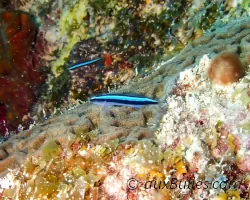
The neon gobyDiscover the neon goby (Elacatinus oceanops), a small western Atlantic reef fish known for its brilliant blue stripe and its role as a cleaner fish that removes parasites from other fish.Read more
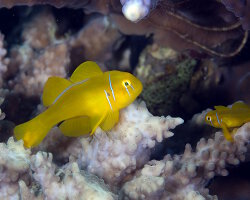
The poison gobyDiscover the poison goby (Gobiodon citrinus), a tiny reef fish with a bright yellow body and distinctive blue markings. It lives among branching Acropora corals in the tropical waters of the Indo-Pacific.Read more
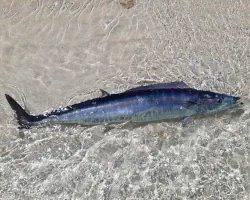
The wahooDiscover the wahoo (Acanthocybium solandri), a powerful pelagic predator found in tropical and subtropical oceans. Recognizable by its streamlined body and distinctive blue vertical stripes, it is a fast swimmer that feeds mainly on fish and squid.Read more
Photo of the Day

Fou à pieds rouges
(Sula sula)
(Sula sula)
 Copyright © 2007-2026 auxBulles.com - All rights reserved. Legal notices.
Photo credits - Our partners