Sealife guideThe Banggai cardinalfishPterapogon kauderni
Last updated on 09/23/2026 at 12:45 AM
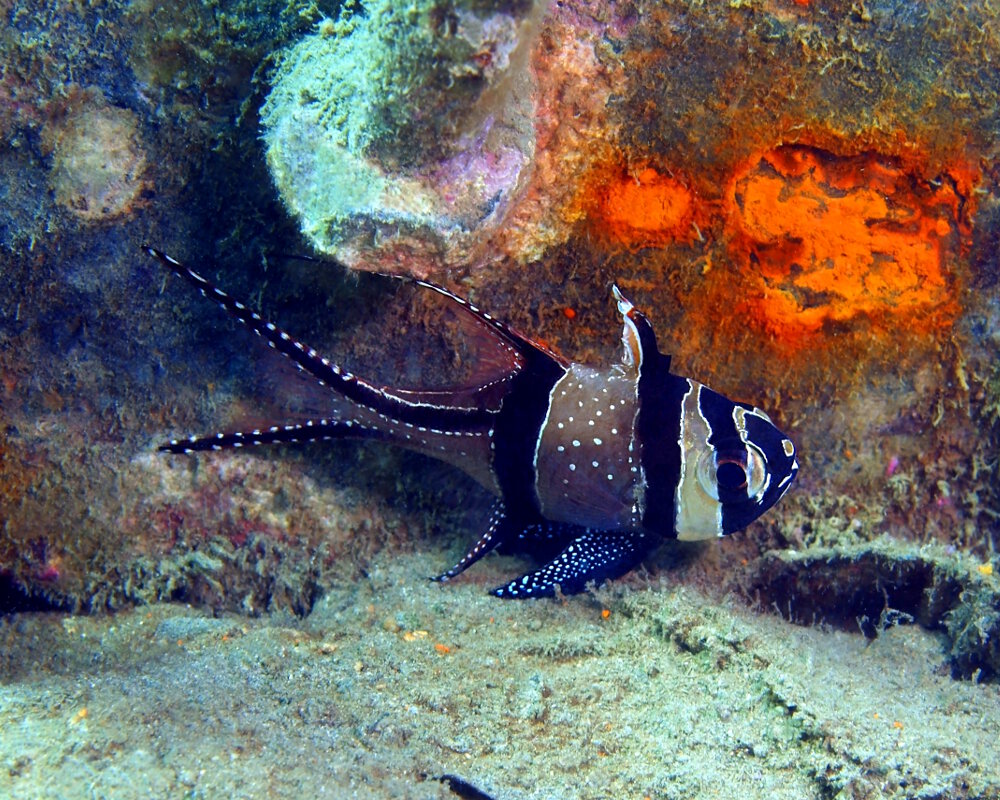
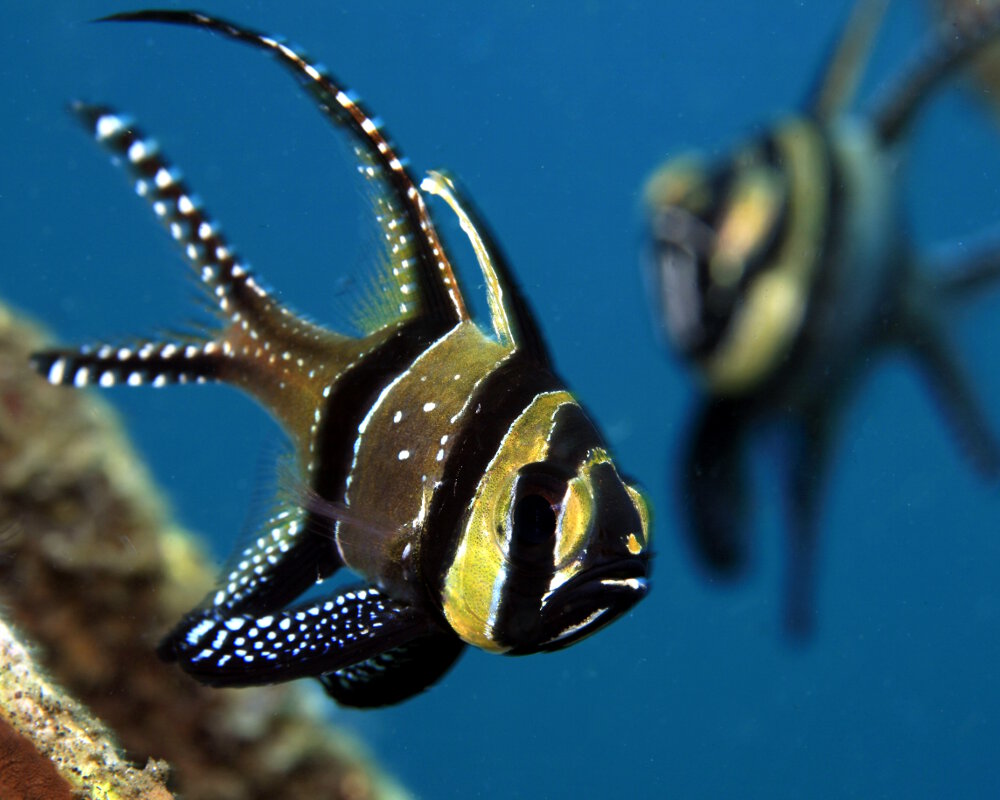
The Banggai cardinalfish (Pterapogon kauderni) is a small tropical fish recognizable by its silvery body marked with broad black bands and its long fins covered with white spots. It naturally lives within a very small area of Indonesia, around the Banggai Archipelago, where it inhabits shallow coastal waters.
Often seen motionless near sea urchins or seagrass beds, this small fish leads a rather sedentary life and usually stays close to its shelter. Its reproduction is particularly remarkable: after spawning, the male collects the eggs and incubates them in his mouth until the young are released.
Taxonomy
English names
Banggai cardinalfish
French namesPoisson-cardinal de BanggaiApogon de BanggaiApogon de Kaudern
Spanish namesCardenal de Banggai
Scientific namePterapogon kauderni (Koumans, 1933)
Description
The Banggai cardinalfish has a short, deep, laterally compressed body. It has three broad black bands edged in white against a silvery background, while its dorsal, anal, and caudal fins are long and covered with numerous white spots. Its first dorsal fin forms a small fringe-like crest, and its caudal fin is deeply forked. It usually measures around 2.4 to 2.8 inches, while the largest individuals can reach about 3.5 inches in length.
Males and females look very similar, but the male has a slightly larger mouth. This difference becomes particularly important during reproduction, when his mouth cavity holds the eggs and then the developing young.
Geographic range
The Banggai cardinalfish has an exceptionally small natural range. It is native to the Banggai Archipelago in eastern Indonesia, off Sulawesi. It also naturally occurs around a few nearby islands, particularly around Taliabu and Luwuk.
Populations have been introduced to other parts of Indonesia, notably through the aquarium trade. These populations therefore occur in regions where the species is not naturally found.
Habitat
The Banggai cardinalfish lives in shallow coastal waters, often just a few feet below the surface. It inhabits coral reefs, seagrass beds, as well as sheltered bays and lagoons. Juveniles in particular seek shelter near sea anemones and sea urchins, while adults often remain close to long-spined sea urchins and reef structures.
When threatened, it quickly takes refuge among the long spines of sea urchins or between coral branches. It generally stays close to its shelter and often lives in small groups. Several individuals may gather around the same sea urchin, which provides protection from predators.
Diet
The Banggai cardinalfish feeds mainly on small animals found in the water or near the seafloor. It particularly eats
copepods and other small
crustaceans that live in the plankton or on the seafloor.
The Banggai cardinalfish hunts close to its refuge. It often remains motionless while waiting for prey to approach, then darts forward to capture it. This technique allows it to feed without moving far from the protection provided by reefs and seagrass beds.
Reproduction
Reproduction in the Banggai cardinalfish begins with the formation of a pair. After spawning and fertilization, the male collects the eggs in his mouth and keeps them in his buccal cavity. He therefore provides most of the parental care for the eggs and young.
During incubation, which generally lasts several weeks, the male does not feed and regularly ventilates the eggs by moving them around in his mouth. After hatching, the young remain protected in his mouth for some time before being released. They are already well developed when they leave the male's mouth and do not go through a prolonged planktonic larval stage.
Did you know ?
The Banggai cardinalfish is classified as
Endangered on the
IUCN Red List. Its very limited natural range and collection for the aquarium trade have contributed to the decline of its populations. The species is also threatened by the degradation of its coastal habitats.
In this species, the male can incubate several dozen eggs in his mouth for several weeks. Even more remarkably, the young do not go through a true planktonic larval stage: they continue developing safely inside the male's mouth before being released as small fish.
Within the same family
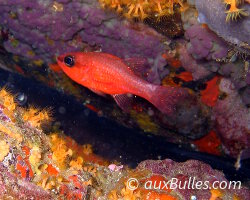
Cardinalfish
(Apogon imberbis)
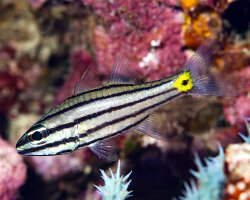
Five-lined cardinalfish
(Cheilodipterus quinquelineatus)
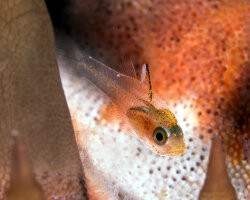
Frostfin cardinalfish
(Ostorhinchus hoevenii)
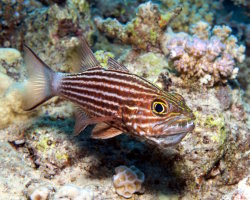
Large toothed cardinalfish
(Cheilodipterus macrodon)
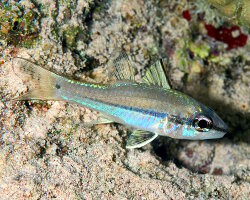
Narrowstripe cardinalfish
(Pristiapogon exostigma)
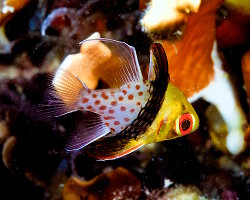
Pajama cardinalfish
(Sphaeramia nematoptera)
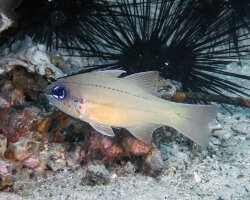
Spotgill cardinalfish
(Ostorhinchus chrysopomus)
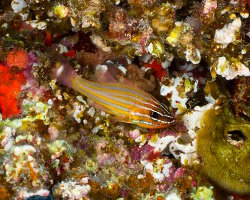
Yellowstriped cardinalfish
(Ostorhinchus cyanosoma)
Discover also
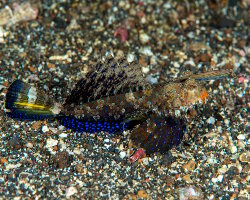
Black and orange dragonet
(Dactylopus kuiteri)
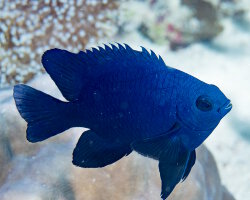
Black damselfish
(Neoglyphidodon melas)
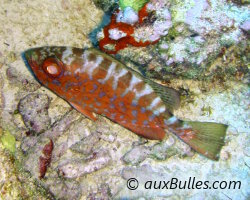
Glasseye snapper
(Heteropriacanthus cruentatus)
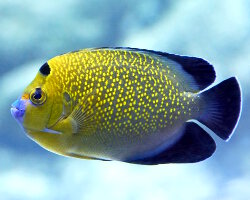
Goldflake angelfish
(Apolemichthys xanthopunctatus)
Harlequin bass
(Serranus tigrinus)
Mahi-mahi
(Coryphaena hippurus)
Sailfin blenny
(Emblemaria pandionis)
Scribbled angelfish
(Chaetodontoplus duboulayi)
The marine species
Sea goldie
(Pseudanthias squamipinnis)



 Copyright © 2007-2026 auxBulles.com - All rights reserved. Legal notices.