Sealife guideThe sea goldiePseudanthias squamipinnis
Last updated on 09/16/2026 at 09:58 PM
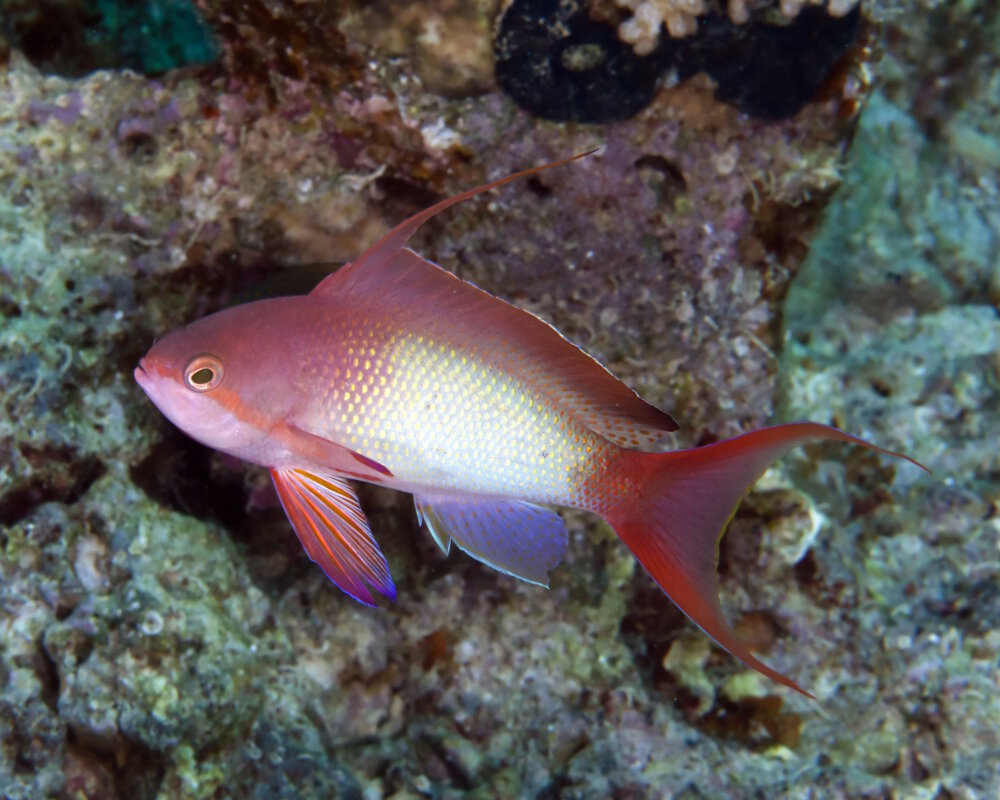
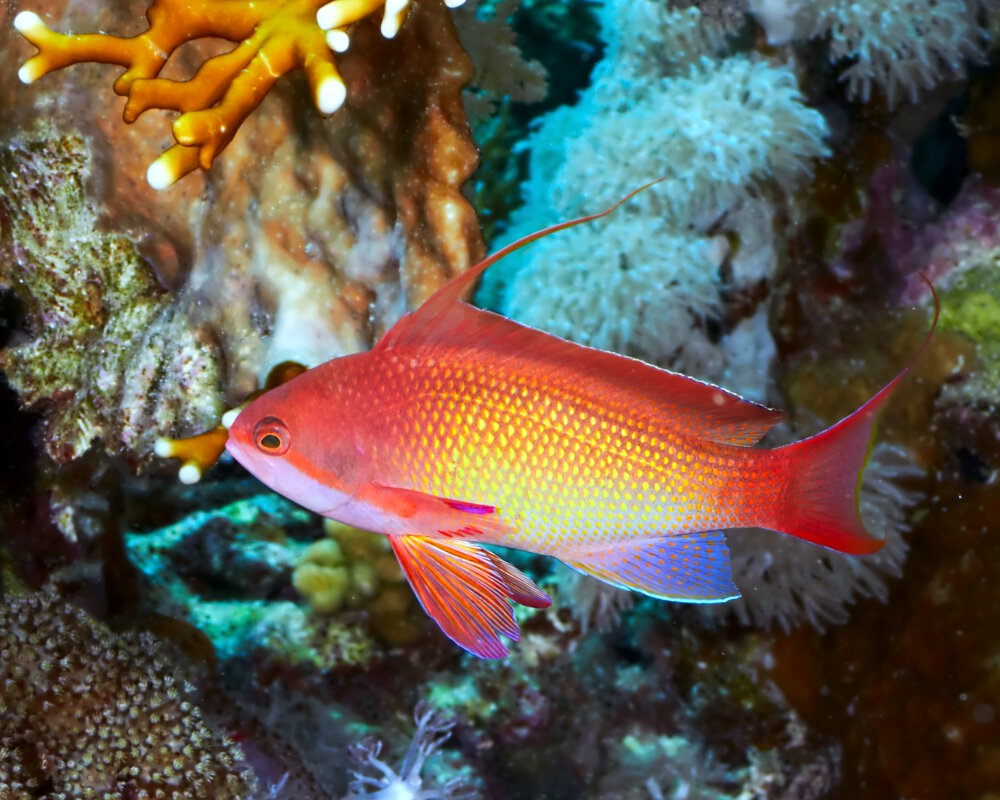
The sea goldie (Pseudanthias squamipinnis), also known as the lyretail anthias, is a small, brightly colored fish that lives above coral reefs throughout the Indo-Pacific. Easy to spot thanks to its vivid coloration, orange-yellow in females and carmine red with yellowish areas in males, it often forms large schools in areas where currents bring a steady supply of food.
Taxonomy
- Common name: Sea goldie, lyretail anthias
- French name: Barbier rouge, barbier à queue de lyre
- Spanish name: Tres colas dorado indico
- Scientific name: Pseudanthias squamipinnis (Peters, 1855)
- Family name: Anthiadidae
- Order name: Perciformes
- Class name: Actinopterygii
Description
The sea goldie has a small, elongated body that is slightly compressed from side to side. Females generally measure around 2.8 inches, while the largest males can reach 5.9 inches in length. Coloration varies greatly between the sexes: females are generally orange-yellow, with a thin purple mark above the eye, while males are predominantly carmine red with yellowish sides.
The male can also be recognized by its dorsal fin, whose third ray extends into a long filament, as well as by a purple mark on its pectoral fins. Its deeply forked caudal fin resembles the shape of a lyre, which explains the name « lyretail anthias » also used for this species.
Geographic range
The sea goldie inhabits tropical waters throughout the Indo-Pacific, from the Red Sea and the coast of East Africa to South Africa, and eastward to Niue in the South Pacific. From north to south, its range extends from Japan to the coast of
Australia.
It is found in particular in the Red Sea, Persian Gulf, Gulf of Oman, and the waters of Indonesia and northern
Australia. It also occurs around many Indo-Pacific islands, including the Mentawai Islands, Raja Ampat, the Togian Islands, and the Banggai Islands in Indonesia, as well as French Polynesia.
Habitat
The sea goldie lives near coral reefs, above coral colonies, isolated patch reefs, and drop-offs. It mainly seeks areas exposed to currents, where the plankton on which it feeds becomes concentrated. It is generally found at depths between 16 and 115 feet, and occasionally down to 180 feet.
During the day, the sea goldie forms large schools above the reef and generally remains close to its territory. As night falls, it takes shelter in reef crevices to protect itself from predators. The territorial male defends a small section of reef where it lives with its group of females.
Diet
The sea goldie mainly feeds on zooplankton, tiny animal organisms that drift in seawater. It also captures small prey such as tiny
crustaceans,
marine worms, and fish larvae.
To feed, schools position themselves above the reef, facing into the current, and intercept planktonic organisms carried by the seawater. This feeding behavior explains why the species frequents reef areas exposed to food-rich currents.
Reproduction
The sea goldie is an
oviparous fish: eggs are released and then fertilized in open water before drifting with the currents as they continue to develop. The species is a protogynous hermaphrodite, meaning that all individuals begin life as females before some change sex and become males. Each territorial male lives with several females and defends his harem against other males.
When the dominant male disappears, the dominant female can change sex and become a male, taking his place. This transformation is relatively rapid and can be completed within a few weeks.
Did you know ?
The sea goldie can change sex during its lifetime. This phenomenon allows the dominant female to become a male when a male in the group disappears. The change is accompanied by a transformation in coloration and behavior.
Tips for observing
The sea goldie is easy to spot above tropical reefs. Females and juveniles often move in large groups in the upper part of the reef, while the more colorful males generally remain close to the reef and keep watch over their group.
Within the same genus
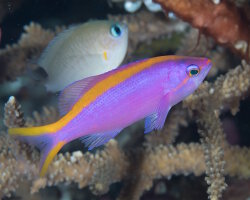
Purple anthias
(Pseudanthias tuka)
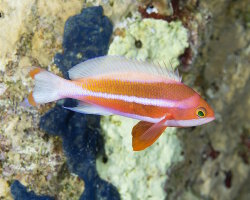
Red sea anthias
(Pseudanthias taeniatus)
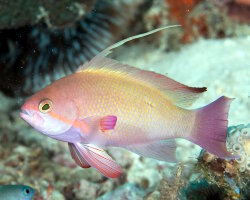
Threadfin anthias
(Pseudanthias huchtii)
Discover also
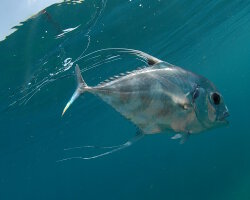
African Pompano
(Alectis ciliaris)
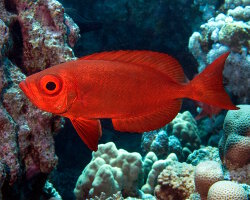
Common bigeye
(Priacanthus hamrur)
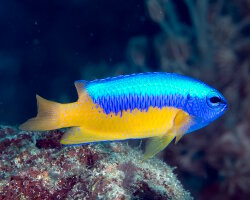
Goldbelly damselfish
(Pomacentrus auriventris)
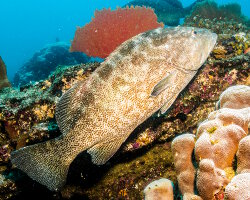
Leopard grouper
(Mycteroperca rosacea)
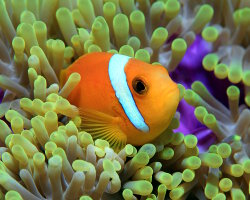
Maldive anemonefish
(Amphiprion nigripes)
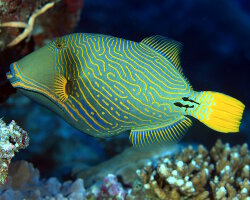
Orange striped triggerfish
(Balistapus undulatus)
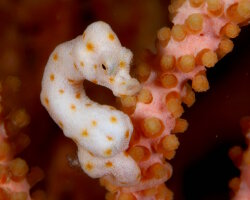
Pontoh's pygmy seahorse
(Hippocampus pontohi)
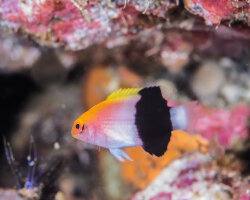
Tarry hogfish
(Bodianus bilunulatus)
The marine species in the Indo-Pacific
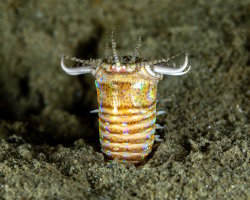
Bobbitt worm
(Eunice aphroditois)
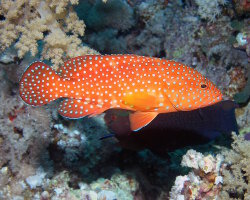
Coral hind
(Cephalopholis miniata)
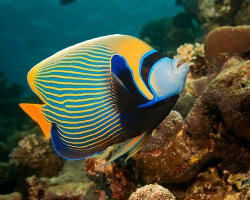
Emperor angelfish
(Pomacanthus imperator)
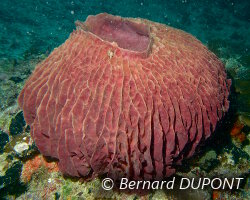
Giant barrel sponge
(Xestospongia testudinaria)
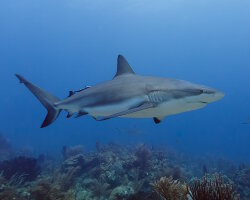
Gray reef shark
(Carcharhinus amblyrhynchos)
Horned sea star
(Protoreaster nodosus)

Lemonpeel angelfish
(Centropyge flavissima)
Tomato grouper
(Cephalopholis sonnerati)