

Sealife guideThe longfin batfishPlatax teira
Last updated on 08/06/2026 at 12:15 AM
Taxonomy
English names
Longfin batfishSpotbelly batfishRoundface batfishRound-faced batfishTail-fin batfishSpotbelly spadefish
French namesPlatax à longues nageoires
Scientific namePlatax teira (Forsskal, 1775)
FamilyEphippidae
OrderPerciformes
ClassActinopterygii
Description
The longfin batfish has a flattened, disk-shaped body with a silvery-gray coloration crossed by broad vertical blackish bands. A splash of bright yellow on the pelvic and pectoral fins adds a striking touch ! Its head is slightly convex, and its mouth is relatively small compared with the rest of its body. The longfin batfish averages about 12 inches in length, with a maximum size of approximately 24 inches.
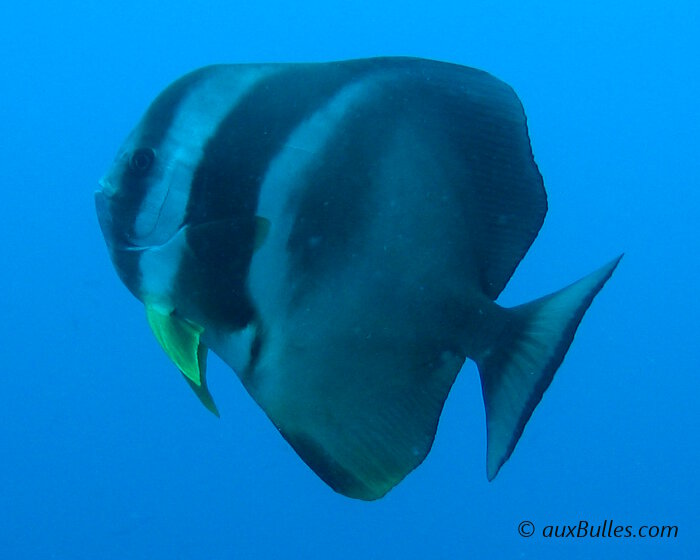
As you can see, the body of the longfin batfish is crossed by two vertical black bands
As you can see, the head of the longfin batfish is crossed by a narrow vertical black band running through the eye. A second, broader black band extends across the rear edge of the gill cover and the base of the pectoral fins. This band ends in a black spot on the lower part of the body. Another distinctive black marking, resembling the beginning of a short line, is located at the origin of the anal fin.
Geographic range
The longfin batfish is found in the warm tropical waters of the Indian ocean, particularly in the Maldives and around many islands, as well as in the western Pacific ocean, from Japan in the north to Australia in the south, including Indonesia. It is also found in the Red Sea.
Habitat
The longfin batfish inhabits waters around coral reefs and shipwrecks down to depths of about 65 feet, although it is also commonly seen swimming in open water near reefs. It usually lives in pairs or small groups of a few individuals, but may occasionally form large schools.
Diet
The longfin batfish feeds on jellyfish, crustaceans, and plankton.
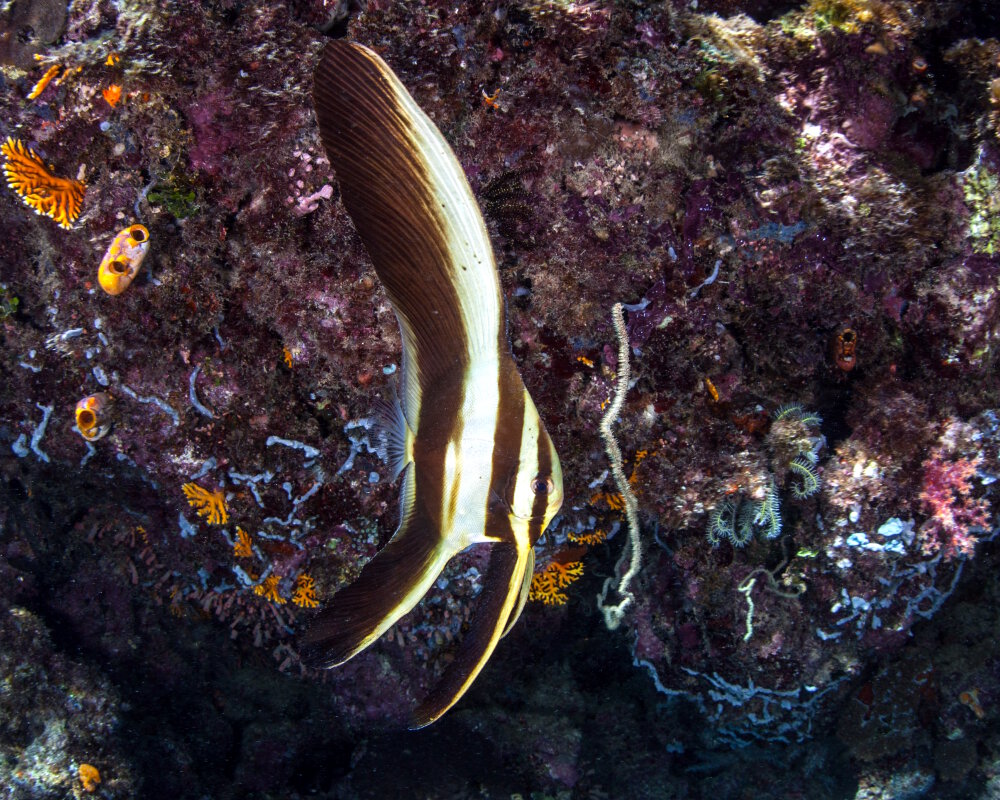
A juvenile longfin batfish (Platax teira) © Ethan Daniels | Dreamstime.com

The longfin batfish has a silvery-gray coloration with a touch of bright yellow
Reproduction
The longfin batfish reproduces sexually. Juveniles differ greatly in appearance from adults, particularly because of their extremely elongated dorsal, anal, and, to a lesser extent, pelvic fins, which give the species its common name of longfin batfish !
Tips for observing
The longfin batfish can be confused with the orbicular batfish (Platax orbicularis), which also displays two vertical black bands in the same arrangement. However, the orbicular batfish has an overall lighter, more silvery coloration. Another distinguishing feature is the absence of the two black markings found on the longfin batfish !

The longfin batfish lives in pairs near shipwrecks
Discover also

Great white shark
(Carcharodon carcharias)
(Carcharodon carcharias)
Leopard shark
(Triakis semifasciata)
(Triakis semifasciata)

Longfin mako
(Isurus paucus)
(Isurus paucus)

Nurse shark
(Ginglymostoma cirratum)
(Ginglymostoma cirratum)

Oceanic whitetip shark
(Carcharhinus longimanus)
(Carcharhinus longimanus)
Ornate wobbegong
(Orectolobus ornatus)
(Orectolobus ornatus)

Whitetip reef shark
(Triaenodon obesus)
(Triaenodon obesus)
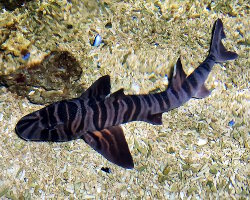
Zebra bullhead shark
(Heterodontus zebra)
(Heterodontus zebra)
Our latestUpdates

The basking sharkDiscover the basking shark (Cetorhinus maximus), the world's second-largest fish. This huge shark feeds on plankton by filtering large amounts of water.Read more
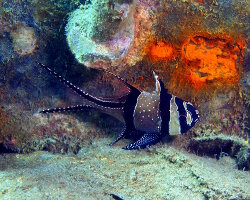
The Banggai cardinalfishDiscover the Banggai cardinalfish (Pterapogon kauderni), a small marine fish endemic to the Banggai Islands, known for its black-and-white stripes and unique reproductive behavior.Read more
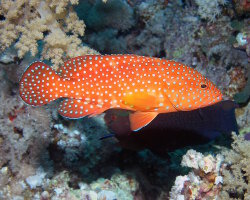
The coral hindDiscover the coral hind (Cephalopholis miniata), a colorful Indo-Pacific grouper known for its reddish-orange body covered with small blue spots.Read more
Photo of the Day
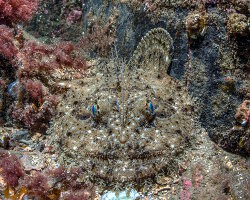
Baudroie commune
(Lophius piscatorius)
(Lophius piscatorius)
 Copyright © 2007-2026 auxBulles.com - All rights reserved. Legal notices.
Photo credits - Our partners