

Sealife guideCrinoids, feather stars and sea liliesEchinoderms
Last updated on 08/11/2026 at 10:23 PM
Classification
- Phylum: Echinoderm
- Class:
- Common name: Crinoid
- Scientific name: Crinoidea
Description
The crinoid class comprises more than 600 marine species.
Crinoids include organisms that are attached to a substrate, unlike all other classes, whose organisms are mobile.
Depending on how they attach themselves, crinoids are divided into 2 groups:
- with a stalk: these are the sea lilies, named for their flower-like appearance
- and without a stalk: these are the feather stars. The lower part of the body is attached to the substrate by means of cirri, which vary in number depending on the species.
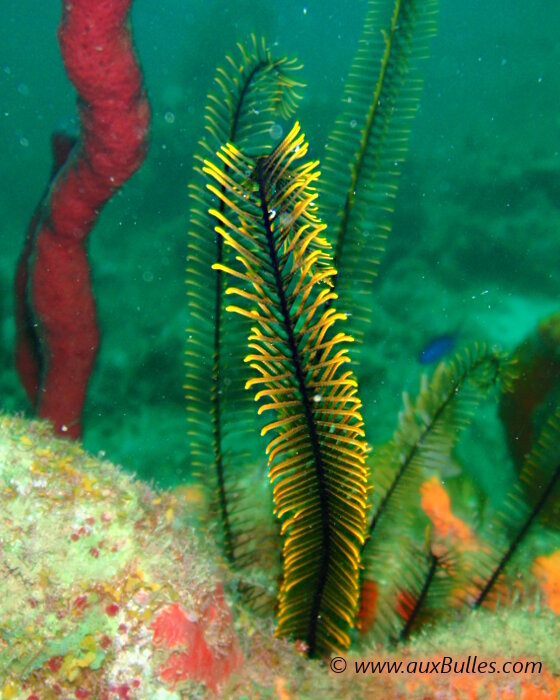
The arms of the golden feather star have a main central ridge and secondary branches called pinnules
Crinoids have a disc-shaped body called the calyx, from which the arms extend. The arms bear paired branches called pinnules, arranged symmetrically.
Crinoids have an extensive water vascular system connected to the outside through countless openings, allowing food particles to be transported toward the mouth.
In crinoids, the mouth and anus are located on the same side of the body, whereas in other echinoderm classes they are located on two opposite sides.
Geographic range
Crinoids are found at all depths, from the surface to the deep sea.
Did you know ?
Crinoids first appeared around 350 million years ago and are therefore among the oldest echinoderms.
Nos fiches
Our latestUpdates

The Guide des poissons de Nouvelle-CalédonieDiscover Guide to the Fishes of New Caledonia by Pierre Laboute and René Grandperrin, an illustrated reference featuring nearly 1,200 species, from rivers and coral reefs to the depths of the ocean.Read more
The neon gobyDiscover the neon goby (Elacatinus oceanops), a small western Atlantic reef fish known for its brilliant blue stripe and its role as a cleaner fish that removes parasites from other fish.Read more
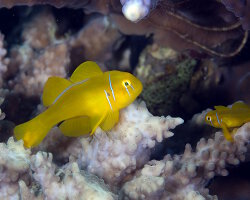
The poison gobyDiscover the poison goby (Gobiodon citrinus), a tiny reef fish with a bright yellow body and distinctive blue markings. It lives among branching Acropora corals in the tropical waters of the Indo-Pacific.Read more
Photo of the Day
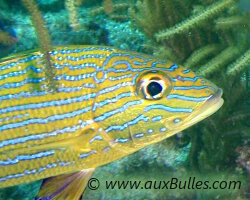
Gorette bleue
(Haemulon sciurus)
(Haemulon sciurus)
 Copyright © 2007-2026 auxBulles.com - All rights reserved. Legal notices.
Photo credits - Our partners