

Islands destinationAldabra atollSeychelles islands | Indian ocean
Last updated on 02/09/2026 at 11:15 PM
A remote atoll in the middle of the Indian ocean
Considered the "Crown Jewel of the Seychelles," Aldabra Atoll is a remote atoll in the Indian ocean, southwest of the Seychelles archipelago, of which it is a part. Aldabra Atoll lies about 640 kilometers (≈ 398 miles) off the east coast of Africa, roughly 420 kilometers (≈ 261 miles) north of Madagascar, and 665 miles from Mahé, the main island of the Seychelles.

Aldabra atoll, of coral origin, consists of four main islands arranged around a shallow lagoon, less than 20 feet deep. Starting from the north and moving clockwise, the islands are: Picard island (4 square miles), Grande Terre island (the largest at 45 square miles), Malabar island (10 square miles), and Polymnie island (2 square miles).
But Aldabra atoll also includes numerous small islands, islets, and rocks scattered within the lagoon, notably Coconut island to the east and Euphrate island to the west, which are the largest of these. The lagoon connects to the ocean via a main channel, or "Grande Passe," in the northwest, as well as three other channels: the East Channel or "Passe Houareau," the Gionnet Channel, and the West Channels.
Measuring 22 miles long and 9 miles wide, Aldabra atoll is the world's largest raised atoll. It has a land area of about 60 square miles surrounding a lagoon of 70 square miles, a third of which is exposed at low tide. The highest point on Aldabra atoll rises just over 39 feet above sea level.
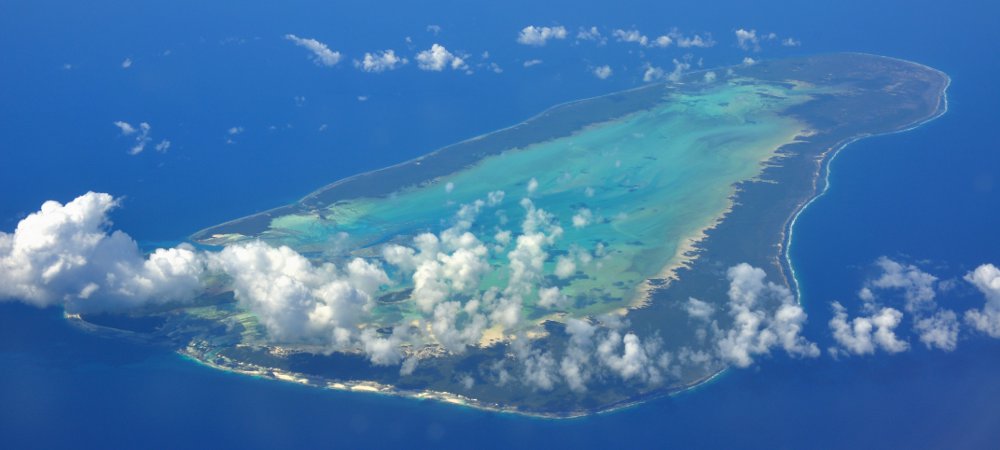
An aerial view of Aldabra atoll, a remote atoll in the middle of the Indian ocean
Aldabra atoll was declared a UNESCO World Heritage Site on November 19, 1982. Classified as a Special Reserve, access to the atoll is strictly regulated to preserve its rich biodiversity. Thanks to these protections, Aldabra serves as an ecological sanctuary, a living observatory of a unique ecosystem found nowhere else in the world.
Biodiversity everywhere !
Aldabra atoll hosts impressive biodiversity. On land, it is home to the world's largest population of giant tortoises, with over 150,000 individuals that arrived on the islands more than 200,000 years ago. Underwater, the marine life is colorful and diverse, including rainbow fusiliers, yellowtail damselfish, green turtles, and hawksbill turtles. In the air, large colonies of birds thrive, including frigatebirds, the Aldabra rail, sacred ibis, founingo, and the red-footed booby.
Aldabra has long been a stopover for sailors and received its name from Arab navigators well before the Portuguese arrived in 1511. By the mid-18th century, the atoll was administratively linked to the French colony of Bourbon island (present-day Réunion island), and many of its place names reflect French explorers such as Lazare Picault and Nicolas de Morphey. At that time, the atoll became a destination for expeditions aimed at capturing giant tortoises. In 1810, following the French defeat in the Indian ocean, Aldabra atoll came under British control.
Jacques-Yves Cousteau, a distinguished visitor
In 1954, Commander Jacques-Yves Cousteau visited the atoll aboard the Calypso and stated, "Aldabra is one of the last natural sanctuaries on the planet, untouched by man !"
In 1965, Aldabra, Desroches, and Farquhar were separated from the Seychelles colony to become part of the British Indian ocean Territory along with the Chagos Archipelago.
At the southwestern tip of Picard island, the British established a research station in 1968 to host scientists studying this unique ecosystem.
In 1976, the Seychelles gained independence, and in 1979 the Seychelles Islands Foundation was created to manage and protect the natural resources of the Aldabra island group, which includes Aldabra atoll, Assumption island, Cosmoledo atoll, and Astove island.
Founded in 2005 by the Islands and Oceans Foundation (IOF), the Aldabra Foundation acts as a hub for the preservation and protection of Aldabra atoll.
Practical information
- Official site of the Seychelles Islands Foundation
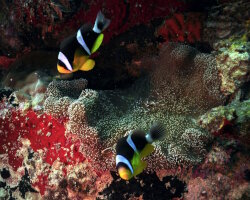
The marine species in Aldabra

Explore new islands !
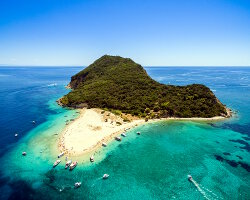
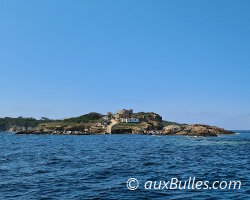
Our latestUpdates

The Guide des poissons de Nouvelle-CalédonieDiscover Guide to the Fishes of New Caledonia by Pierre Laboute and René Grandperrin, an illustrated reference featuring nearly 1,200 species, from rivers and coral reefs to the depths of the ocean.Read more
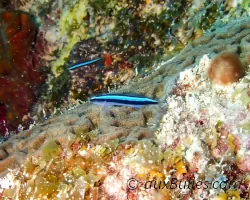
The neon gobyDiscover the neon goby (Elacatinus oceanops), a small western Atlantic reef fish known for its brilliant blue stripe and its role as a cleaner fish that removes parasites from other fish.Read more
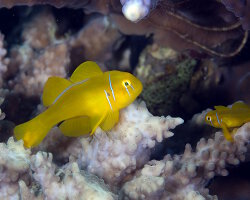
The poison gobyDiscover the poison goby (Gobiodon citrinus), a tiny reef fish with a bright yellow body and distinctive blue markings. It lives among branching Acropora corals in the tropical waters of the Indo-Pacific.Read more
Photo of the Day
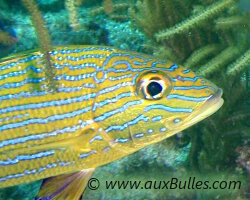
Gorette bleue
(Haemulon sciurus)
(Haemulon sciurus)
 Copyright © 2007-2026 auxBulles.com - All rights reserved. Legal notices.
Photo credits - Our partners