Sealife guideThe lumpfishCyclopterus lumpus
Last updated on 08/25/2026 at 10:07 PM
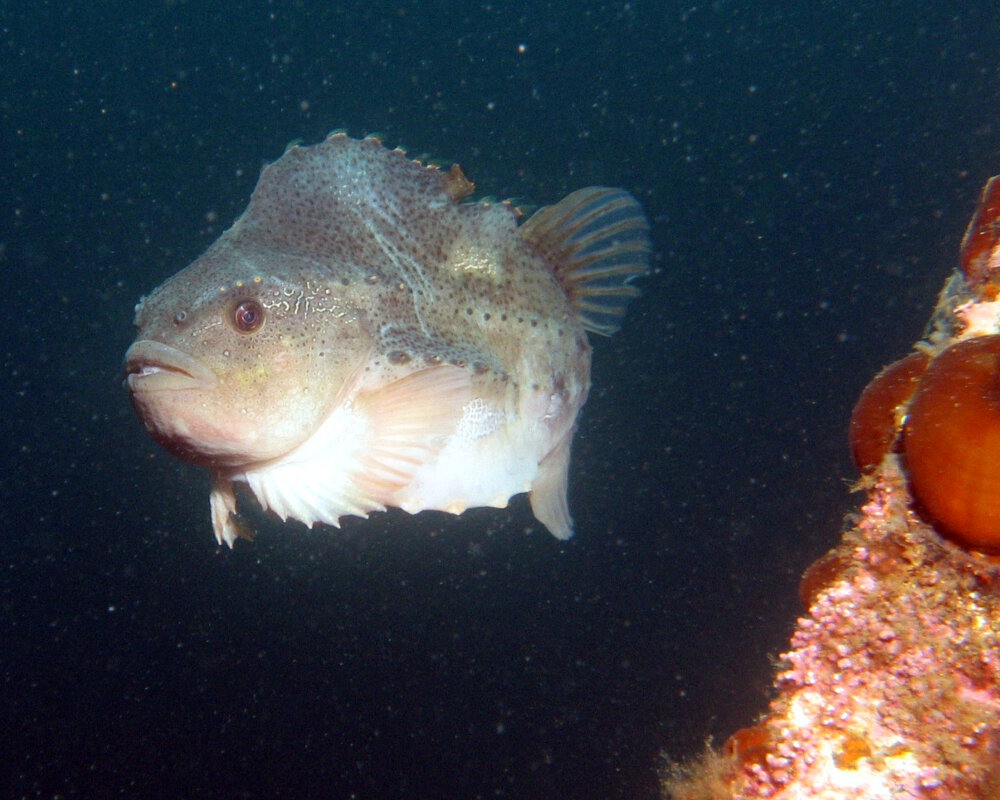
The lumpfish (Cyclopterus lumpus), also known as the lumpsucker, is a marine fish found in the cold and temperate waters of the North Atlantic. Its stocky body, skin covered with tubercles, and almost round shape give it a very distinctive appearance. It also has a remarkable suction disc under its body that allows it to attach firmly to rocks.
The lumpfish mainly lives alone and makes seasonal movements between deeper waters in winter and shallower areas in summer. It is also important to northern fisheries, particularly for its eggs, which are used as a less expensive alternative to caviar.
Taxonomy
English names
LumpfishLumpsucker
French namesLompe ou poule de merGros molletCycloptère
Spanish namesLiebre de marLompa
Scientific nameCyclopterus lumpus (Linnaeus, 1758)
Description
The lumpfish has a short, thick, almost rounded body covered with numerous bony tubercles that give it a bumpy appearance. Its first dorsal fin is covered by a thick layer of skin and forms a kind of ridge along its back. Its pelvic fins are modified into a suction disc located underneath the body, allowing it to attach firmly to rocky surfaces.
Its coloration varies depending on the individual and stage of life. Males develop a reddish coloration on the underside of the body during the breeding season, while females may become blue-green. The lumpfish can reach a maximum length of 24 inches and a weight of 21 pounds.
Geographic range
The lumpfish is found in the cold and temperate waters of the North Atlantic. In the Northwest Atlantic, it occurs from northern Canada and Hudson Bay to Labrador, then southward to New Jersey in the United States. In the Northeast Atlantic, it ranges from the Barents Sea, Iceland, and Greenland to the coasts of Spain, including the British Isles and the coasts of Western Europe.
Habitat
The lumpfish mainly inhabits cold marine waters, generally between 164 and 492 feet deep, although it can be observed from the surface to much greater depths. Adults mainly live on rocky seafloors, but they can also be found among floating seaweed.
Juveniles often live among seaweed beds in bays and fjords before gradually moving into deeper waters as they grow. Throughout the year, adults also make seasonal movements between deeper waters in winter and shallower areas in summer.
Diet
The lumpfish feeds on small marine animals that it captures in the water column or near the seafloor. Its diet includes jellyfish and comb jellies, as well as small
crustaceans,
marine worms, and small fish.
Reproduction
Breeding takes place close to shore in shallow waters. The female lays her eggs on a rocky seafloor, where they remain clustered as they develop. After spawning, the male plays a particularly important role: he remains near the eggs and actively defends them against predators until they hatch.
During the breeding season, males develop a red or orange coloration on the belly, while females generally become blue-green.
Did you know ?
A suction disc under the belly
The lumpfish has a true suction disc underneath its belly. It is formed by the modification of its pelvic fins and allows the fish to attach firmly to rocks, even when currents or waves are strong.
Lumpfish eggs
The lumpfish is primarily harvested for its eggs, which are processed and marketed as a less expensive alternative to sturgeon caviar. This use has led to specialized fisheries in several regions of the North Atlantic, particularly Iceland, Greenland, Norway, and Canada.
Discover also
The marine species in the North Atlantic