

Sealife guideThe Malabar grouperEpinephelus malabaricus
Last updated on 09/24/2026 at 11:00 PM
The Malabar grouper (Epinephelus malabaricus) is a large grouper found in tropical Indo-Pacific waters. It inhabits reefs as well as coastal areas, mangroves, and estuaries. Solitary, it often stays near rocks and underwater structures where it can hide and wait for prey.
Taxonomy
English names
Malabar grouper
French namesMérou malabar
Spanish namesMero malabárico
Scientific nameEpinephelus malabaricus (Bloch & Schneider, 1801)
FamilyEpinephelidae
OrderPerciformes
ClassActinopterygii
Description
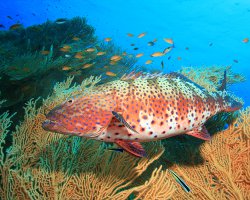
The Malabar grouper has an elongated, fairly robust body, with a large head and a wide mouth. Its coloration ranges from light gray to yellowish brown. Its body is crossed by five discontinuous, slightly oblique dark bands, generally wider toward the belly, and covered with numerous small dark spots and markings. Its rounded caudal fin and fins covered with small dark spots add to its distinctive appearance.

The Malabar grouper (Epinephelus malabaricus) © Stephankerkhofs | Dreamstime.com
Juveniles already display the main features of the adult coloration. As with many other groupers, their appearance gradually changes as they grow. The largest individuals can exceed 7.5 feet in length and reach a weight of 331 lb.
Geographic range
The Malabar grouper inhabits tropical Indo-Pacific waters, from the Red Sea and the coasts of East Africa to Tonga, and from Japan to Australia.
However, the Malabar grouper is not found in the Persian Gulf, where it may be confused with the closely related orange-spotted grouper (Epinephelus coioides), which is much more common.
Habitat
The Malabar grouper lives in a variety of habitats, including coral and rocky reefs, as well as mangroves, estuaries, tidal coastal areas, and sandy or muddy bottoms. Juveniles are more commonly found along shorelines and in estuaries.
The Malabar grouper is found in shallow waters down to about 492 feet. The species is generally solitary and often stays near shelters where it can hide and keep watch over its surroundings.
Diet
The Malabar grouper is a carnivorous predator that feeds mainly on fish and crustaceans. It generally hunts near the bottom and uses its large mouth to quickly capture animals that come within range. It can also eat cephalopods such as squid and cuttlefish.
Reproduction
The Malabar grouper is a protogynous hermaphrodite: individuals begin their adult lives as females, and some later become males as they grow. Sex change occurs in large individuals, generally after several years. Studies show that males are significantly larger than females and that sex change generally occurs when fish exceed about 3.3 feet in length.
To reproduce, Malabar groupers can gather in spawning aggregations. They then release their gametes into the water.
Did you know ?
The Malabar grouper is among the largest groupers in the world. It can reach 7.5 feet in length.
The Malabar grouper is an important species for fishing and aquaculture in Asia. It is farmed in several Asian countries, including Taiwan, Vietnam, Thailand, Indonesia, and China. It is one of the groupers traded in the Live Reef Food Fish Trade and is particularly prized by restaurants and specialty markets, especially in Hong Kong and mainland China.
The malabar grouper is listed as many other marine species within The IUCN Red List of threatened species. The malabar grouper appears in the IUCN Red List since 2018 within the category Least Concern !
Tips for observing
To avoid confusing the Malabar grouper (Epinephelus malabaricus) with the orange-spotted grouper (Epinephelus coioides), pay particular attention to the body color and spots. The Malabar grouper has generally dark spots, ranging from dark brown to black, as well as irregular white or pale spots on the head and body. In the orange-spotted grouper, the spots are more typically orange, orange-brown, or reddish brown, and the white or pale spots are absent. Both species also have several dark bands across the body, which can make identification difficult at first glance.
Within the same genus

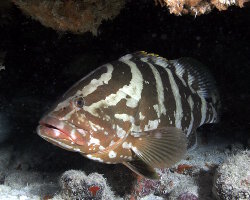
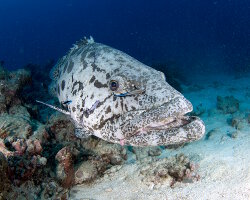
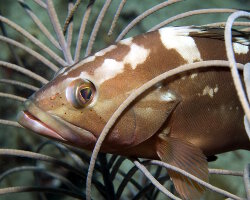
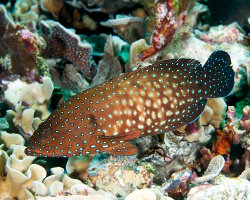
Within the same family


Discover also


Our latestUpdates
The neon gobyDiscover the neon goby (Elacatinus oceanops), a small western Atlantic reef fish known for its brilliant blue stripe and its role as a cleaner fish that removes parasites from other fish.Read more
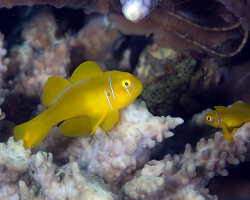
The poison gobyDiscover the poison goby (Gobiodon citrinus), a tiny reef fish with a bright yellow body and distinctive blue markings. It lives among branching Acropora corals in the tropical waters of the Indo-Pacific.Read more
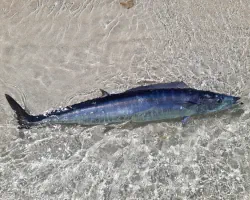
The wahooDiscover the wahoo (Acanthocybium solandri), a powerful pelagic predator found in tropical and subtropical oceans. Recognizable by its streamlined body and distinctive blue vertical stripes, it is a fast swimmer that feeds mainly on fish and squid.Read more
Photo of the Day

Fou à pieds rouges
(Sula sula)
(Sula sula)
 Copyright © 2007-2026 auxBulles.com - All rights reserved. Legal notices.
Photo credits - Our partners