

Sealife guideThe black jellyfishChrysaora achlyos
Last updated on 09/12/2026 at 01:31 PM
Although the black jellyfish was photographed in the 1920s, it was not officially described and classified by five scientists until August 1997.
Taxonomy
English names
Black jellyfishBlack sea nettle
French namesMéduse noire géante
Scientific nameChrysaora achlyos (Martin, Gershwin, Burnett, Cargo & Bloom, 1997)
FamilyPelagiidae
OrderSemaeostomeae
ClassScyphozoa
Description
The black jellyfish, also known as the black sea nettle, is a truly impressive jellyfish because of its enormous size ! Its bell is remarkable, measuring almost three feet in diameter. Its oral arms and tentacles are equally enormous, extending up to 20 and 23 feet in length, respectively, in the largest specimens.

Hard not to feel tiny when faced with this gigantic black jellyfish during its occasional appearances in the coastal waters of Southern California © James Jackson, modified by auxBulles licensed under Creative Commons
The bell of the black jellyfish is dark and purplish, becoming brown or even black, while its oral arms are lighter in color, ranging from red to pink. The coloration of the black jellyfish darkens and varies with age.
Geographic range
The black jellyfish is found along the southwestern coast of the United States and northern Mexico, from Monterey Bay in Northern California to Baja California in the south. Rather rare in Monterey Bay, it appears in large numbers from time to time in the coastal waters of San Diego in Southern California.
Habitat
Like all jellyfish, the black jellyfish is a pelagic species that lives in the open water and drifts with the currents.
The black jellyfish is a jellyfish species that probably lives at great depths but has only recently appeared in the coastal waters of Southern California.
Diet
The black jellyfish feeds with the currents using its long stinging tentacles. It feeds on animals that become trapped in its tentacles, including plankton, small fish, and even other species of jellyfish.
Did you know ?
Although the black jellyfish is probably a deep-sea species, it has recently appeared in the waters along the California coast: a first appearance in San Diego in the summer of 1989 was followed by a long absence before its return in 1999 and, more recently, during the 2010s.

The bell of the black jellyfish is dark and purplish, becoming brown or even black, while its oral arms are lighter in color, ranging from red to pink © James Jackson, modified by auxBulles licensed under Creative Commons
The black jellyfish provides « room and board » for the Pacific butterfish, which finds food among the jellyfish's tentacles and protection beneath its bell.
Described only recently, the black jellyfish still raises many questions among scientists regarding its actual distribution, life cycle, and behavior.
Cases of stings have been reported among swimmers in Southern California. Its sting is painful but not incapacitating or fatal to humans: the pain lasts for about 40 minutes but has no known lasting effects. This is probably related to its diet. Jellyfish that feed on larger animals tend to have more intense stings.
Within the same genus


Within the same family
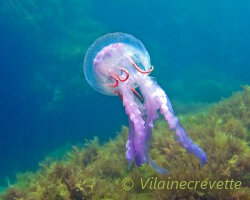
Discover also


Our latestUpdates
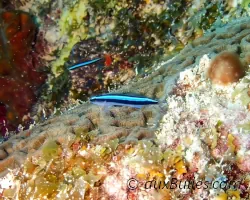
The neon gobyDiscover the neon goby (Elacatinus oceanops), a small western Atlantic reef fish known for its brilliant blue stripe and its role as a cleaner fish that removes parasites from other fish.Read more
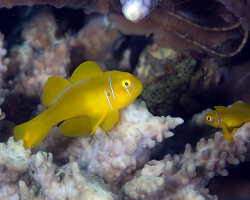
The poison gobyDiscover the poison goby (Gobiodon citrinus), a tiny reef fish with a bright yellow body and distinctive blue markings. It lives among branching Acropora corals in the tropical waters of the Indo-Pacific.Read more
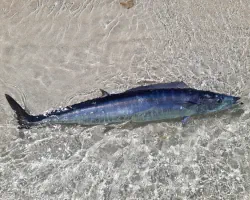
The wahooDiscover the wahoo (Acanthocybium solandri), a powerful pelagic predator found in tropical and subtropical oceans. Recognizable by its streamlined body and distinctive blue vertical stripes, it is a fast swimmer that feeds mainly on fish and squid.Read more
Photo of the Day

Fou à pieds rouges
(Sula sula)
(Sula sula)
 Copyright © 2007-2026 auxBulles.com - All rights reserved. Legal notices.
Photo credits - Our partners